With rare exception, I start my day by skimming a handful of RSS feeds specific to my interests and my work.Then, if any of them are relevant to a work project, I paste them into a document so I can reference them later.Gemini Notebook (formerly NotebookLM) introduced me to an interesting feature that could help me skim those RSS feeds much more efficiently once I pasted them in, but I'm not typically enthusiastic about using cloud-based AI if alternatives exist.
So, I decided to integrate an AI directly into an RSS reader so that I didn't need to manually copy and paste anything, and the entire thing runs locally.It doesn't replicate NotebookLM's full suite of features, but it does replicate my favorite features.NotebookLM is great, but I prefer something local No limits, no manual intervention, and no privacy trade-offs My single biggest concern with cloud-based AI service, including NotebookLm, is that everything passes through Google's servers.
Google explicitly states that they don't train their AI on anything you upload to NotebookLM unless you opt in, but your files are still processed and stored on the server.In my case, the actual risk is minimal.I mostly use it for non-sensitive, non-confidential research, but it is a habit I prefer to avoid.
If I were doing something even remotely sensitive, I'd probably preclude it immediately.On the other hand, I can take whatever steps are necessary to secure data that is stored on my PC.Related Don’t Risk Losing All Your Encrypted and Cloud Data: Back It Up Now Encryption and cloud storage are modern necessities, and they make backing up even more important.
Posts 1 By Brad Morton In the specific case of RSS feeds, the lack of automation was also a bit of an annoyance.NotebookLM is manual, it doesn't have the option to pull RSS feeds on a schedule.Finally, there are the constraints with the free tier.
The daily limits for report-style generation and chat questions are capped and there is a 50-source ceiling per notebook.That is fine if I'm doing focused research on a topic area, but it doesn't work if I want a digest to skim first thing in the morning and briefs generated spontaneously throughout the day.An RSS feed can easily have more than 50 different sources divided into multiple different categories.
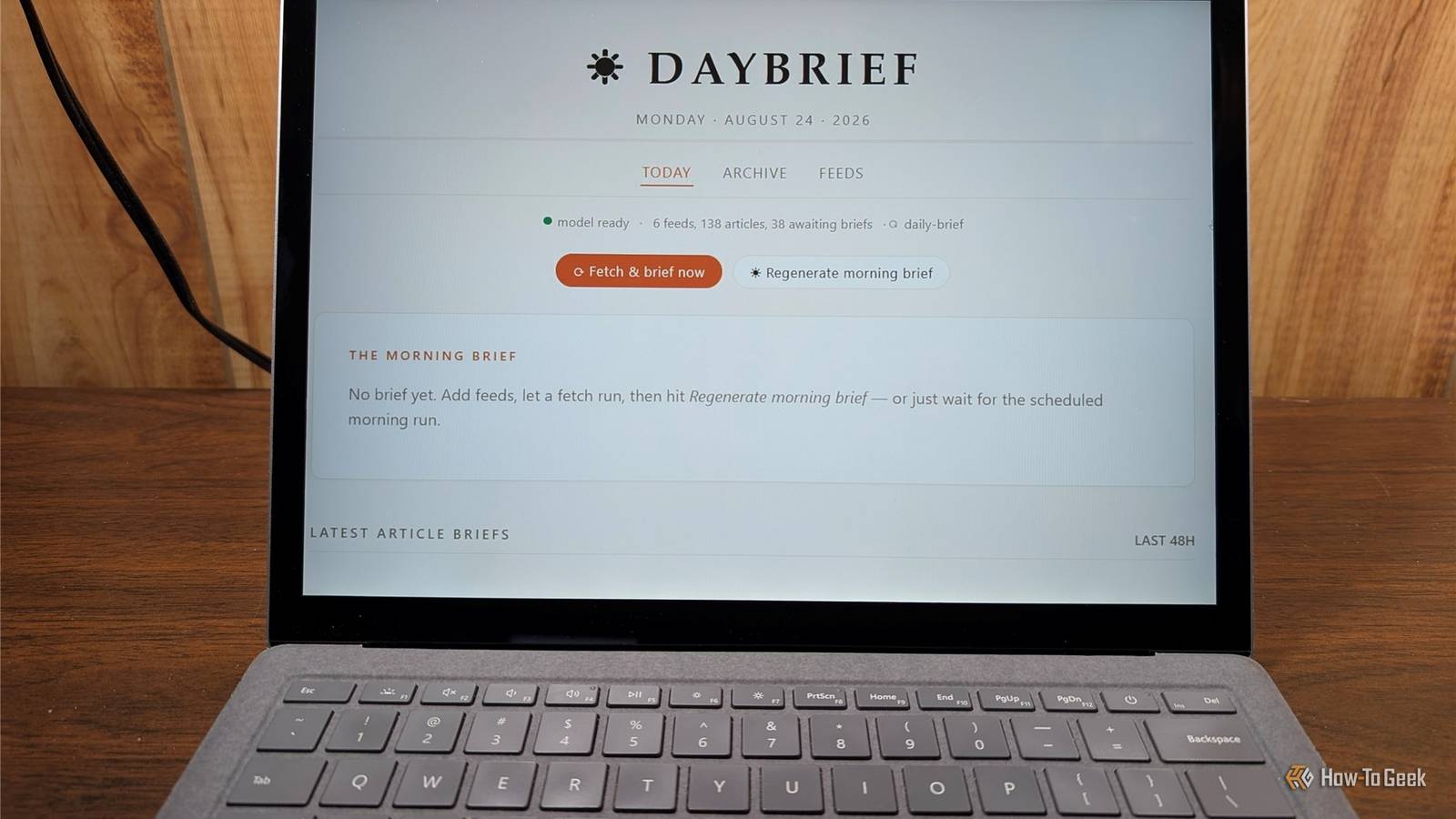
With those limits in mind, I set out to build something more targeted to what I was actually using it for.A vibe-coded AI-powered RSS digester How does it work? Close To build this, I started with three basic requirements: Everything needed to be local and run using open-weight models It needed to be able to generate morning summary digests and run digests as the day went on It needed to be able to handle as many sources as I care to apply.Rather than attach an existing FOSS RSS reader to an AI (it worked, but it was wasteful), I quickly vibe-coded an application that handles RSS feeds natively.
In practice, I can add a new RSS feed just like I would on any normal RSS reader.Under the hood, the entire project uses Gemma 4 12B running with Ollama, which strikes a good balance between quality and memory usage.After all, I don't want the process to be so demanding that my PC is unusable while it is running—I need to be able to do other things simultaneously.
I expected the project to require a bit of troubleshooting to get it working correctly, but it actually worked well out of the gate.I added an RSS feed, it took a few minutes to run through Gemma, and then I got my summary.After fiddling with the prompt to get the output's tone more to my liking, I was happy.
Local and open-weight have real trade offs A 12 billion-parameter model will never be a frontier model The only real drawback is model intelligence.No model you can run on average consumer hardware will know as much or be able to "reason" as well as a frontier model with terabytes of VRAM at its disposal.In practical terms, the smallest model I found to produce decent results was 7B parameters, which will run quantized in 8GB of memory.
You could even run it on a CPU-only setup—like my old laptop-turned AI node—but it'll be agonizingly slow.It is going to be integrated into my Discord bot and voice assistant Recently, I've been running an AI Discord bot and an AI home assistant that I can talk with.With a little bit of tweaking, I'll be able to combine the projects with the RSS Digester to build something way more interesting.
I'll be able to toggle it on and have it read the morning's briefing that was created for me, and because the Discord bot and Voice Assistant already have the ability to discuss a file it is examining, I'll be able to ask specific questions too.With even more fine-tuning, I may even allow it to "break through" and spontaneously tell me something that it knows I'll want to hear.
Read More