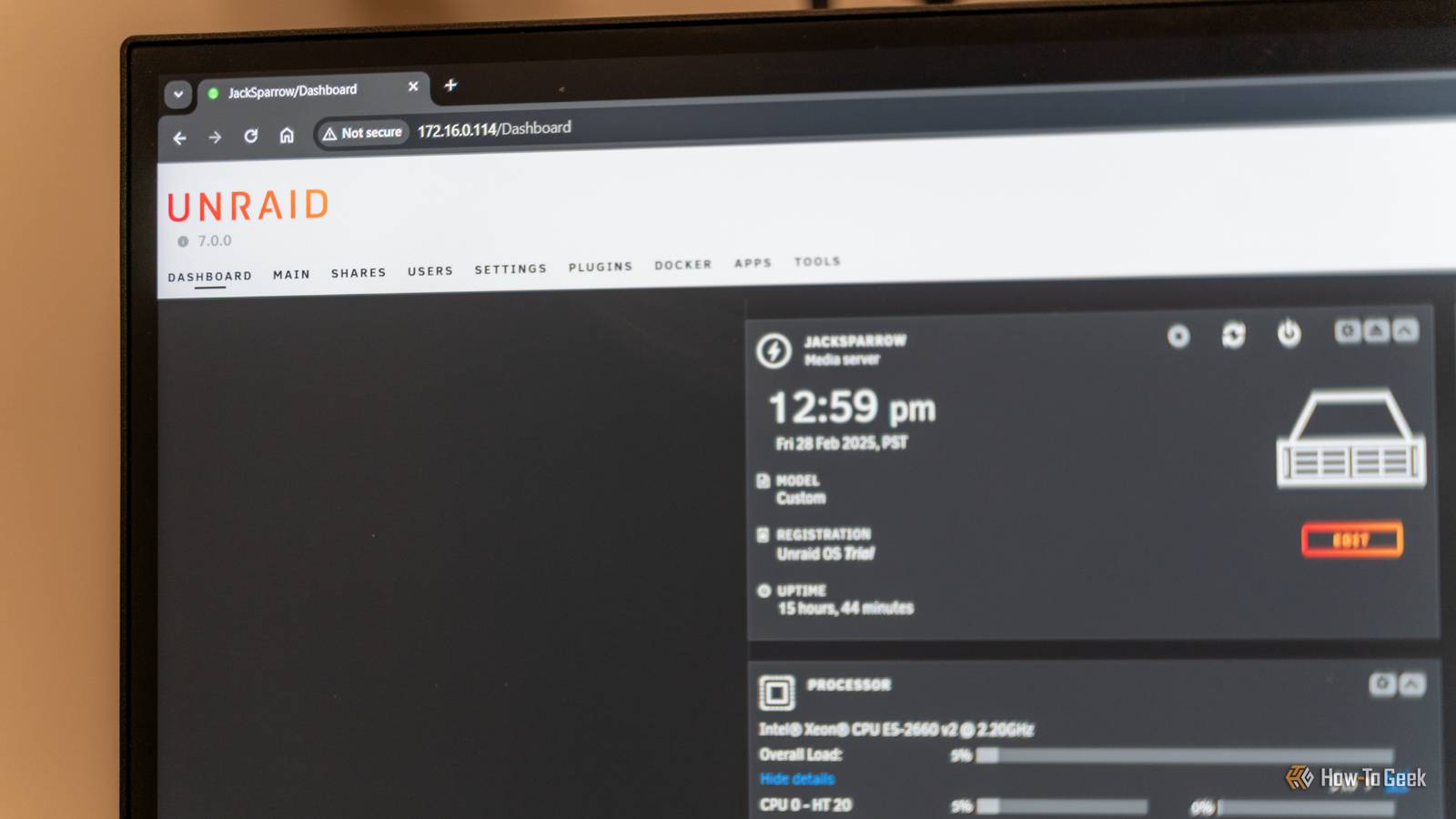
The debate between Unraid and TrueNAS feels as strong as the debate between Plex and Jellyfin.The thing is, while Plex and Jellyfin solve a very similar problem, Unraid and TrueNAS aren't solving the same problem at all.In fact, they're very different at the core, so make sure you pick the right NAS OS for your specific use case.
TrueNAS is built for large-scale enterprise deployments It just so happens to work in your homelab, too Close TrueNAS wasn't always TrueNAS.TrueNAS actually got its start back in 2005 when the developer, Olivier, wanted to turn an old home PC into a NAS.He then built FreeNAS, which was later taken over by iXsystems in 2009 and introduced as TrueNAS as an enterprise appliance.
FreeNAS remained open and ran as a community version, but in 2019, iXsystems unified FreeNAS and TrueNAS under TrueNAS Community Edition and TrueNAS Enterprise.The thing is, at this point, TrueNAS is for enterprise, but it still works in a homelab situation.The backbone of TrueNAS is ZFS, which is a rock-solid file system that is perfect for enterprise use.
With ZFS you create drive vdevs, which allow you to really have a very redundant system.That's what TrueNAS is known for—redundancy.It's one of the most solid, reliable, and dependable NAS operating systems out there, for both home and enterprise applications.
However, ZFS is both TrueNAS' headlining feature and biggest downside.In fact, ZFS is reason I chose not to use TrueNAS in my homelab back in 2021 when I first built it out.ZFS functions much like traditional RAID, just with different names for the levels.
RAIDZ1 is redundant to one drive failure, much like RAID 5 is.RAIDZ2 is redundant to two drive failures, much like RAID 6.However, ZFS also has RAIDZ3, which is redundant to three simultaneous drive failures.
The thing is, you can actually have multiple vdevs in a single drive pool.So, let's say you have six drives total, with three of them being 4TB and three being 8TB.With normal RAID, you would essentially have six 4TB drives if you put them into one normal RAID pool.
However, with ZFS, you could make a RAIDZ1 vdev of the three 4TB drives, and then another RAIDZ1 vdev of the three 8TB drives, and combine them into a big drive pool that was 24TB in size.This is something normal RAID isn't capable of.So, TrueNAS really is built for enterprise-level functioning.
It can handle hundreds of drives of any size, with all sorts of configurations, and remain rock solid through it all.But, it's pretty rigid in how it works.And that's why I personally chose to go with Unraid for my server back in 2021.
Unraid was designed with drive freedom There's no RAID here, and that's a good thing Close While TrueNAS is essentially infinitely scalable (so long as you can plug the drives into the main system), Unraid is .Unraid only supports up to 30 drives in an array, and you can only have one array per server.The array is the headlining feature of Unraid.
Within an array, you can have basically any size drive you want and the array just adds it all up—outside of the one (or two) largest drives, those are reserved for parity.So, if you have a big conglomerate of drives, like one 12TB drive, three 8TB drives, two 6TB drives, four 4TB drives, and two more 2TB drives, with TrueNAS and RAIDZ1, you actually could only use the 8TB and 4TB drives, as RAIDZ1 requires at least three drives to build the vdev.Of course, you could choose to include the two 6TB drives with the 4TB drives, though you'd lose the extra 2TB of storage on each drive.
The 2TB drives would basically be useless as a RAIDZ1 vdev, though they could be used as individual drives.Really, you would only get about 44TB of storage if you combined the 12TB with the three 8TB, and the two 6TB with the four 4TB drives.Those same drives in Unraid, however, would give you 56TB of storage with the 12TB acting as parity.
Need more storage? Pull out a 2TB and replace it with a 12TB, now you just gained another 10TB of storage.This is the main reason I went with Unraid—Unraid gives you drive freedom, though it is at the expense of some redundancy.My current Unraid server has 12 drives in it with a single parity disk, which means I can lose one of my 12 drives and be fine.
If another drive fails during the parity rebuild, all information that was on drive and the drive that failed is gone—the rest of the drives remain usable.This is because the drives are independent of each other and the parity just keeps a calculated block to reconstruct things if a drive fails.It's similar to RAID, but different.
While Unraid only supports one array that runs on that parity system, it still supports a bunch of pools that are built just like TrueNAS with ZFS, Btrfs, or XFS.This means you could have a large multi-drive ZFS pool, but it doesn't benefit from Unraid's normal parity structure.At the end of the day, Unraid isn't meant for heavy enterprise environments.
At most, Unraid provides two disk redundancy, while TrueNAS and ZFS allow you to build multiple vdevs each with their own level of redundancy all pooled into one storage cluster.Pick the right NAS OS based on the situation you're in, not which is better They're both great tools that solve different problems There is no "right" or "wrong" NAS operating system to choose for a homelab—but there is a right or wrong one for homelab.Unraid and TrueNAS serve entirely different purposes.
If your homelab needs extreme redundancy and reliability, go with TrueNAS.There's really no better option.TrueNAS now has Docker support, and has become very modern over the past few years.
If your homelab is more of a tinkerer's paradise, and you're okay with only having one or two drive redundancies, then go with Unraid.It's more modifiable, has more capabilities overall, and is the perfect place to cut your teeth on homelabbing—that's what I did.So, don't fall into the trap of "This is good and that is bad!" Simply take a few minutes to evaluate what needs are and then choose the best operating system for you.
Just because you read it on Reddit doesn't make it true There's an old saying, "Opinions are like armpits.Everyone has them, and most stink." The same is true about Reddit opinions.I can't tell you how many threads I read before choosing Unraid, or after choosing Unraid, that Unraid was inferior to everything else out there.
"ZFS is best," I'd read over and over.The thing is, that's true—for that person.So, when making decisions in your homelab, don't let internet conjecture sway you.
Unraid and TrueNAS aren't solving the same problems, and that's okay.
Read More