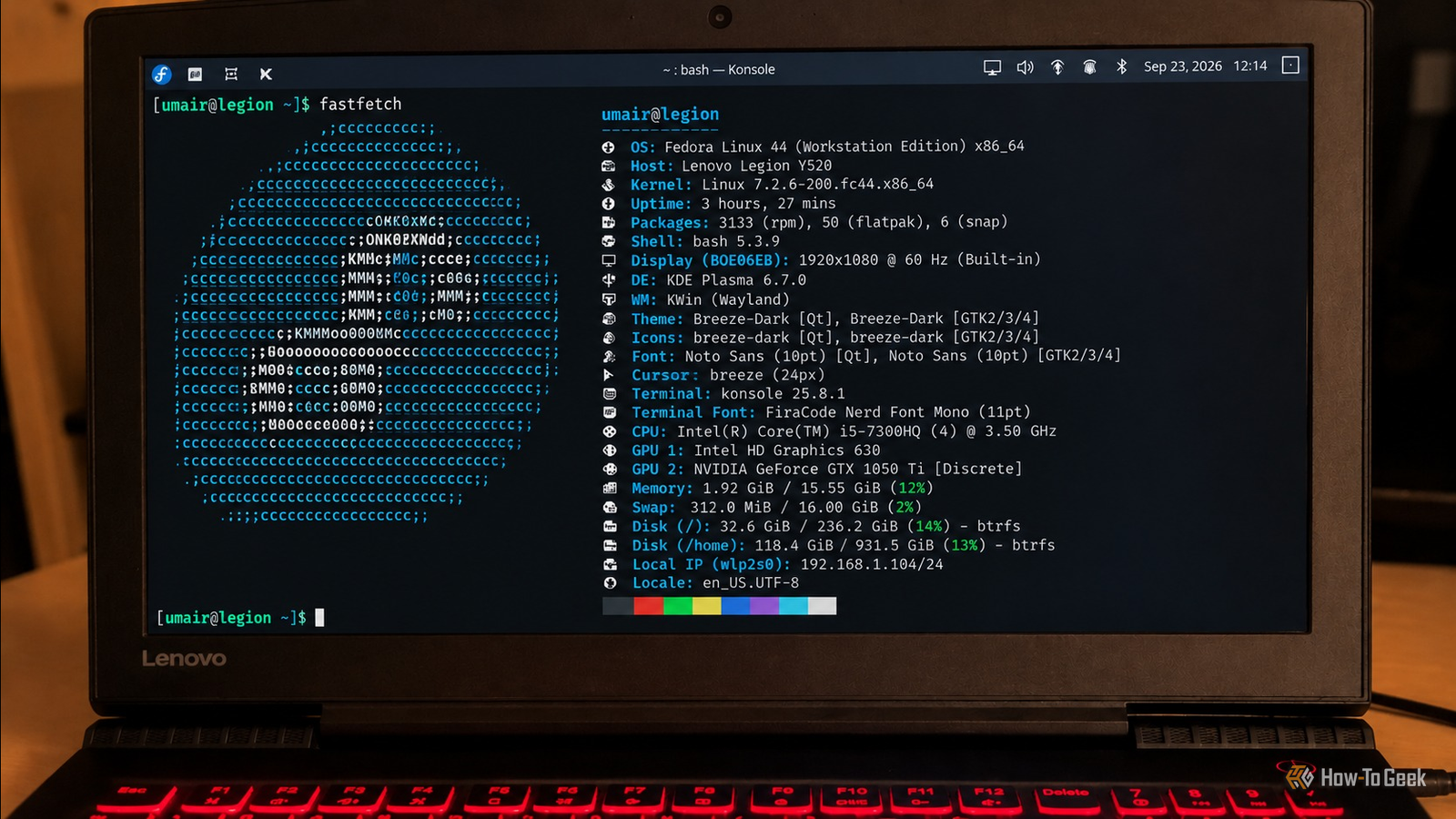
I bought my Lenovo Legion Y520 in mid-2018, roughly a year after Lenovo released it.At the time, its specs made it a perfectly capable gaming laptop.It was never particularly light or refined, though, and the mediocre speakers and usual gaming-laptop quirks were always part of the package.
Several years later, it is still perfectly usable, but the laptop no longer felt particularly exciting.I eventually installed Fedora KDE on it, mostly because I wanted Linux on hardware I already owned.What surprised me was how much better the entire machine felt afterward.
The CPU and GPU are still old, but they suddenly seemed to have plenty of life left.Fedora reduced the amount of work the laptop did The Y520 spends less time dealing with software I never asked for Close One of the most noticeable changes was what happened when the laptop was doing absolutely nothing.A Windows installation, which already has a lot of bloatware, accumulates a lot of background software over several years.
A gaming laptop can have even more of this because manufacturers often include their own control panels and gaming utilities.Fedora KDE gives me a much cleaner starting point.There is no Lenovo Vantage running in the background and no collection of Windows-specific services that I have no reason to use.
Fedora obviously still has background services, but I can see what is running and decide what actually belongs on the machine.Related GNOME or KDE Plasma: Choosing the wrong one can ruin your Linux experience The desktop environment determines your day-to-day experience, making it far more important than the distro.Posts 2 By Dibakar Ghosh On the Y520, the idle memory usage is often around 1.8 GB to 2GB.
With 16GB installed, that leaves plenty of memory available for applications.That doesn't prove Linux is universally more efficient than Windows on every machine, but it does show why an older laptop with 16GB of RAM can feel comfortable when the operating system isn't constantly competing for those resources.A modern kernel made the old hardware feel less old Fedora keeps the software stack much newer than the laptop The Y520 might have been released several years ago, but Fedora is not running a software stack from 2018.
The distribution ships with the latest Linux kernel, latest Mesa components, and a modern KDE Plasma desktop.That gives the laptop newer hardware support and a much more current desktop environment than the machine had when I originally bought it.KDE Plasma 6 is particularly good on this hardware.
The laptop has enough CPU, RAM, and GPU capacity to run Plasma comfortably without turning off everything that makes a modern desktop pleasant to use.Wayland also gives the desktop a modern display stack, and KDE lets me decide how much animation and graphical effects I actually want.The result is a desktop that feels current even though the computer underneath it is not.
Btrfs gives the old laptop some modern storage features Compression and snapshots are useful even on a small SSD Fedora’s support of Btrfs is another part of the system that makes the Y520 feel more modern than its age suggests.Btrfs supports transparent compression and reduces the amount of physical storage used by compressible files, which is useful when the system lives on a 256GB SSD.Compression obviously cannot create free storage out of nothing.
Files that are already compressed generally have little to gain, and compression still requires CPU work.Related This forgotten SATA trick made my cheap old SSD feel brand new Your SSD has been asking for some breathing room this whole time! Posts 12 By Umair Khurshid Snapshots are more interesting for this particular machine because I experiment with Linux software, packages, configurations, and system changes on the Y520.Having filesystem snapshots available gives me another layer of protection when experimenting with the system.
That does not make Btrfs a replacement for backups, but it makes experimentation considerably less stressful.It can handle modern AI experiments A small quantized model fits well on old gaming hardware One of the more unexpected things I started doing with the Y520 was running an LLM on its GTX 1050 Ti.This is not the sort of workload I would have associated with a 2018 gaming laptop when I bought it, but the combination of Linux, modern AI software, and quantized models makes it possible.
I use Qwen 2.5 3B with the Q4_K_M quantization.The quantized model takes roughly 2GB of VRAM, which leaves enough room on the GTX 1050 Ti’s 4GB of VRAM for the model to run locally without needing a modern GPU.I get around 20 tokens per second during generation.
That is nowhere near modern local AI hardware, but it is fast enough for the model to feel usable for short prompts.It is a good example of how much life an old computer can gain when the software ecosystem moves forward even if the hardware does not.The GTX 1050 Ti still has some life left Lightweight gaming is still perfectly reasonable on this GPU The GTX 1050 Ti was never a high-end mobile GPU, and its 4GB of VRAM looks particularly modest now, but I still use it for playing Y520 for playing , , and .
Steam and Proton make this considerably more practical on Linux.I can install games, enable Proton when necessary, and see how they perform on hardware that was originally designed around Windows gaming.Related Does Linux really run faster than Windows? I tested both to find out Spoiler alert: Tux has wings.
Posts 11 By Jordan Gloor Not everything works, but it would be wrong to expect that for an 8-year-old laptop, and it does not need to run every new AAA game to justify keeping a discrete GPU.For the games I actually play on it, the GPU still does its job.The hardware did not change, but the experience did The most important improvement is difficult to capture with a benchmark because the difference comes from a collection of small improvements rather than one spectacular feature.
Linux didn't upgrade the hardware, but it made it considerably more useful.A laptop I might otherwise have thrown away or left sitting in a cupboard is still a responsive desktop, a lightweight gaming machine, and capable enough to run software that did not even exist when I bought it.
Read More