
For several years, we have seen additive manufacturing software play a more central role in our industry.LPBF machines achieve higher yields and can produce thinner-walled parts thanks to the software.Bambu Lab‘s shake-up of the desktop industry and beyond is, in part, due to its self-identification as a software company and its use of software to tackle problems previously only solvable with mechanical engineering solutions.
With more AM-specific software, more affordable options, more unique settings, and more automated workflow tools, software is set to let additive do more with less.With the same dollars invested in machines, we will be able to make more and make better parts.A lot of the excitement is around the AI boom.
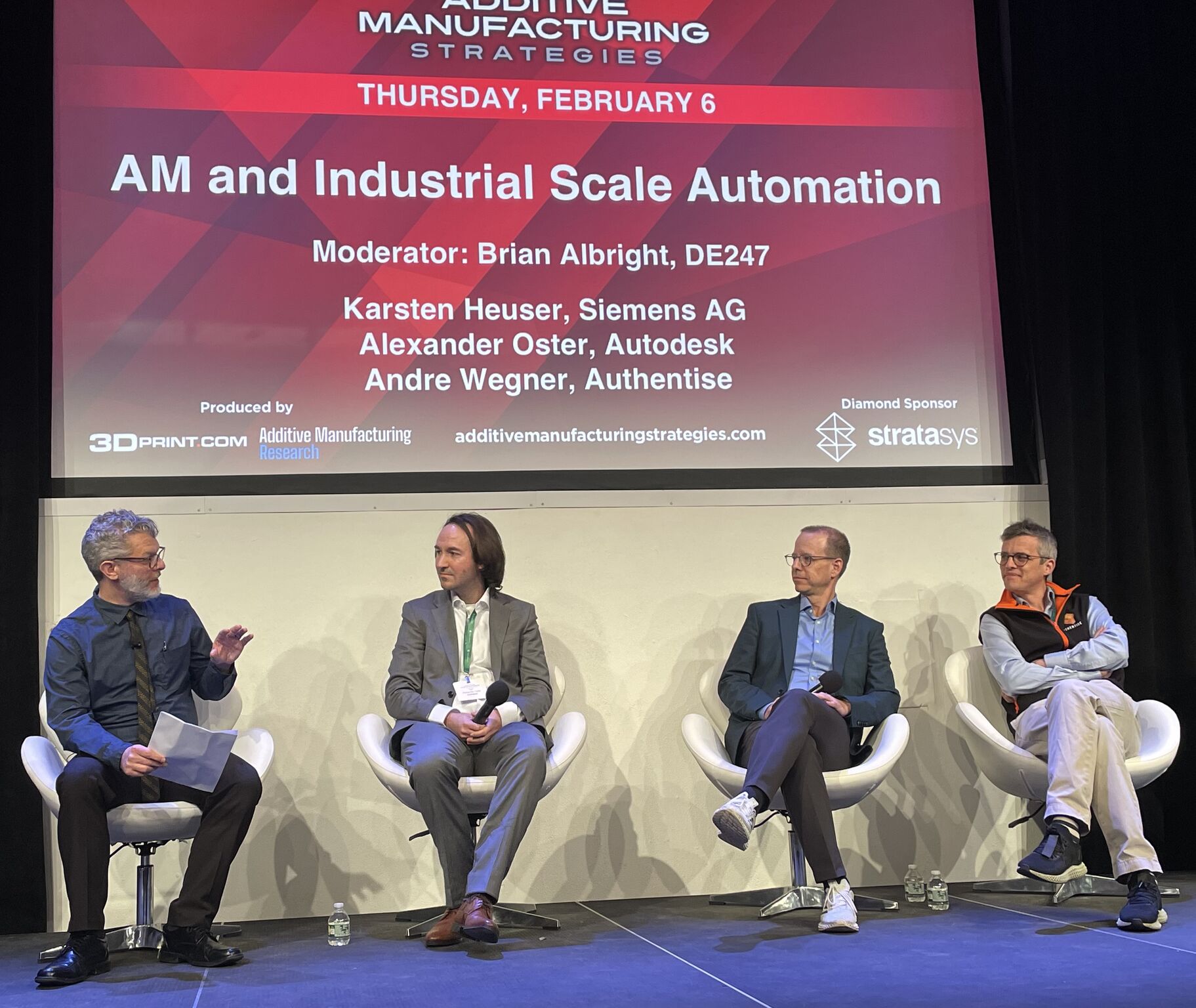
Siemens’ Additive Manufacturing leader, Karsten Heuser, Vice President Additive Manufacturing and Head of Advanced Manufacturing told us that, “Just three years ago, ChatGPT changed the way how we interact with software in our private lives.Today, Co-pilots and AI agents are becoming integral to our own industrial software tools at Siemens.In 2026, orchestration agents will start to coordinate specialized purpose-driven agents to execute complete workflows for advanced part manufacturing.
This will fundamentally change how engineers engage with industrial software: complex workflows for AM design or AM data analytics will become as intuitive as generating a speech in ChatGPT.The real limitation won’t be technology—it will be the willingness of companies and engineers to adapt and leverage these capabilities.” Daghan Cam At Additive Manufacturing Strategies 2025.Image courtesy of 3DPrint.com.
AI Build‘s CEO, Daghan Cam, is also bullish about the impact of LLMs and beyond telling us, “In 2025, the software industry reached unprecedented productivity gains by incorporating AI agents as an extension of the workforce.This transformation was so rapid that within months of the introduction of agentic coding platforms such as Claude Code and Codex, almost all software engineers started relying on AI as an inseparable part of their daily development workflows.In 2026, we expect this shift to expand from digital services into physical processes, with additive manufacturing emerging as a front runner due to its dependency on years of engineering knowledge.
This transformation goes much beyond the automation of mundane tasks.It completely blurs the lines between isolated roles like designers, engineers and product managers in an organization to enable a culture of ‘full stack builders’ with visibility and influence over the entire development cycle of new products, like in the golden days of architecture and engineering before the industrial revolution.At Aibuild, we are in the driving seat of this agentic AI future, redefining engineering workflows to elevate additive manufacturing to its long promised potential in close collaboration with our partners and customers.” Euler’s CEO Eythor Runar Eiriksson is more enthusiastic about vibe coding, which terrifies me, “Hardware has taken us far and now software needs to keep up.
In 2026 we will hopefully see more software offerings maturing into the glue that binds real AM applications together, with a clear tilt toward serial production.The stacks that win will be the ones that make workflows reliable and repeatable so AM runs like production, not a science project.I am also hoping that vibe coding will not do a number on the industry, because if it pushes companies toward unvalidated homegrown tools, we risk ending up with brittle silos instead of scalable production software.” Euler3d’s interface.
Image courtesy of Euler3d.Autodesk’s Alexander Oster is not as focused on agentic AI or LLMs but rather on a more process-driven use of AI, “The silent commoditization of the AM software stack will continue, and the entry-level, sub $100k LPBF machine segment will make use of Process Simulation, AI-based Quality Control, and special toolpathing algorithms to match high-end industrial systems in part quality and reliability.This will make many applications viable that have been commercially out of reach until now.
Of course, only for small parts, but that is very much where our technology can compete in the first place.” Authentise’s Andre Wegner opined to us that, “Over the next twelve months we’ll finally see the thing everyone’s been hinting at for a decade: fully automated AM production loops that actually run in the wild, not just in PowerPoints.The early systems at Nexamo and ZF are proving that you can close the loop from order to print to inspection without an operator shepherding every click.That changes the economics completely.AI will push this forward faster than people expect.
We’re moving past ‘assistants’ and into systems that understand engineering intent and apply it across CAD, repair, planning, and qualification.That’s the big unlock.If software knows why you made a decision, not just the geometry you produced, it can regenerate options, fix bad models, and draft half the paperwork you used to spend nights on. And then there’s qualification.
The NDAA requirement for one million qualified parts by the end of 2027 will force everyone to industrialize.You can’t brute-force your way there.You need automated data capture, automated evidence packages, and qualification engines that learn from each build.
The winners won’t be the ones with the prettiest slicer.They’ll be the ones who treat qualification as a software problem.If 2024–25 was about proving AM can scale, 2026 is when the software finally makes it inevitable.” Now feels like an AI high-water mark, and an AI Ponzi scheme crash and ensuing global economic deleveraging seem inevitable.To me, it’s challenging to see which parts of the AI boom will last and remain useful, and which will not be workable without deep subsidies from optimistic investors.
It’s called deep learning because you have to have deep pockets.To me, pattern-based tools and coding aids will always be worth it, and people will pay to accelerate development even if this would stall.AI quality control seems like a surefire thing; designing parts with AI frightens me, and time-saving workflows seem highly helpful.
Google built the lowest cost per click and the lowest cost for the biggest index search tool, which also worked better than anything else.OpenAI is building a tool meant to be better than rivals, but it is not always, and it uses up more and more electricity over time.If OpenAI were building a Prius, it may work, but they want to build a Ferrari, one where they’re still losing money on users spending $200 per month, it won’t work, especially if that Ferrari is also meant to be a dump truck and an excavator.
Bad strategy, therefore, may significantly delay the advent of AI, but some vestigial structures will remain and, in and of themselves, deliver significant value.Or more succinctly put, can you spell AI without Sam Altman? Intrerspectral’s CEO, Isabelle Hachette, is also, of course, using and looking at AI, but believes that the real secret is in the interpretation and signals we can distil from data.“In 2026, the Additive Manufacturing market will continue the digital thread journey, providing seamless communication, real-time monitoring, and remote diagnostics.
It will be vital to transform complex process data into real-time actionable insights and enable manufacturers to scale additive production with confidence, consistency, and true industrial reliability and data security.” That’s a key insight to me, it’s not the Morse code, it’s the message.We all knew that broadband video was coming, but it was in predicting the impact of platforms, influencers, legacy content producers, and audience aglomeration that outsized gains were to be had.Andre is right to bring up the one-million-part NDAA requirement, which seems, quite frankly, impossible at the moment.
But if you could AI or 10,000 engineers your way to this goal, it would be an immense prize.Phase3D’s Niall O’Dowd is clearly also thinking along those lines, telling us that, Phase 3D at AMS 2025.Image courtesy of 3DPrint.com.
“While I’m super optimistic about the future of AM in critical industries, its penetration isn’t fast enough.Our customers have been successfully reaching qualified status on many of their parts, but it’s still too slow and costly despite the huge demand in the defense and aerospace space industries.“Over the next 12 months, I’ll bet on a dramatic emphasis on part-centric (not build-centric) qualification efforts that not only include print processes but also utilize in-process inspection to ensure quality.
Whether it’s improvements to delta-qualification, Installation Qualification, Operational Qualification, and Performance Qualification, the industry will begin to rely heavily on data collected during the print to accelerate the most high value applications.” Niall also points out interesting underlying trends that could be a real force multiplier for the industry in reaching our everyday goals of putting product out and bigger goals of making more makable.The Managing Director of South African 3D printing service, implementation and training firm HH Industries, Devon Hagedorn-Hansen, mentioned that, “More software for LPBF in 2026 will have the ability to control the laser right down to the vector.Providers like Oqton and Dyndrite are already offering these features and are working with OEM’s to integrate this control into the machines.
It’s a new competitive advantage for LPBF users who understand the process and would be able to differentiate their quality, speed, and even microstructure on parts.This creates a new playing field for experienced companies that can use the same parts but add some IP to the process and differentiate themselves from competitors using the same machines.There is also a merging of the software, and the lines between machine software and data preparation software are being tested and blurred.
Some OEMs will stick to their own developed software, but others who can no longer sustain large software teams will leverage those from software providers.The users will get more control over the process but also the outcome of their parts.” The 2D printing industry ate itself because all money went into capital expenditures on ever-better machines, and no one in the offset, roto, flexo, or digital world took the time to develop a clear advantage or better business.Ever-increasing debt, with the same company and the same customers, is a recipe for disaster.
I think it’s very wise to recommend that people focus not on the box but on their unique ability to create structures and flow better than anyone else.Looking at the entire additive market, Christoph Völcker, founder of the prestigious 3D Pioneer’s Challenge Prize and Editor of the Pushing Boundaries: Pioneers of Advanced Technologies book, sees “software as the central growth driver for Additive Manufacturing,” and points to “targeted and intelligent use of specialized software solutions” as having a broad impact.At the same time, “the development of highly complex and highly efficient cooling structures is expected to benefit significantly from these advances.” He points to “solutions from Siemens, such as Mendix in combination with Siemens NX, demonstrate how software tools can be meaningfully integrated into existing IT architectures, operational processes, and sales structures.
The coordinated interaction of these systems has already proven itself in industrial practice and reflects the realities of mature enterprise environments, and Autodesk’s combination of software solutions for hybrid manufacturing, automation, and Fusion’s well-known ease of use promises dynamic progress.” Accessibility, integration, and custom software seem like relatively prosaic developments when compared to the “everything is possible” world of thinking machines, but it’s in wiring additive processes into the enterprise, making easier processes, and making CAD more accessible, that a lot of the important gains across the next year will likely come from.Software, not materials and machines, seems to be in the driving seat right now.Lower capex, higher volumes, and more criticality have made software more crucial in everyday operations and in wringing out efficiencies, safety, and profit from those operations.
Subscribe to Our Email Newsletter
Stay up-to-date on all the latest news from the 3D printing industry and receive information and offers from third party vendors.Print Services
Upload your 3D Models and get them printed quickly and efficiently.Powered by FacFox
Powered by 3D Systems
Powered by Craftcloud
Powered by Xometry
3DPrinting Business Directory
3DPrinting Business Directory


