Happy Halloween! There’s nothing scary in today’s 3D Printing News Briefs, except for how much news there is to share! We’ve got stories about an IPO, additive manufacturing (AM) quality data, hybrid manufacturing, metal 3D printing, construction 3D printing, and much more.Read on for all the details! Amaero’s U.S.IPO Back On, Pricing Announced Last month, metal powder producer Amaero Inc. filed for an initial public offering (IPO) in the United States.
The plan was to offer about 7.5 million shares and raise about $52.6 million.The company is in the middle of a major buildout of its U.S.manufacturing operations in Tennessee, and it’s spent a lot of money working to increase its powder production capacity, so the IPO was coming at a good time.
But then, right after it filed with the U.S.Securities and Exchange Commission (SEC), Amaero put on the brakes.Citing adverse market conditions, the company postponed the IPO in late September, and said that while its registration statement remained filed with the SEC, it had not been declared effective yet.
While no new timetable was shared, the fact that the IPO statement stayed on file made it seem like the company would go public sooner rather than later.That day recently came: on October 14th, Amaero announced updated pricing, and the next day, completed its IPO of 4,705,883 shares of its common stock at $4.25 per share.The company is now trading under the ticker symbol “AMRO” on the Nasdaq Capital Market.
Amaero granted underwriters a 30-day option to buy up to an additional 705,882 shares at the IPO price, less underwriting discounts and commissions.Over the next year, the company plans to use up to $10 million of the net proceeds to buy capital equipment, and use the rest of the proceeds for general corporate purposes, like operating expenses, working capital, and R&D.Melotte Uses amsight to Majorly Cut Weekly AM Quality Data Handling Industrial AM specialist Melotte, working with demanding industrial markets like aerospace, defense, and semiconductors, recently implemented amsight, which connects material, machine, printing, post-processing, and inspection evidence to support quality and traceability.
The company now reports that it’s been able to majorly reduce manual efforts involved in managing AM quality data: from three hours a week collecting data and importing it to Excel files, down to just 20 minutes a week.amsight has also helped Melotte speed up root-cause analysis, and strengthen the quality evidence for customers.Prior to adding amsight to its workflow, Melotte spent around four hours searching documentation and connecting information, and now, depending on the specific issue, the work can be completed in less than 30 minutes.
With amsight, the company is using connected production data to more quickly identify process issues.In one example, Melotte linked CT results with build information from a dual-laser printer to isolate defects to one specific laser, and then fixed the problem.“For us, the problem was never a lack of data, it was bringing the data together in a way we could actually use.
With amsight, we now have build, CT, sensor, and maintenance information connected in one environment.That gives us a much clearer view of what is happening across the process,” said Thomas Vandenberghe, Designer at Melotte.“Root-cause analysis used to mean going from one file to another, then back to the machine to inspect sensor data.
Now we can see these relationships much more quickly.It gives us the broader process view we simply did not have before.” New HORKOS NX70 DUO Hybrid System Powered by Meltio Japanese machine tool manufacturer HORKOS CORP and Spanish Meltio, which develops wire laser metal deposition technology, together announced a new hybrid solution that combines both additive and subtractive manufacturing.HORKOS launched the NX70 DUO version AM, a twin-head non-bed machining center pairing high-precision cutting with Meltio’s W-LMD technology.
The new system is based on HORKOS’s existing NX70 1510B machining center, and allows manufacturers to easily switch between its own precision machining and welding wire deposition from Meltio in the same system, which makes for greater manufacturing flexibility..This will be very helpful for complex components like closed impellers, where traditional machining can be tough because of limited tool access.With HORKOS’s proprietary Non Bed Structure, the NX70 DUO version AM has a compact footprint, and its Water Soluble iMQL technology helps keep the machining environment cleaner.
MadeHere, Meltio’s official partner in Japan, is supporting the integration of Meltio’s technology into the new HORKOS NX70 DUO version AM, and one has already been sold to a key industrial customer.“Thanks to this solution, Meltio continues to strengthen its role as a trusted partner for industrial partners and customers in Japan that need to incorporate metal additive manufacturing into a hybrid system to create and repair metal parts using different materials,” said Adam Hourigan, APAC Sales Manager at Meltio.“We appreciate Horkos Corp.’s confidence in our DED technology as we continue to grow in Japan.
We are excited for the possibilities this new technology opens up for our industrial customers and partners.” Contract Manufacturer AMP Building New Prototyping Facility in Austin U.S.contract manufacturer and engineering services provider Advanced Manufacturing Partners (AMP), focused on technology transfer and process development, just announced that it’s chosen Austin, Texas as the location where it will build its new flagship prototyping facility.It already houses a lot of advanced machinery and capabilities to offer customers.
AMP offers LPBF additive manufacturing, CNC machining, finishing, heat treatment, testing, and inspection under one roof, from names like Zeiss, Solukon, EOS, and AMCM.In fact, AMP says it has the world’s first AMCM M 8K large-format metal 3D printer; the American Center for Manufacturing Innovation (ACMI) in Texas was actually the first customer for that system, but ACMI’s Founder and CEO John Burer is partnering with AMP’S Executive Director Nick Bass.AMP helps customers speed up prototype development and scalable processing in order to enable domestic manufacturing, but what sets it apart from many contract manufacturers is that it allows customers to retain and own their intellectual property (IP).
This allows companies to scale their prototypes as they choose.“AMP represents a pivotal shift in how hardware innovation gets done.By lowering the barrier to entry for world-class manufacturing and accelerating the prototype process, AMP enables companies to iterate faster, scale seamlessly, and bring groundbreaking products to market at an unprecedented pace,” said Bass.
AMP will host a grand opening and ribbon-cutting for the new facility early next year.Evology Manufacturing Purchases Industrial EOS M 400-4 AM System Pictured (left to right): Lee Barbiasz, Area Sales Director, EOS, Chris Keidl, VP of Operations, Evology Manufacturing, Marie Niehaus-Langer, CEO, EOS, Alex Stemper, Area Sales Manager, EOS, Sean Momsen, VP of Business Development & Marketing Speaking of U.S.contract manufacturers, Wisconsin-based Evology Manufacturing announced its acquisition of an EOS M 400-4 industrial metal AM system to meet increased production demand.
Once the company installs the printer, its EOS fleet will total 10 systems, eight of which are metal and two polymer.Evology specializes in precision machining, tooling, industrial AM, and production services, and is also the newest member of the EOS Production Partner Network.The acquisition of this large-format EOS system results from more customers putting their deadlines, projects, and confidence in Evology, so the company is investing in its own capacity to keep up the same level of responsiveness, even in the face of more orders.
Evology mainly services industries like automotive, aerospace and defense, and industrial manufacturing.The EOS M 400-4, with its 400 x 400 x 400 mm build volume and four 400-watt lasers, will allow Evology to manufacturer larger metal components.“Our space customers are driving a backlog on our existing fleet of M 290s.
To live our vision of becoming the most trusted, capable, and agile contract manufacturer, we strive to start building the same day an order is placed.When lead times consistently stretch beyond two to three weeks, we add capacity,” said Chris Keidl, Vice President of Operations, Evology Manufacturing.“The EOS M 400-4 takes us beyond our M 290 platform with a larger build envelope, four lasers, and automated manufacturing.
It strengthens our ability to run bigger, more complex metal jobs and reflects our commitment to investing in the technologies that help our customers succeed.” Concretta Homes Using LUYTEN’s Large-Format Mobile 3D Construction Printer Platypus X4 SE The PLATYPUS X4 Special Edition by Australian additive construction (AC) enterprise LUYTEN 3D recently arrived in Long Beach.Said to be California’s largest mobile 3D construction printer, the system will be operated by Long Beach-based Concretta Homes to build residential construction and coastal infrastructure, using intelligent software, advanced robotics, and proprietary 3D printable materials.The mobile PLATYPUS X4 SE has a print envelope of up to 6 m high and 14 m wide, and is supported by extendable modular tracks, bringing the system right to the build site.
LUYTEN used it to print Australia’s “first” full-scale, certified, structurally code-compliant building in 2021, and last year printed what it says was the first multi-story home in the country, incorporating integrated structural columns and printed walls.Now, the AC company’s systems are used across five continents, including the U.S.The seawalls and coastal defenses in Long Beach have been damaged by recent storms, so Concretta Homes will use the Platypus X4 SE to print fire-resistant concrete housing, as well as support construction of seawalls and other coastal protection structures.
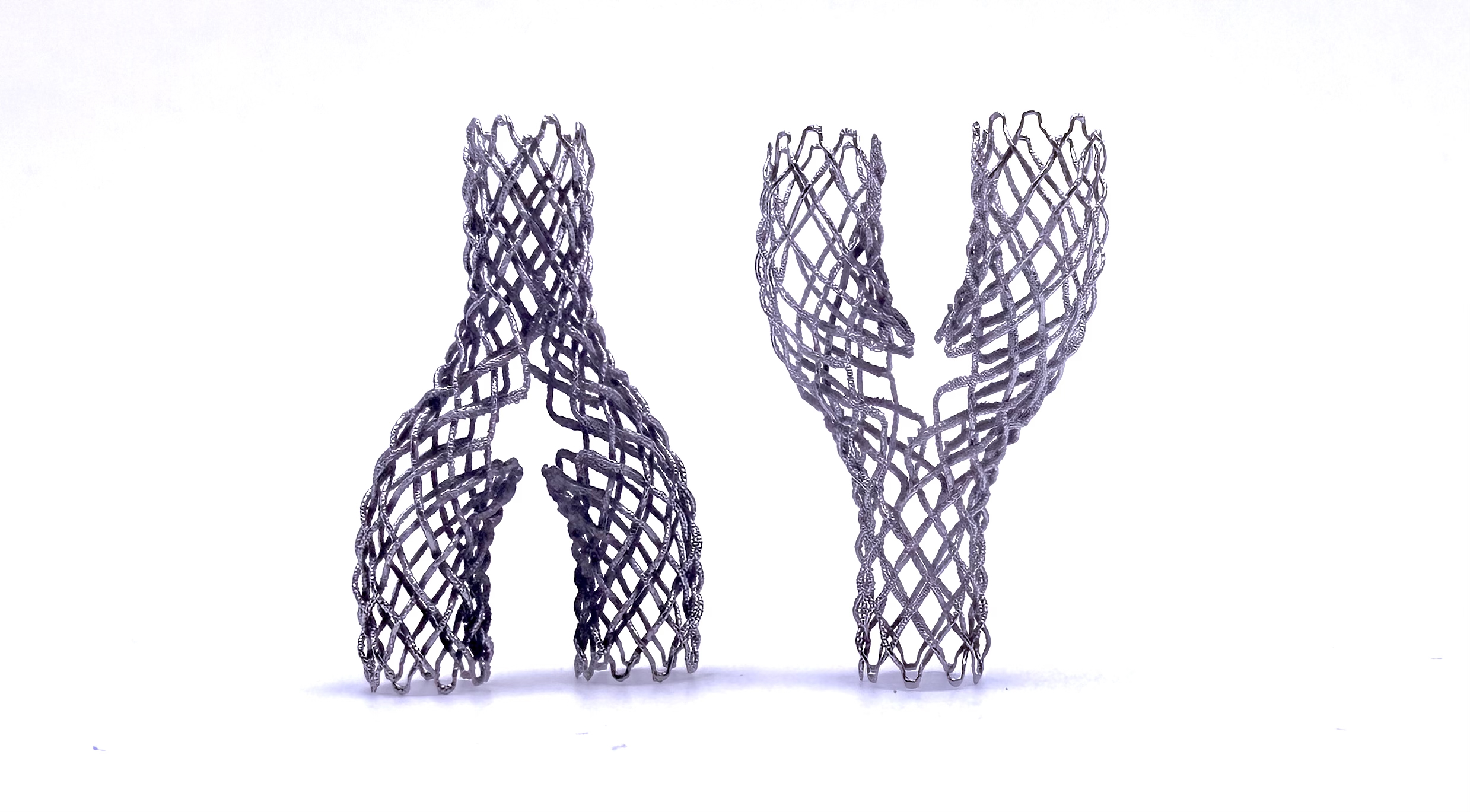
“Here in Long Beach, the need for resilient construction is clear—from the homes we build to the structures protecting our coastline.The PLATYPUS X4 SE gives us the scale and flexibility to build fire-resistant concrete homes and tackle seawall construction, backed by LUYTEN’s experience in underwater concrete printing,” said Lawrence Johnson, Construction Manager at Concretta Homes.International Research Team 3D Printing Nitinol Cardiovascular Medical Devices 3D printed Nitinol tapered flow-diverter stent with variable fiber density, sectional size & shape.
Most metal 3D printed medical devices are based on lattice structures, with interconnected elements arranged in repeating patterns.While not hard to design and print, bending rigid struts informs their behavior, which isn’t good for transcatheter applications—these implants have to fit within small diameters, move through blood vessels, and later recover the original shape, without performant deformation.An international team of researchers from IMDEA Materials Institute, Universidad Politécnica de Madrid (UPM), the Massachusetts Institute of Technology (MIT), and the University of Galway recently won the National James Dyson Award for their development of a patented 3D printing method to make personalized cardiovascular medical devices out of the superelastic metal alloy nitinol.
Their method enables one-step printing of flexible braided structures that mimic blood vessels and can be compressed without failure.As lattice structures are compressed, they become very stiff, but this braided architecture can withstand deformation, and maintain its structural integrity, by moving and reorienting interwoven filaments, like traditional braided stents.The researchers applied a combined chemical etching and electropolishing treatment to the 3D printed devices in order to get the necessary biomedical-grade surface finish.
Their tests found that this post-processing step decreased fiber thickness by nearly 48%, and cross-sectional area by about 71%, in comparison to the as-printed structures.So the braided stents could withstand compressions up to 50% of their original diameter, while still keeping over 90% elastic recovery.Plus, using these could majorly reduce the risk of vascular injury and thrombosis, because their chronic outward force (COF) was much lower than seen in conventional 3D printed lattice structures.
Next steps for the research team are in vitro biocompatibility and animal studies; if those are successful, they can move on to clinical investigations in human patients.Subscribe to Our Email Newsletter Stay up-to-date on all the latest news from the 3D printing industry and receive information and offers from third party vendors.Print Services Upload your 3D Models and get them printed quickly and efficiently.
Powered by FacFox Powered by 3D Systems Powered by Craftcloud Powered by First Mold Powered by Xometry 3DPrinting Business Directory 3DPrinting Business Directory
Read More