A few years ago, my father unexpectedly passed.In the difficult weeks and months that followed, I found myself with the task of going through his stuff, both physical items like tools and plenty of computer stuff, including old media, laptops, and external hard drives.While going through anyone's belongings can be rough, I was shocked at the sheer amount of various things we had in storage.
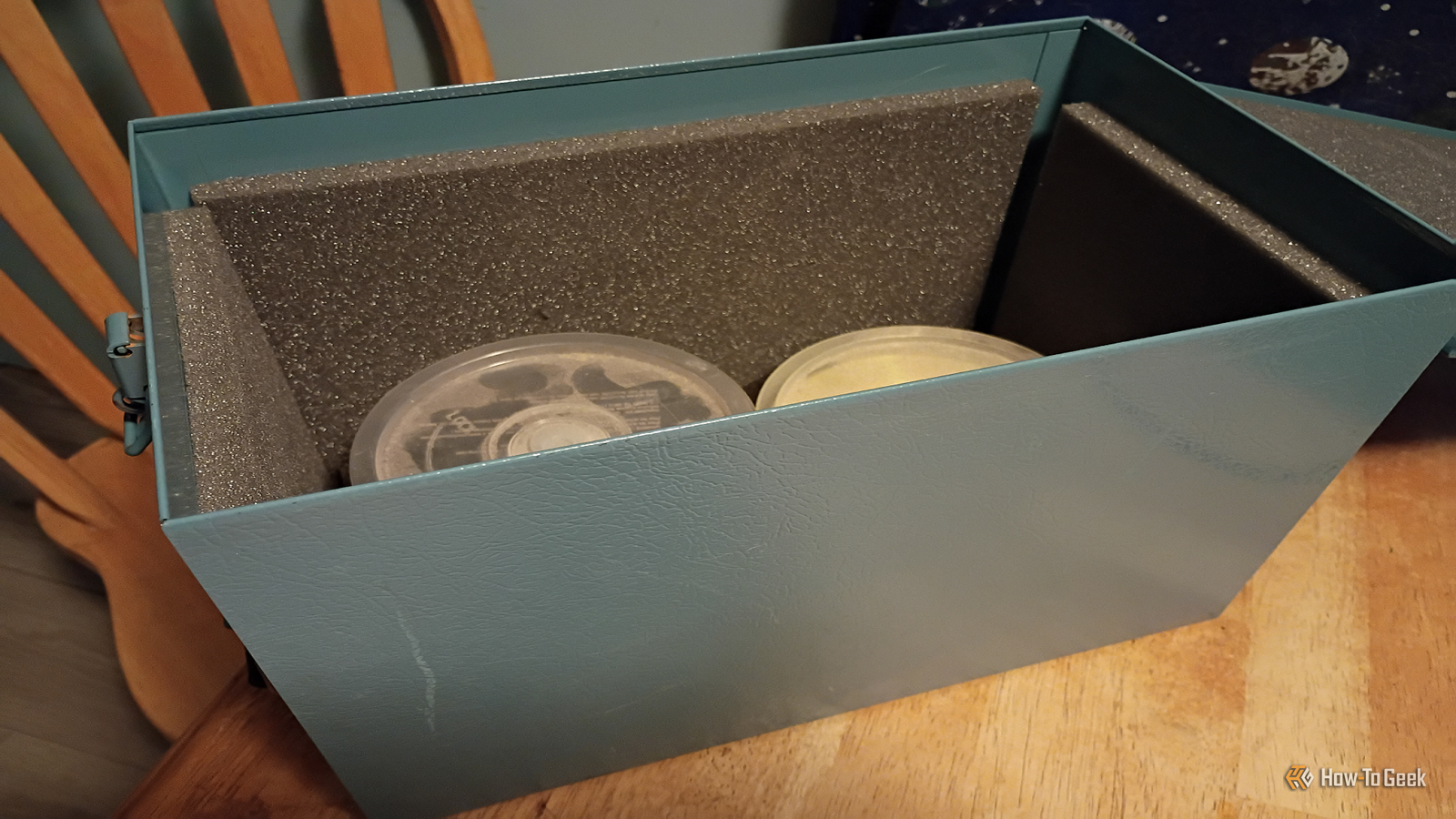
I'm still finding interesting things I never knew we had.But among my initial finds were a ton of books, an old banjo that I fixed up, and something unexpected: a box of old discs I had completely forgotten about.It all started with a little blue box A surprising gem among a lot of stuff My dad collected and saved everything.
He loved tools, hardware, storage media, and scale models, and had a knack for finding unique stuff.As I went through the garage, I found several boxes (large totes, really) of old CD-ROMS, vintage magazines, and software from the 80s and early 90s.I even found an old Logitech mouse.
No Blu-ray discs, though.But there was one small, blue box that sat apart from the rest.There wasn't very much in it, perhaps 16 or so discs in cases and two spindles of discs (one CD-R and the other DVD-R).
I started the process of looking through them, and while I'm not even halfway through the project, I was surprised at some of the gems I've found so far.Quiz 8 Questions · Test Your KnowledgeWeird and quirky storage drivesTrivia challengeFrom hybrid SSHDs to bizarre form factors — how well do you really know the oddest corners of storage technology?Hybrid DrivesForm FactorsHistoryHardwareOdditiesBegin 01 / 8Hybrid DrivesWhat does the acronym SSHD stand for in the context of hybrid storage drives?ASolid State Hard DriveBSolid State Hybrid DriveCSequential Storage High-DensityDStatic Spinning Hard DiskCorrect! SSHD stands for Solid State Hybrid Drive.These drives combine a traditional spinning hard disk with a small amount of NAND flash memory to accelerate frequently accessed data, giving users a middle ground between HDD capacity and SSD-like speed.Not quite — SSHD stands for Solid State Hybrid Drive.
While 'Solid State Hard Drive' sounds convincing, it's actually a common misconception.The 'hybrid' part is key, since these drives merge both spinning magnetic platters and flash memory into a single unit.Continue 02 / 8HistoryWhich company is widely credited with popularizing the consumer SSHD by releasing the Momentus XT in 2010?AWestern DigitalBToshibaCSeagateDSamsungCorrect! Seagate's Momentus XT was a landmark product that brought the SSHD concept to mainstream consumers.It combined a 500GB spinning platter with 4GB of SLC NAND flash and used adaptive memory technology to learn which data to cache for faster access.Not quite — it was Seagate that popularized the consumer SSHD with its Momentus XT in 2010.
The drive used a modest 4GB of SLC NAND flash alongside a traditional 500GB platter, and it was groundbreaking enough to turn many heads in the enthusiast storage community.Continue 03 / 8OdditiesWhat was unusual about the Intel Optane Memory H10, released in 2019?AIt combined a 3D XPoint Optane cache with a QLC NAND SSD on a single M.2 cardBIt used a spinning platter alongside Optane memory in a 2.5-inch chassisCIt was the first drive to use PCIe 5.0 alongside SATA flash storageDIt embedded Optane memory directly into a USB thumb drive casingCorrect! The Intel Optane Memory H10 crammed both 3D XPoint Optane cache and QLC NAND storage onto a single M.2 2280 card.This meant the Optane portion acted as a super-fast buffer for the slower QLC NAND, all within one slot — a genuinely clever hybrid approach for thin laptops.Not quite.The Intel Optane Memory H10 was unusual because it placed 3D XPoint Optane cache and QLC NAND SSD storage together on one M.2 card.
This dual-storage-on-one-stick design was highly unconventional and required special Intel RST drivers to function correctly, making it a quirky product indeed.Continue 04 / 8Form FactorsThe Sony Microvault and similar tiny USB drives once came in novelty shapes like food items and cartoon characters.What is the technical term for this category of novelty drives?APromotional flash drivesBSwag drivesCDesigner USBsDCustom-molded drivesCorrect! The industry term most commonly used is 'promotional flash drives.' They are widely produced as branded giveaways and collectibles, molded into virtually any shape imaginable — from sushi rolls to rubber ducks.Some rare novelty drives have become genuine collector's items over the years.Not quite — the most widely recognized industry term for novelty-shaped USB drives is 'promotional flash drives.' These quirky drives are manufactured in bulk for marketing campaigns and giveaways, and the moldable casings mean manufacturers have produced everything from mini pizza slices to tiny LEGO-style bricks.Continue 05 / 8HardwareApple's Fusion Drive, introduced in 2012, is a type of hybrid storage.
How does it differ from a traditional SSHD?AIt uses proprietary Apple flash chips soldered directly to the HDD circuit boardBIt combines a separate SSD and HDD into a single logical volume managed by softwareCIt is a single physical unit with flash embedded in the same enclosure as the platterDIt caches only the operating system boot files using a dedicated firmware controllerCorrect! Apple's Fusion Drive is two separate physical drives — an SSD and an HDD — that macOS presents as a single unified volume using Core Storage (later APFS).Unlike an SSHD where everything is in one enclosure, Fusion Drive relies entirely on software-level management to decide what lives on the flash and what goes on the platter.Not quite.The key difference is that Apple's Fusion Drive consists of two separate physical drives — an SSD and an HDD — merged into one logical volume by macOS software.
A traditional SSHD is a single self-contained unit with its own firmware controller managing the flash cache, making them architecturally quite different despite achieving similar goals.Continue 06 / 8OdditiesWhat was the primary purpose of the Robson cache technology Intel developed before eventually pivoting toward SSDs?ATo use a small NAND chip on the motherboard to accelerate hard drive performanceBTo embed flash memory inside RAM DIMMs for faster boot timesCTo create a PCIe-attached SSD that could cache optical disc dataDTo use CPU-integrated storage for caching OS page filesCorrect! Intel's Robson technology — which became Intel Turbo Memory — placed a small NAND flash cache on a mini-PCIe card inside laptops to speed up hard drive access.It worked alongside Windows ReadyBoost and ReadyDrive but was largely underwhelming in real-world performance, and the project was quietly shelved as SSDs took over.Not quite.Intel's Robson/Turbo Memory technology used a small NAND flash chip on a mini-PCIe card to cache hard drive data on laptops.
It leveraged Windows Vista's ReadyBoost and ReadyDrive features but never lived up to the hype, and it was eventually abandoned as standalone SSDs became cheaper and far more effective.Continue 07 / 8HistoryThe iomega Zip drive was a popular removable storage medium in the late 1990s.What was the original storage capacity of the first Zip disks released in 1994?A250MBB100MBC750MBD50MBCorrect! The original Iomega Zip disk launched in 1994 with a 100MB capacity, which was enormous compared to the 1.44MB floppy disks it aimed to replace.Later iterations pushed capacity to 250MB and even 750MB, but the original 100MB version was the one that captured the imagination of consumers and creative professionals alike.Not quite — the first Iomega Zip disks released in 1994 held 100MB, a staggering amount at the time when standard floppy disks only held 1.44MB.
Later versions expanded to 250MB and 750MB, but it was that original 100MB capacity that made the Zip drive a cultural phenomenon in offices and design studios throughout the late 1990s.Continue 08 / 8HardwareWestern Digital's Black² drive was a quirky dual-drive product released around 2013.What made it so unusual?AIt contained both a 120GB SSD and a 1TB HDD in a single standard 2.5-inch form factorBIt used dual spinning platters rotating in opposite directions to reduce vibrationCIt featured two separate SATA connectors, one for flash and one for the platterDIt combined SSD storage with a built-in PCIe controller on a 2.5-inch boardCorrect! Western Digital's Black² squeezed a 120GB SSD and a full 1TB HDD into a single 2.5-inch, 9.5mm-thick drive — the same size as a standard laptop hard drive.The catch was that it required special WD software to unlock the HDD portion, and it appeared as two separate drives to the operating system rather than one seamless volume.Not quite — the Western Digital Black² was remarkable because it packed a 120GB SSD and a 1TB HDD into one standard 2.5-inch laptop-sized enclosure.
Unusually, users had to install WD's own software to unlock and access the HDD portion, and the two storage sections appeared as separate drives rather than being merged transparently like Apple's Fusion Drive.See My Score Challenge CompleteYour Score/ 8Thanks for playing!Try Again A few great old PC games And a few not-so-great ones When I first opened the box, there was a layer of old CD-Rs in multicolored cases, along with several CDs in standard jewel cases.The CD-Rs consisted primarily of backup copies of software either I or someone in my family had burned at some point or another.There were a lot of casino/slot machine games based on board games, like Monopoly (I can't stand Monopoly).
They didn't run at all.A few of the CDs were badly scratched, and at least one of them had some mild disc rot.I tried using CD Roller to extract the data from them, but it just didn't work for that particular batch (the program worked for other discs).
There were two other backed-up games in there that I was able to save: a copy of Lemmings and Oh No! More Lemmings and an old Hoyle Solitaire collection for MS-DOS/Windows.I had to use DOSBox to get them going, but the discs worked despite my concerns about them failing like the other games did.So I backed it up to an ISO file to preserve and still play a few levels once in a while.
Make sure you back up your discs, especially if you're pulling old ones out of storage like this.Disc rot and corruption are very real problems for older media! Related The 450x storage leap: Why jumping from 1.44MB floppies to 650MB CDs changed PCs forever The 650MB miracle: How the CD-ROM's microscopic lasers fueled the 90s PC revolution Posts 51 By Sydney Butler My old homemade Weird Al MP3 disc I wondered what happened to some of those MP3 CDs If you traveled back in time and asked the teenage version of me who my favorite musician was, I would have said, “Weird Al” Yankovic and then probably launched into an hour-long lecture about why I liked him so much.If you asked me today, I'd say the same thing, but qualify that it's now more like a cross between Yankovic, Frank Zappa, Tom Petty, and Ween.
So, imagine my surprise when I found the old MP3 disc I made from my Weird Al collection back when I first started driving.Hey, MP3 discs made it so I didn't have to keep changing the CDs out, and damaging them (I was notoriously hard on my CDs back then).I still have the original “Weird Al” CDs.
And the cassettes.And the LPs.As I said, I'm a fan.
But it was very cool to find this old MP3 disc again.It had four albums on it and a few tracks from earlier in Al’s career.Some of the data was corrupted, though, but I managed to recover most of the tracks.
The MP3 disc was a cool find (even if I don't need extra copies of the tracks), but one thing that truly surprised me was the DVD copy of Weird Al Live that I found in the box.It was the official DVD, but was being stored in one of those slim multicolored jewel cases.It's a bit scuffed, but it still plays just fine.
I have all the CDs and already ripped FLAC versions of them for my personal streaming, but this was a welcome blast from the past for sure.Related 7 Obscure Optical Disc Formats That Never Reached the Popularity of DVD The forgettable frisbees.Posts 24 By Sydney Butler A concert video from 22 years ago An old performance exhumed from History Perhaps the most surprising of all the discs was a CD-R labeled “David: Live 2004.” It didn't want to play on the DVD Player or my old PC’s DVD drive, despite the fact that they normally handled VCDs (video CDs) just fine in the past.
I couldn't even get it to load in Windows Media Player (which is what I was using at the time).Luckily, I was able to access the disc in the file manager and copy the media files onto my hard drive.From there, I tried them in Windows Media Player, but that threw an error, so I tried VLC Media Player and got them running.
Kind of.The video is choppy as can be, and there is definitely some damage to the file.The video played long enough (it died at the 10-minute mark) to snag some screenshots, but that's about as far as I could get it to go.
I completely blocked playing this show out of my memory, but between the years of 2002 and 2005, I played and performed live in a variety of different places, like bars, clubs, and outdoor events.I mostly played folk and rock songs, but sprinkled in the occasional novelty tune.I have audio recordings of a few songs from that time.
Now, I can't share a lot of the recording due to copyright law, but here's a clip of one of my original songs.It's, as the kids would probably say, "a bit cringe." The concert is an hour long and sounds amateurish at best.I got better at playing and composing.
I promise.Regardless, it's nice to have a (somewhat embarrassing) memento of the music I played “back in the day.” Related Claude wants to replace the way I research.I tested whether it can I was skeptical about whether or not Claude could change the way I do research, so I tested it out.
Here's what happened.Posts By David J.Buck It's amazing how much we forget when we pack things away I was astonished that most of the discs still worked after all the time they spent in storage.
I'm glad I found them.Now, these are just a few highlights of what I found; I'm still going through the discs, but I did find one that says "SBR website and original songs," so you never know.While this happened several years ago, I still kept most of the discs I found.
They currently live on my CD shelf, overlooking the living room–right across from his ashes.There was also an entire spindle of DVD-Rs in that box, and I have no idea if they have anything on them or not.And just in case you're wondering: I backed everything up I found, of course.
Verbatim CD-Rs Verbatim CD-R Blank Discs 700MB 80 Minutes 52X Recordable Disc for Data and Music - 100pk SpindleSee at Amazon Expand Collapse
Read More