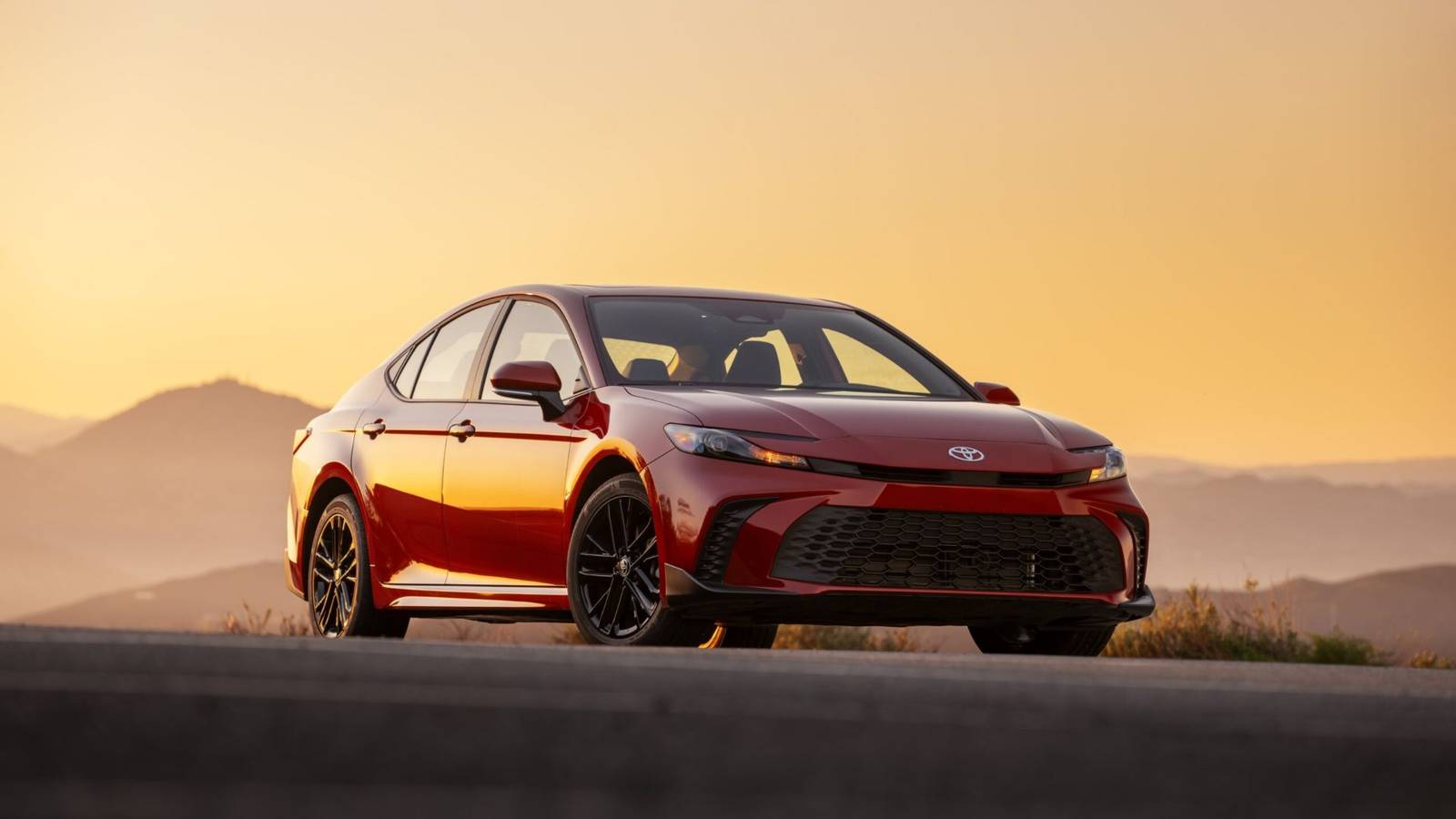
People sometimes joke that the Lexus ES is just a Toyota Camry in a nicer suit.That joke has always been an oversimplification, but the 2026 redesign makes it harder to dismiss.For example, both cars dropped their gas-only engines in the same redesign cycle.
Every 2026 Camry is now a hybrid.The 2026 Lexus ES is hybrid-only as well, though this year Lexus also introduced a fully electric ES version.The Camry sits on Toyota's TNGA-K platform, with the new ES riding on an evolved version Lexus calls GA-K.
When two cars from the same company share this much under the skin, the real question isn't which one is nicer.It's what the higher price on one of them (i.e., the Lexus) actually buys.To that end, the starting MSRP might be farther apart than some realize.
The 2026 Toyota Camry starts at $30,895, including the $1,295 destination charge.By contrast, the 2026 Lexus ES 350h starts at $51,095, including destination.In essence, the entry-level ES costs $20,200 more than the entry-level Camry before any options are added.
The 2026 Toyota Camry also comes with a fuel economy edge over its ES counterpart that holds across nearly every trim level, save for one exception.Where the extra money for a Lexus actually pays off is elsewhere: a longer warranty, more rear-seat room, and an interior crafted to a different standard.Toyota Camry Sedan Base: $29,100 Base Trim Engine 2.5-liter Four-Cylinder Hybrid Base Trim Transmission CVTi-S CVT Base Trim Drivetrain Front-Wheel Drive Powered by Expand Collapse Same displacement, different generations Lexus borrows the Camry's engine (but with premium fuel) Toyota offers five Camry trims: LE, SE, Nightshade, XLE, and XSE.
The ES 350h lineup is a little smaller with two trims, Premium and Premium+.Both lineups offer front-wheel drive or all-wheel drive, regardless of the trim level.Both cars use a 2.5-liter four-cylinder gas engine paired with an electric motor, and each sends power through a continuously variable transmission.
The Camry uses Toyota's fifth-generation hybrid system, pairing the 2.5-liter four-cylinder (184 horsepower) with a 100 kW front motor (about 134 horsepower) for 225 combined horsepower in front-wheel drive.The ES 350h leverages a newer sixth-generation Lexus hybrid system, pairing the aforementioned 2.5-liter engine (186 horsepower) with a 201-horsepower front motor for a combined output of 244 horsepower.Likewise, both cars add a second motor at the rear axle for all-wheel drive versions, although the two systems behave differently.
The Camry's rear motor pushes total output from 225 to 232 horsepower.The rear e-axle for the ES does not change the total at all, holding steady at 244 horsepower in both front- and all-wheel drive, since the extra motor goes toward traction rather than added power.The Lexus ES also requires premium fuel, while the Camry runs on regular 87 octane.
Premium is more per gallon than regular, a recurring cost worth noting as we head into the fuel economy numbers below.Lexus ES Sedan Base: $49,700 Base Trim Engine 2.5-liter inline-4 hybrid Base Trim Transmission e-CVT Base Trim Drivetrain Front-Wheel Drive Powered by Expand Collapse The Camry's fuel economy advantage One configuration is the exception to the rule Close Here's how the full lineup breaks down for both the 2026 Toyota Camry and the 2026 Lexus ES, according to the EPA: Camry LE FWD: 52 city / 49 highway / 51 combined Camry LE AWD: 50 city / 49 highway / 50 combined Camry SE, Nightshade, XLE, XSE FWD: 47 city / 45 highway / 46 combined Camry SE, Nightshade, XLE AWD: 46 city / 46 highway / 46 combined Camry XSE AWD: 43 city / 43 highway / 43 combined Lexus ES 350h FWD: 48 city / 44 highway / 46 combined Lexus ES 350h AWD: 47 city / 42 highway / 44 combined The base Camry LE holds the widest advantage over the ES 350h.It beats the ES by five mpg combined in front-wheel drive (51 versus 46 mpg) and by six mpg combined in all-wheel drive (50 versus 44 mpg).
Move up to the SE, Nightshade, and XLE, and things are more evenly matched.In front-wheel drive, for example, these three trims tie the ES 350h exactly at 46 mpg combined.The XSE, Camry's top trim, also ties the ES at 46 combined in a front-wheel drive configuration.
For all-wheel drive models, however, the Camry still comes out (mostly) ahead in combined mpg, which could be a selling point for those who live where all-wheel drive is a necessity.The only exception here is how the Camry XSE with all-wheel drive drops to 43 combined, a single mpg behind the ES 350h.That's the only pairing in this entire comparison where the Lexus wins on fuel economy.
Bigger wheels, sportier suspension tuning, and added curb weight in general explain that XSE AWD dip, since it's the most performance-oriented Camry Toyota sells.Related Lexus reinvents the ES for 2026: 6 big changes as the luxury icon goes electric ES 350e and ES 500e represent a "multi-pathway" pivot for Lexus.Posts By Carl Anthony Where the Lexus ES feels like a Lexus Richer materials and premium audio The ES is a bigger car overall.
It measures 202.4 inches long on a 116.1-inch wheelbase, compared to the Camry at 193.5 inches in length on a 111.2-inch wheelbase.Most of the extra length for the ES translates to rear-seat legroom, not cargo space.The ES offers 40.7 inches of rear-seat legroom, compared with 38 inches in the Camry, a noteworthy difference for anyone who regularly rides in the back seat, as well as for families with kids and car seats.
In terms of trunk space, the Camry offers more at 15.1 cubic feet versus the ES at 13.3 cubic feet, despite the Lexus being the longer car.Buyers who regularly haul luggage, golf clubs, or a stroller or two will find the Camry offers more room to get the job done.Both ES 350h trims come wrapped in NuLuxe, a synthetic leather alternative, paired with heated and ventilated front seats and ambient lighting.
The Camry only offers ventilated seats as a package on the XLE and XSE, and ambient lighting only comes standard on those same two trims.Genuine leather, meanwhile, shows up on the Camry XSE, not the ES, since Lexus sticks with NuLuxe.A front-seat knee heater is an option for the ES, a small comfort touch the Camry doesn't offer.
Meanwhile, the technology suite favors the Lexus.Every ES 350h comes standard with a 14-inch touchscreen and a 12.3-inch digital gauge cluster.The Camry LE, SE, and Nightshade make do with an eight-inch touchscreen and a seven-inch gauge cluster; only the XLE and XSE step up to the 12.3-inch versions of each.
The audio systems arguably favor the Lexus as well.The ES Premium trim comes standard with a 10-speaker system, while the Premium+ upgrades to a 17-speaker, 1,800-watt Mark Levinson system.The Camry's best available audio option is a nine-speaker JBL setup, bundled into a package on the XLE and XSE.
For anyone who listens to music or podcasts on every commute, what Lexus is offering here could be a deciding factor.Toyota wins on price and fuel economy; Lexus wins on tech and luxury Buyers who want good fuel economy, the lowest purchase price, and don't mind a smaller standard infotainment screen should look at the 2026 Camry.Buyers who want more rear legroom, the option for a Mark Levinson stereo, or that general luxury-car feel, and don't mind paying more at the dealership and at the pump, should look at the ES 350h instead.
The 2026 Toyota Camry has a three-year, 36,000-mile bumper-to-bumper warranty, a five-year, 60,000-mile powertrain warranty, and five years of corrosion protection (unlimited mileage).The hybrid battery carries a 10-year, 150,000-mile warranty.The 2026 Lexus ES has a four-year, 50,000-mile bumper-to-bumper warranty, a six-year, 70,000-mile powertrain warranty, and six years of corrosion protection (unlimited mileage).
The hybrid battery carries the same 10-year, 150,000-mile warranty as the Camry.
Read More