A colossal solar flare could graze the Earth tomorrow, prompting speculation of northern lights sightings and blackouts.A coronal mass ejection – a giant solar explosion sending streams of charged particles into space – fired off the sun at 1.39pm yesterday.Space weather forecasters (yes, they’re a thing) categorised the blast of plasma as a M5.8 (moderate) flare, the second-most powerful ranking.
The eruption from the sunspot AR4436 has already triggered a radio blackout over the Atlantic Ocean.While it’s heading away from Earth, there’s a chance it will ‘brush’ past us in the early hours tomorrow morning, according to the Met Office.More flares could follow as the sunspot is now rotating into Earth’s ‘strike zone’, so any ejections from it will be on a direct path towards us.
Sign up for all of the latest stories Start your day informed with Metro's News Updates newsletter or get Breaking News alerts the moment it happens.Solar flares ‘can affect power grids and GPS’ When solar particles hit the magnetic bubble that protects our planet from radiation, it causes a geomagnetic storm, also called a solar storm.These particles generate electrical currents and magnetic fields.
All this extra energy can damage spacecraft, pipelines and railroad tracks, as well as disrupt power grids.Communication blackouts mainly affect methods which use high-frequency radio waves, such as ham radio and commercial aviation.Jim NR Dale, a meteorologist with the British Weather Services, told Metro that blackouts happen because the flares weaken radio waves.
‘This is due to ionisation within the ionosphere,’ he says, referring to the fuzzy, glowing layer of the planet which meets space.‘Basically, the waves are blocked and dispersed.‘The flares in the worst-case scenarios can affect other technical apparatus such as satellites, power grid outputs and GPS.’ This probably means your phone won’t be affected by the storm, but navigation systems may be knocked out.
Earth’s magnetosphere can get peeled back, meaning satellites in high altitudes (like GPS ones) are hit with more radiation than usual.Satellites in low-Earth orbit are better protected but can still experience technical hiccups, like signal dropouts and reboots. Forecasters expect the arrival of tomorrow’s ejection arrival to cause a G1-level geomagnetic storm.But Dale says this one is ‘minor’, so blackouts shouldn’t be much of a worry.
‘G4/5 are the biggies,’ he added.GPS is also far more resilient than you might think, Lisa Dyer, executive director of the GPS Innovation Alliance, tells Metro.‘Past experience of these events has shown us that the system continues to function normally even during intense space weather,’ she says.
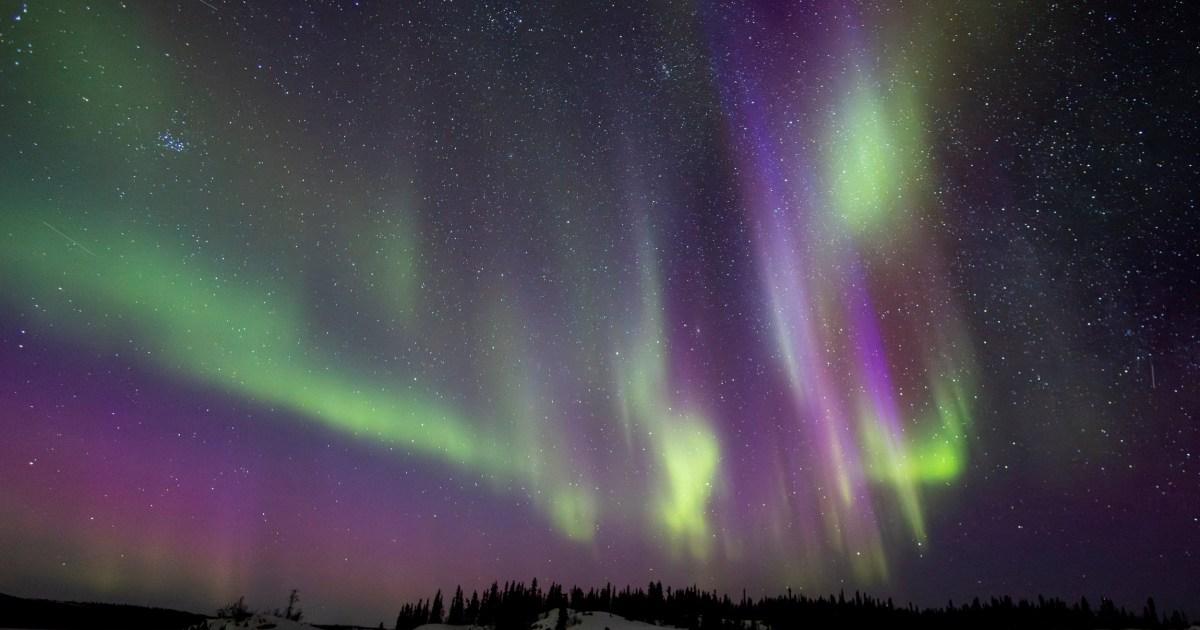
‘The satellites remain safe even under extreme conditions, and we can expect operations to remain stable throughout the space weather event.’ Where can I see the northern lights? One pleasant potential side effect of all this solar material is a dazzling light shows in the nighttime sky.When the particles mingle with the gases in Earth’s atmosphere, they create various colours: Oxygen creates green or red light, while blue and purple come from nitrogen.Trending Now Putin stockpiling 'unkillable' fibre-optic drones for 'future assault on NATO' World 1 day ago By Sarah Hooper Teaching assistant 'can't remember why' she spat in child's face in police interrogation Star-Wars themed yacht that's inspired by Darth Vader's destroyer ship Reform councillor quits days after election over 'racist' posts This cosmic light show, known as the aurora borealis or northern lights, could be seen across northern Scotland tomorrow if the skies are clear enough, space forecasters say.
The monitoring service AuroraWatch UK is currently reporting no significant geomagnetic activity.The sun’s activity ebbs and flows on an 11-year cycle and reached its peak, called solar maximum, last year.During this, the sun spits out more flares than usual.
That’s why auroras were seen as far south as London last year, as the powerful solar storms drive auroras further south.Get in touch with our news team by emailing us at [email protected] more stories like this, check our news page.
MORE: UK set to be hotter than Hawaii with temperatures rising to 25°C MORE: Nasa chief wants to ‘Make Pluto Great Again’ MORE: Donald Trump praises ‘super hearing’ of NASA chief’s ‘beautiful’ ears Comments Add as preferred source News Updates Stay on top of the headlines with daily email updates.This site is protected by reCAPTCHA and the Google Privacy Policy and Terms of Service apply.Your information will be used in line with our Privacy Policy HomeNewsTech Related topics Met OfficeNorthern LightsSpace New planet discovered - and it has a very familiar smell Tech April 24, 2026 By Rory McKeown Eerie footage of 'angel-shaped' UFO released by the White House Tech 1 day ago By Josh Milton
Read More