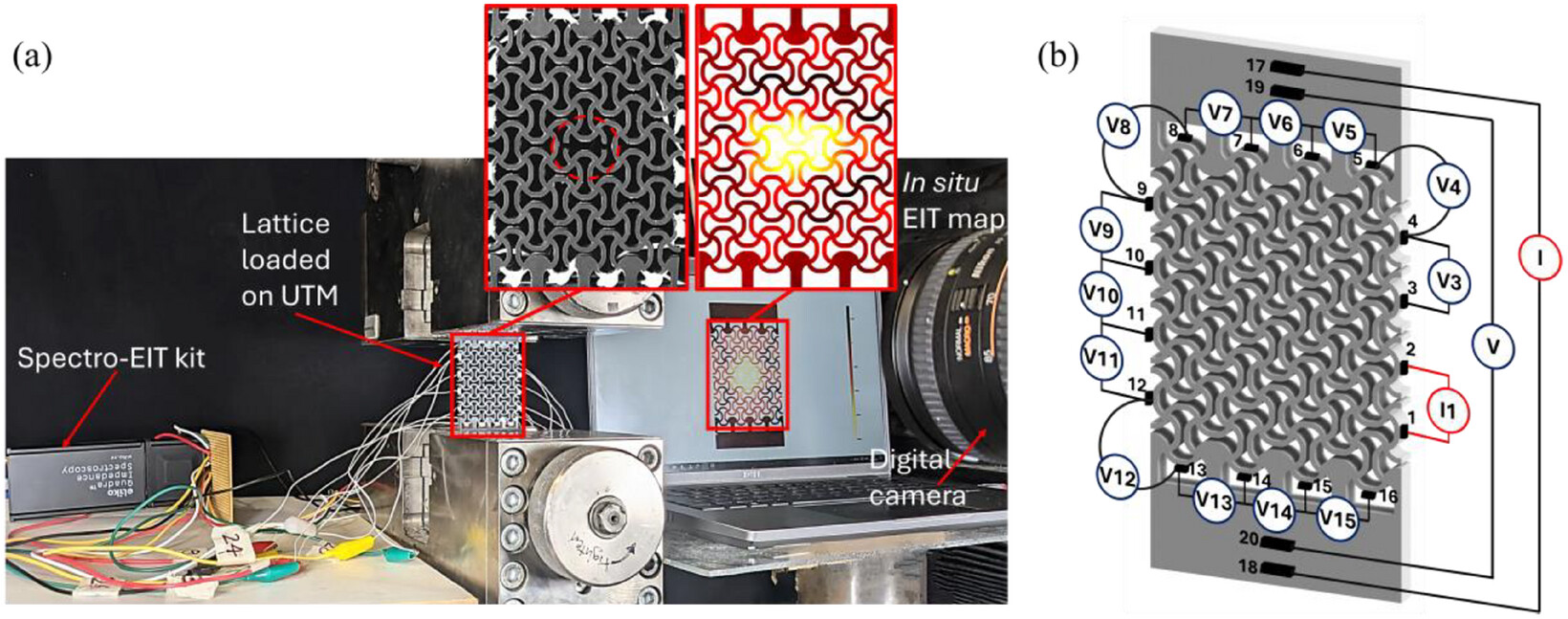
A new paper, “Full-Field Damage Monitoring in Architected Lattices Using In situ Electrical Impedance Tomography,” points to lattices being able to detect damage.This could really help composites in critical applications such as aviation detect and predict damage as it occurs.Testing and inspection are very important to keeping vehicles safe through maintenance and replacement parts.
The easier and quicker you make testing, the lower the cost of the part or vehicle will be over its lifetime.Despite extensive knowledge of scheduled maintenance, wear and tear, and extraordinary circumstances, sudden, rapidly evolving, or catastrophic damage can still occur unexpectedly or be hard to predict.Adding sensors to objects increases costs and perhaps more dependencies or problems.
Safety sensors can also malfunction, and they add cost.What’s worse, their placement or power use could lead to new failures.So turning the actual thing into a sensor seems like a really interesting approach.
Here, they use Electrical impedance tomography (EIT), a non-contact inspection method already used in patients to map lung function or to map oil flow in pipelines.The process is also called Industrial Process Tomography (IPT) or Electrical Resistance Tomography (ERT).A ring of electrodes is placed in a liquid, tank, pipe, or other thing to be measured (or a belt of electrodes is placed around the chest); the device then sends current through the pipe to the other electrodes in sequence.
It then measures whether something changes the voltage at a given location and how conductive that location is; using this information, and inferring what things are by their voltage (or changed voltage), it generates a color-coded 3D mesh that shows a live view of what is happening inside without having to open it up.Distribution of measured resistances for all 16 current injection configurations in the intact specimen at different strain states (A–E).They then made carbon nanotube-doped resins and 3D printed a set of Voronoi lattices 48 millimeters in width.
They then made a conductivity map of the structure.Updated maps showed that, over time, damage occurred at sites with conductivity loss.What’s more, they found that different topologies could show different levels of damage detection.
By measuring resistance, they can find and quantify fractures.The team hopes to build functional systems like this and create a “pathway toward intrinsically self-sensing, damage-aware material systems.” Schematic showing (a) adjacent and (b) across current injection schemes with adjacent voltage measurements.The work was done at Professor Shanmugam Kumar’s Sustainable Multifunctional Materials and Additive Manufacturing (SM2AM) Lab at the University of Glasgow.
The algorithm used to map and locate damage could track cracks as they grew, usually up to one strut away from the fracture.Professor Kumar stated, “In this research, we’ve developed a new way to map electrical changes across an entire 3D-printed lattice structure in real time.The output is somewhat like an MRI scan: just as an MRI can show what is happening throughout the body, our approach allows us to see how different parts of the lattice are responding while it is under strain.
Conventional measurements can tell us what is happening at a particular location in a material, or provide an overall, averaged indication of the structural health of the whole structure.However, they cannot show us in detail where damage is developing and how it is spreading throughout the structure.Our research shows that, by combining carefully designed lattice structures with EIT, we can obtain this much richer picture of structural behaviour, including detecting damage before the structure ultimately fails.
The engineered lattice architectures enable control over sensing fidelity.This technique could open up potential applications in areas such as structural health monitoring and other advanced engineering systems, although further work is needed to develop and scale the technology for practical applications.” Also part of the team were Glasgow’s Akash Deep and Professor Andrew McBride, and Dr.Andrea Samore and Professor Alistair McEwan from the University of Sydney.
I just knew that all those Voronoi patterns that people were printing years ago would be useful for something.This could be a very exciting process for aviation parts, 3D-printed valves, impellers, and 3D-printed ship screws.It would be interesting to see if they could do this live in a ship engine or a rocket.
We are very bad at creep strength and cyclical loading.We also suck at making vat-polymerization-made structures that last a long time.And the composites we use may be very strong in some ways, but they can fail catastrophically.
If we look at things like 3D printed boats or composite wing or fuselage parts, this could really be amazing.By allowing quick, inexpensive testing and a live view of damage as it occurs, this could make many parts much safer.Image courtesy of Deep et al., Advanced Functional Materials Subscribe to Our Email Newsletter Stay up-to-date on all the latest news from the 3D printing industry and receive information and offers from third party vendors.
Print Services Upload your 3D Models and get them printed quickly and efficiently.Powered by FacFox Powered by 3D Systems Powered by Craftcloud Powered by First Mold Powered by Xometry 3DPrinting Business Directory 3DPrinting Business Directory
Read More