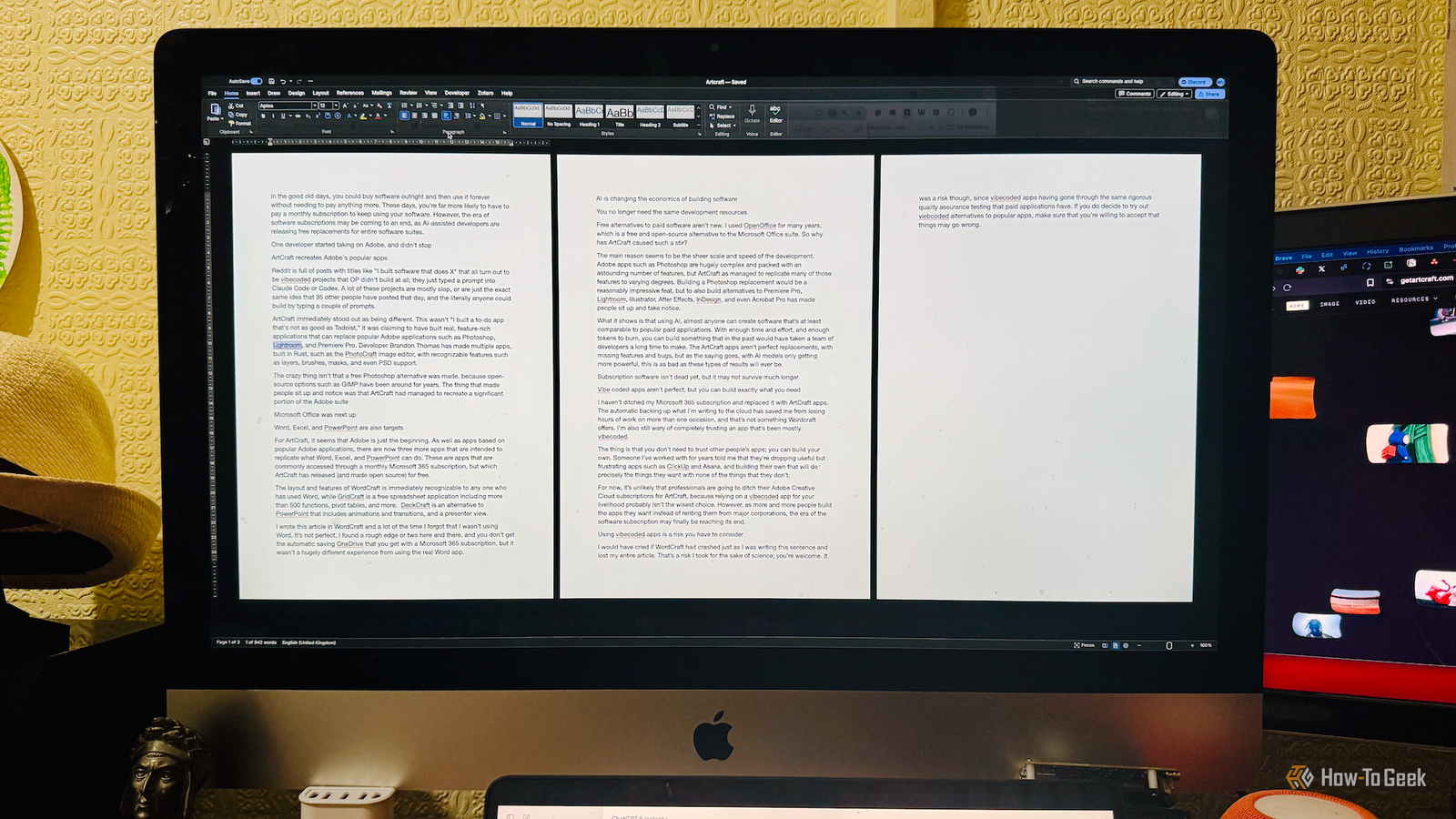
In the good old days, you could buy software outright and then use it forever without needing to pay anything more.These days, you're far more likely to have to pay a monthly subscription to keep using your software.However, the era of software subscriptions may be coming to an end, as AI-assisted developers are releasing free replacements for entire software suites.
Add How-To Geek on Google Add as Preferred Source Follow on Google Discover One developer started taking on Adobe, and didn't stop ArtCraft recreates Adobe's popular apps Reddit is full of posts with titles like "I built software that does X" that all turn out to be vibe-coded projects that OP didn't build at all; they just typed a prompt into Claude Code or Codex.A lot of these projects are mostly slop or are just the exact same idea that 35 other people have posted that day, and that literally anyone could build by typing a couple of prompts.ArtCraft immediately stood out as being different.
This wasn't "I built a to-do app that's not as good as Todoist"; it was claiming to have built real, feature-rich applications that can replicate many of the features of popular Adobe applications such as Photoshop, Lightroom, and Premiere Pro.Developer Brandon Thomas has built (or had AI build) multiple apps in Rust, such as the PhotoCraft image editor, with recognizable features such as layers, brushes, masks, and even PSD support.The crazy thing isn't that a free Photoshop alternative was made, because open-source options such as GIMP have been around for years.
The thing that made people sit up and notice was that ArtCraft had managed to recreate a significant portion of an entire suite of software.Related I canceled over $400 in yearly subscriptions by spending $20 to vibe code my own alternatives A single AI subscription can pay for itself many times over if you use it to build tools rather than just chat.Posts 4 By Dibakar Ghosh Microsoft Office was next up Word, Excel, and PowerPoint are also targets For ArtCraft, it seems that Adobe is just the beginning.
As well as apps based on popular Adobe applications, there are now three more which are intended to replicate what Word, Excel, and PowerPoint can do.These are apps that are commonly accessed through a monthly Microsoft 365 subscription, but which ArtCraft has released (and made open source) for free.The layout and features of WordCraft are immediately recognizable to anyone who has used Word, while GridCraft is a free spreadsheet application including more than 500 functions, pivot tables, and more.
DeckCraft is an alternative to PowerPoint that includes animations and transitions and a presenter view.I wrote this article in WordCraft, and a lot of the time I forgot that I wasn't using Word.It's not perfect; using the Editor to check for errors was a painful experience compared to Word.
WordCraft also can't automatically back up what I'm writing to the cloud, which is one of the most useful features of my Microsoft 365 subscription.For general writing purposes, however, it wasn't a hugely different experience from using the real Word app.AI is changing the economics of building software You no longer need the same development resources Close Free alternatives to paid software aren't new.
I used OpenOffice for many years, which is a free and open-source alternative to the Microsoft Office suite.So why has ArtCraft caused such a stir? The main reason seems to be the sheer scale and speed of development.Adobe apps such as Photoshop are hugely complex and packed with an astounding number of features, but ArtCraft has managed to replicate many of those features to varying degrees.
Building a Photoshop replacement would be a reasonably impressive feat, but to also build alternatives to Premiere Pro, Lightroom, Illustrator, After Effects, InDesign, and even Acrobat Pro has made people sit up and take notice.What it shows is that using AI, almost anyone can create software that looks and functions somewhat like popular paid applications, even if it lacks features and may not be highly reliable.With enough time and effort, and enough tokens to burn, you can build something that in the past would have taken a team of developers a long time to make.
The ArtCraft apps aren't perfect replacements, with missing features and bugs, but as the saying goes, with AI models only getting more powerful, this is as bad as these types of results will ever be.Subscription software isn't dead yet, but it may not survive much longer Vibe-coded apps aren't perfect, but you can build exactly what you need I haven't ditched my Microsoft 365 subscription and replaced it with ArtCraft apps.The automatic backup of what I'm writing has saved me from losing hours of work on more than one occasion, and that's not something WordCraft offers.
I'm also still wary of completely trusting an app that's been mostly vibe-coded.The thing is that you don't need to trust other people's apps; you can build your own.Someone I've worked with for years told me that they're dropping useful but frustrating apps such as ClickUp and Asana and building their own that will do precisely the things they want with none of the things that they don't.
For now, it's unlikely that professionals are going to ditch their Adobe Creative Cloud subscriptions for ArtCraft, because relying on a vibe-coded app for your livelihood probably isn't the wisest choice.However, as more and more people build the apps they want instead of renting them from major corporations, the era of the software subscription may finally be reaching its end.Using vibe-coded apps is a risk you have to consider I would have cried if WordCraft had crashed just as I was writing this sentence and lost my entire article.
That's a risk I took for the sake of science; you're welcome.It was a risk, though, since vibe-coded apps are unlikely to have gone through the same rigorous quality assurance testing that many paid applications have.If you do decide to try out vibe-coded alternatives to popular apps, make sure that you're willing to accept that things may go wrong.
Read More