I'm a firm believer that a good smart home should work mostly like magic; when you walk into a room, the lights should turn on, and they should only turn off again when you leave.Sometimes you still need manual control, but I could never make a dashboard that really worked.I finally cracked the problem and now my dashboard is actually useful.
Add How-To Geek on Google Add as Preferred Source Follow on Google Discover Most dashboards I see online are just way too busy You can't see the wood for the trees People love posting their dashboards online.This was a thing even before vibe-coding made it possible to create dashboards just by asking an AI chatbot.A lot of the dashboards I see online look incredibly impressive but seem to be almost unusable.
They're packed with so many different elements that it's impossible to see what's what.Video camera feeds, charts, and buttons are everywhere, and trying to find the information you want is like looking for a needle in a haystack.My initial dashboards were like this.
The default Home Assistant dashboard used to add every new device automatically, so it quickly became a total mess.It would take what felt like 20 minutes to scroll to the bottom of the screen.These messy dashboards are no use at all; if you can't find the controls you need when you need them, then your home really isn't that smart at all.
Related 7 Home Assistant features I wish I’d started using sooner Long time, no scene.Posts 1 By Adam Davidson A minimal dashboard looks great but isn't always that useful You can go too far the other way I then moved to the opposite end of the spectrum.My messy dashboard wasn't of any use to me at all, so I decided to create a minimal dashboard with just a handful of controls.
The idea was that with only a few things on the dashboard it would be easy to find the information or button that I needed.This part was at least true.With a minimal dashboard, it was easy to find what I needed without having to hunt through a mass of different buttons, charts, and video feeds.
The problem was that with only a handful of things on the dashboard, I regularly found that the one control I really needed to use wasn't on it.I tried switching things out with others, but no matter what I tried, there was always something missing when I needed it.It took me quite some time to realize that I needed different controls at different times.
What I really needed was a minimal dashboard that could change throughout the day, so that's exactly what I set up.I realized that I needed different things from my dashboard at different times Something that's useful in the morning may not be useful later on Close My dashboard now changes automatically, based on a number of different criteria.The first is time: in the morning my dashboard has information such as the weather for the day, what the kids are having for lunch at school, and the day's calendar events.
In the evening, the weather and lunches are gone, replaced with lighting controls for the living room and a button to turn on the electric blanket before bed.The second criterion is my location.Using presence sensors and Bluetooth proxies, Home Assistant can tell which room I'm in.
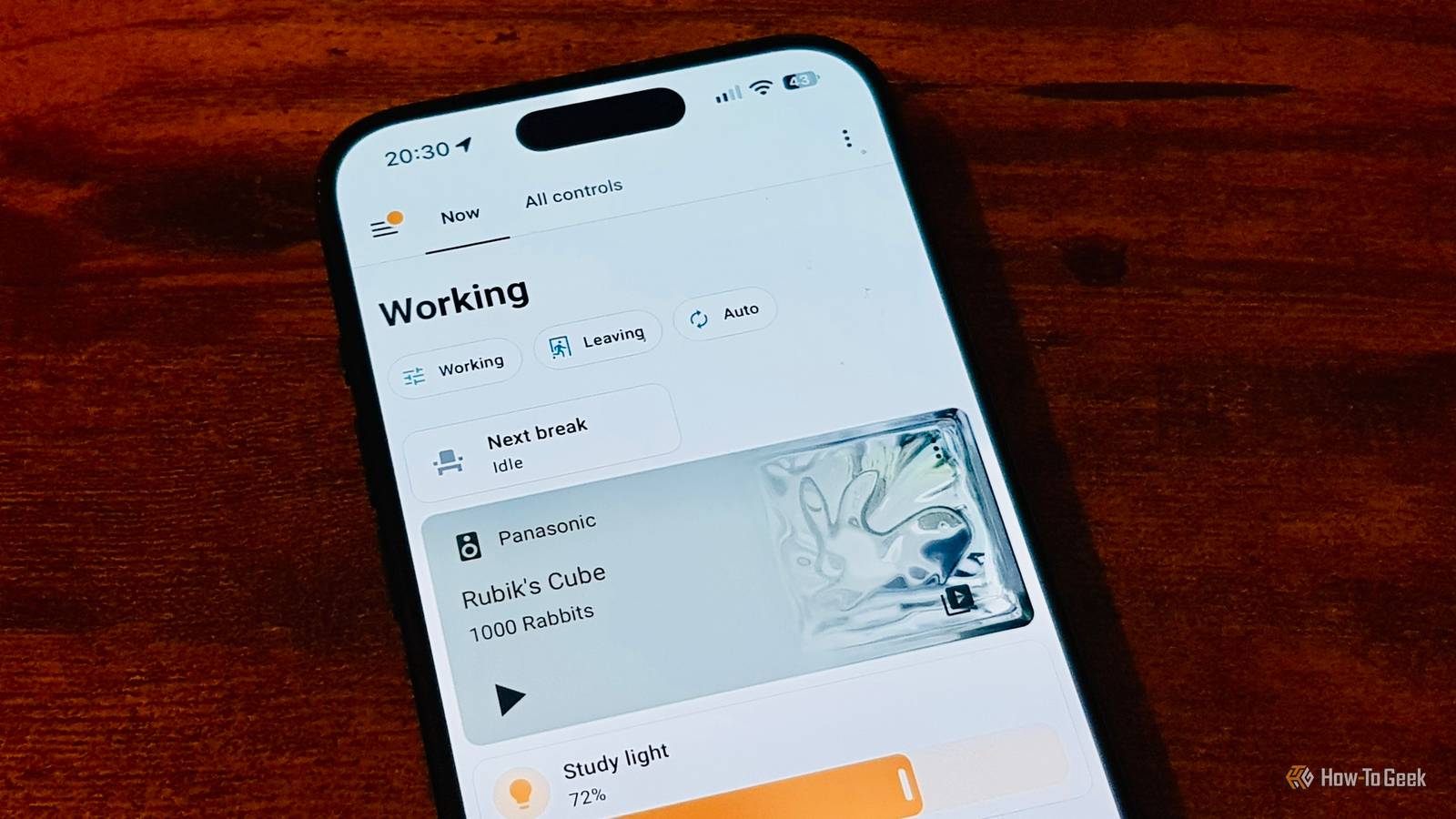
During the day, if I'm sitting at my desk, the dashboard shows the things I need for my home office, such as controls for the lights in that room, music controls, and details of how long I've been sitting and when my next stand-up break is due.In the evening, if I'm in the living room and the TV is on, the dashboard changes to show TV controls, controls for the lights, and a button to mark that I've taken my medication.When I'm in the bedroom at night, it switches to show controls for the main bedroom light and the bedside lamp, and a button to turn off the electric blanket.
The whole thing works using dashboard sections.The cards for the morning dashboard are all in one section, the cards for the Watching TV dashboard are in another, and so on.Each section has a visibility condition which can hide or display the section depending on the states of various sensors and entities.
I finally have a useful dashboard It's minimal enough to use but includes most of the things I need It took me far too long to figure out that what I really needed was a dashboard that adapted to my needs.Now that I finally have one, it's given me the best of both worlds.Each dashboard view is minimal enough that it's easy to find the controls or information that I need, but by automatically changing, the key features that I want are always on the current dashboard when I need them.
It's been quite a revelation.I use this dashboard on my phone, enabling me to do things such as turning off the bedside lamp when I'm in bed.The same concept could be applied to a wall-mounted dashboard, although some of the location-based features might not really be suitable, since a wall-mounted tablet always stays in one place.
My dashboard almost feels like magic The first day I tried out my new dashboard, it really blew me away.When I was sitting down to watch TV, I was able to pause the current show, dim the lights, and turn on the electric blanket, all from the same dashboard that had been showing the weather and lunch orders earlier that same day.Sometimes Home Assistant really does make me feel like I might be a wizard.
Read More