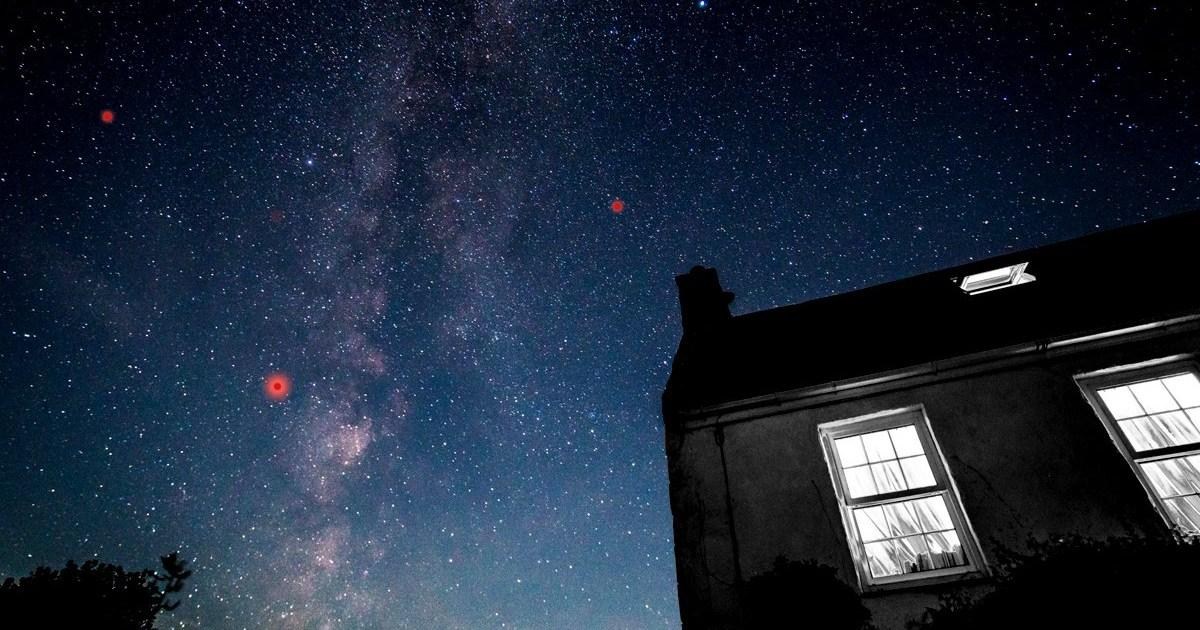
Since 2023, scientists have discovered about 300 so-called little red dots looking down at us.These dots, sometimes called rubies, have been spotted by the James Webb Space Telescope, sometimes only taking up one pixel in photos.We have no idea what they are for sure and what makes these specks odd is that they’re really, really old.
Almost as old as time itself.Now researchers from Johns Hopkins University in Baltimore think they have the answer – a never-before-seen type of black hole, according to their paper in Physical Review Letters.‘They are very compact, red objects, seen as they were within roughly the first billion years after the Big Bang,’ the study’s co-author, Loris Del Grosso, tells Metro.
‘At first they were puzzling because they did not fit either of the obvious explanations.’ Red dots could be cosmic hungry-hungry hippos Black holes are gargantuan pits of eternally dark nothingness, so dense that their gravity prevents anything, even light, from escaping.Most are made from the rotting remains of a dead star, drifting through space and sitting at the heart of large galaxies, like our own.A primordial black hole, however, would have existed back when the universe was a dark, star-less pit.
‘Primordial ones could have almost any mass, from far lighter than the sun to thousands of times heavier,’ Del Grosso, a postdoctoral researcher, says.‘They would also already exist when the first galaxies were forming, giving them a head start to grow.That head start is why they could explain how such massive black holes appeared so early.’ Researchers suspected these hungry-hungry relics formed from collapsed parts of the young universe, their tint being clouds of dust sucked inside.
Follow Metro on WhatsApp to be the first to get all the latest news Metro’s on Whatsapp! Join our community for breaking news and juicy stories.To test this, the team zoomed in on Abell 2744-QSO1, a red dot that twinkled when the universe was just 700million years old.QSO1 sits in Abell 2744, or Pandora’s Cluster, a giant group of galaxies four billion light-years from Earth.
This dot seems to be made of the first elements that formed during the beginning of the universe: hydrogen and helium.It also sports a swirling, super-hot disc of cosmic crumbs, energy, and gas, hinting it’s more unspoiled and older than other little red dots.The team modelled how a dot like QS01 could form from a primordial black hole.
There were three explanations for QSO1, says study co-author Valerio De Luca, a postdoctoral researcher at Johns Hopkins.First, rather simply, was it born that way? ‘This is ruled out, because it would have left a detectable imprint on the cosmic microwave background, the afterglow of the Big Bang,’ De Luca says.Their second hunch was that QSO1 was made of smaller primordial black holes, though the messiness of the universe makes it unlikely.
This left option three: lighter primordial “seeds” that sprouted by swallowing bright dust and gas, allowing a young black hole to reach large mass within just a few hundred million years.‘This one works,’ says De Luca.‘It can reproduce the properties of well-studied dots such as QSO1, whose light is magnified by the gravity of a galaxy cluster in front of it.’ The team now intend to look at other little red dots to see if any more fit the primordial black hole bill.
Still, Del Grosso is open to other explanations for these red-tinted astronomical objects.They could be chunky black holes that formed in the ‘ordinary’ way, such as a galactic gas cloud that collapsed, like a crumpled-up sheet of paper.‘The black hole may be wrapped in an extremely dense cocoon of gas that absorbs its light and re-emits it, so the whole thing glows like the surface of a giant, cool star,’ Del Grosso says.
If that’s the case, the dots would be an entirely new phenomenon: ‘black hole stars’.Other scientists have suggested the dots are short-lived giant stars, or infant galaxies making stars at mind-boggling speeds.Up Next Or, Del Grosso adds, all of the above.
‘These ideas are not necessarily rivals either,’ she adds.Trending Now Inmate released early from HMP Wandsworth says Russell Brand is ‘talk of the prison’ UK 14 hours ago By John Dunne James Bulger’s killer Jon Venables tells parole board he should stay in prison Popular high street chain to make return 14 years after collapse Entire 'ghost estate' has been empty for seven years because no one ever moved in ‘A primordial black hole could be the seed at the centre of a black hole star.’ As scientists continue to point telescopes into the cosmos, Del Grosso hopes they can even discover how much they weigh or how fast they grow.‘That will help us tell these explanations apart,’ she adds.
Get in touch with our news team by emailing us at [email protected] more stories like this, check our news page.Get in touch with our news team by emailing us at [email protected].
For more stories like this, check our news page.MORE: Parent accused of pooping in rival school’s corridor after 42-0 football defeat MORE: Inside the eerie nuclear bunker that has an airlock and crucial internet access MORE: Entire ‘ghost estate’ has been empty for seven years because no one ever moved in Add as preferred source News Updates Stay on top of the headlines with daily email updates.This site is protected by reCAPTCHA and the Google Privacy Policy and Terms of Service apply.
Your information will be used in line with our Privacy Policy HomeNewsTech Related topics SpaceWeird news
Read More