A few weeks ago, I visited Professor Alexander Kaplan at Luleå University of Technology.Originally from Austria, Kaplan has spent more than 20 years at the university working on the physics of lasers, welding, and additive manufacturing (AM).While reviewing his recent research, I came across a paper from his group on something that sounds almost too basic at first: powder absorbance.
The paper, “Absorbance study of powder conditions for laser additive manufacturing,” measured the absorbance of metal powders used in AM across wavelengths from 330 to 1560 nm, spanning ultraviolet, visible, and near-infrared light and covering many wavelengths relevant to industrial laser processing.The study goes beyond the usual discussion of absorption.It is a reminder that in laser powder-bed fusion (L-PBF), powder is not simply a material waiting to be melted.
The particles themselves are part of the optical system.Kaplan says: “Though manufacturing processes by laser beams are applied in many industrial applications, the absorption mechanisms and the extent of energy losses are hardly known.It can be estimated that commonly between 30% and 70% of the beam power is lost by reflections.
Improved understanding of absorption has high potential to improve the process efficiency and quality controllability.” The study included 39 powder samples from 16 different materials.The list is broader than I expected: several steels, including 316L-type material, H13, 630 stainless, and Inconel 718; aluminum alloys such as AlSi10Mg and AlSi40; titanium and Ti-6Al-4V; Nitinol; chromium; copper; brass; iron ore; and a TiCoCrFeNiMo high-entropy alloy.The researchers also varied powder condition, examining different particle-size fractions, new and used powder, stored and oxidized powder, aged AlSi10Mg, and powder mixtures.
That makes the paper more relevant to everyday AM than the title might suggest.Absorbance spectra of eight powders investigated in the study.The red line indicates a 1070 nm laser wavelength.
In AM, we often discuss energy input as if it is fully defined by the machine: laser power, scan speed, hatch distance, and layer thickness.From those values, we calculate energy density and define process windows.That is not wrong, but it is incomplete.
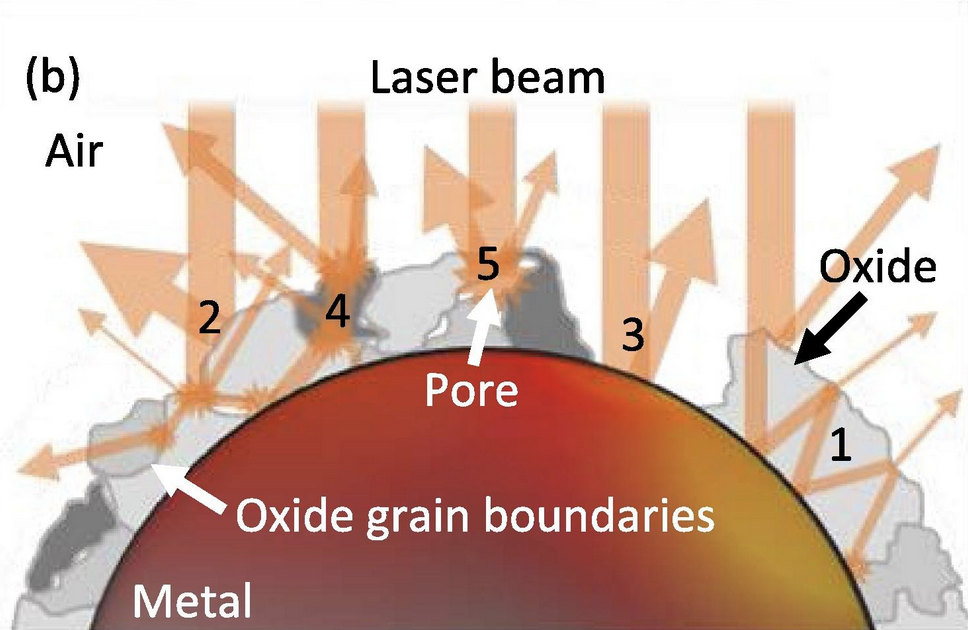
The machine defines how much energy is delivered by the beam.The powder bed influences how much of that energy is actually absorbed.A powder bed is not a flat metal surface.
It is a rough, granular structure made up of particles, gaps, oxide layers, satellite particles, irregular contact points, and local angles.A laser beam can reflect from one particle to another, pass into gaps, scatter, or remain trapped longer than it would on a flat, polished surface.This is one reason why the paper found higher measured absorbance for powders than calculated values for flat material surfaces.
Powder geometry helps absorption.The laser has more than one chance to interact with the material before energy escapes.For anyone working with powder-bed fusion, that sounds logical.
Still, it is useful to see it measured across many materials.In the real L-PBF process, the beam interacts not only with loose powder.Part of the energy also interacts with the melt pool, where absorption conditions are different.
The balance between powder-bed absorption and melt-pool absorption can vary during processing.The Luleå study focuses on the powder-bed part of that interaction.The numbers also show why wavelength matters.
At the common near-infrared wavelength around 1070 nm, the study found larger differences between materials than at shorter wavelengths such as 450 nm, 635 nm, and 650 nm.The authors report that absorbance varies less between materials at these shorter wavelengths, helping explain why shorter-wavelength lasers have become attractive for reflective materials.Copper reflects strongly at the near-infrared wavelengths used by most fiber lasers, which is one reason green and blue lasers have become important in copper L-PBF.
The Luleå study fits that picture: copper showed much higher absorbance in the visible range, while absorbance dropped toward the near-infrared.But absorption is only the first part of the copper problem.Even when the laser wavelength is better matched and finished parts can be produced, copper remains demanding.
High thermal conductivity pulls heat away quickly, which can destabilize the melt pool.Lack-of-fusion defects, keyhole-related porosity, residual stress, local cracking, and property variation can still appear if the process is not carefully controlled.For highly conductive copper parts, small defects may be critical when the application depends on electrical or thermal performance rather than density alone.
That is why the absorbance data is useful, even when the industry already knows that green lasers help.It adds another piece to the process puzzle: how powder condition affects the first step in energy transfer.If the powder surface, particle size, oxidation state, or reuse history changes the absorbed energy, it can also change the thermal history that follows.
For copper, that thermal history is often where material-quality problems start to appear.Powder morphologies of stainless steel, aluminum, copper, iron ore, and brass materials evaluated in the absorbance study.Aluminum is another useful example.
The aluminum powders did not behave as flat-surface calculations might suggest because the powder bed changes the interaction.The study also shows that aging and oxide formation can affect the absorbance behavior of AlSi10Mg.That is relevant because aluminum powders naturally form oxide layers, and those layers are part of the real process, not a laboratory inconvenience.
For the steel powders 1.4404 and 1.4542, smaller particle-size fractions showed higher absorbance than larger ones.The authors report an average increase of about 6% for 1.4404 and about 2.4% for 1.4542.The explanation is straightforward.
Finer powders have more surface area and create more opportunities for multiple reflections.More importantly, the effect was measured, helping explain why changes in powder specification can alter the process even when the alloy remains the same.The paper also looked at powder aging, storage, and use.
Stored titanium powder, used steel powders, oxidized copper, and aged AlSi10Mg all behaved differently from fresh or untreated powder.The effects were not uniform.Powder condition does not alter a single property in a predictable way; it influences surface characteristics, chemistry, morphology, and optical response differently depending on the material.
Copper oxidation is a clear example.Oxidized copper showed a different absorbance curve from fresh copper.AlSi10Mg behaved differently after aging, and the used steels differed from the new powders.
These are exactly the kinds of differences that can arise in production, where powder is stored, reused, sieved, blended, and handled.The study included powder mixtures designed to represent changes in particle size, alloying, or impurities, and a high-entropy alloy mixture.The absorbance of a mixture could be estimated from its components in some cases, but not perfectly.
The authors note that differences in density, particle size, segregation, and uneven distribution can influence the result.When powder is blended, recycled, or produced from less controlled feedstock, it may be tempting to treat it as a simple average of its ingredients.The paper suggests that the powder bed does not always behave that neatly.
This does not mean recycled or used powder is unsuitable, nor that every small change in powder condition will disrupt a process.It means that powder condition can influence energy coupling and helps explain why process parameters may sometimes need adjustment.Powder quality is often assessed using chemistry, particle size distribution, flowability, apparent density, oxygen and moisture content, and reuse limits.
Those are still necessary, but the Luleå study adds another practical layer: the same powder may also need to be understood as an energy-coupling surface.Other research has approached the same problem from different angles.In situ work on L-PBF has shown that absorptivity during processing can differ from static measurements and liquid-metal estimates.
Direct measurements during melt-pool formation have also shown that absorptivity is not a fixed number detached from the process.More recent studies on textured or modified powders show that powder surfaces can be engineered to change laser absorption.Comparison of absorbance spectra for fresh powders and powders affected by storage, reuse, oxidation, and aging.
Read together, these studies make the same point from different directions: absorption evolves with material condition and processing environment.That will become more important as AM moves further into production and material reuse.Production powder does not stay perfect.
It is stored, dried, sieved, reused, blended, and handled in different ways.In many factories, powder history becomes part of process history.For critical parts, the answer is often tighter control.
Better powder specification.Better incoming inspection.Better reuse rules.
Better traceability.All of these factors also add cost.For AM to become easier to adopt and more cost-competitive, one practical question is how much powder variation a process can tolerate before it becomes unstable.
The Luleå study does not answer that question directly.It measured absorbance, but those measurements help explain one way powder variation enters the process: through changes in energy absorption, which in L-PBF is directly linked to wavelength and optical interactions.For electron beam powder-bed fusion, a similar study would also be interesting, but it would have to ask different questions.
Laser PBF is strongly linked to optical absorption, reflection, and wavelength.EB-PBF involves factors such as electron interactions, vacuum, charge behavior, preheating, thermal conductivity, and powder-cake formation.The underlying question is still relevant for all powder bed fusion: how does powder condition influence the way energy enters the powder bed? That question is not academic.
It is connected to powder reuse, scrap-derived powder, recycled material streams, process stability, and the real cost of qualification—all factors that influence how stable and economical a process can be.Industrial adoption becomes easier when a process can accept a realistic spread in powder condition and still produce a stable outcome.It becomes even more important when powder is reused because reuse naturally broadens its spread.
The faster we can understand how a new powder batch couples energy into the process, the faster we can qualify it, adjust parameters, and move from material uncertainty to controlled production.After more than 20 years in AM, I still appreciate papers that deepen my understanding of a familiar subject.This paper did that.
It made a familiar subject look slightly different.I already knew that powder absorption varies.Everyone in AM knows that.
What I took from the Luleå study is more specific.Powder condition changes energy coupling.Powder-bed geometry makes real absorption different from flat-surface calculations.
Wavelength influences how strongly those effects appear.Particle size can shift absorbance.Aging and oxidation can change the optical response.
Mixtures do not always behave as simple averages.Together, this changes how we should think about powder in AM.Powder is part of the machine-material interaction.
In powder-bed fusion, that interaction is where the process really begins.About the Author: Ulf Lindhe.Image courtesy of The Org.
Ulf Lindhe is a veteran executive in the additive manufacturing industry with decades of experience spanning technology development, industrial strategy, and global market expansion.He has held senior leadership roles within the metal additive manufacturing sector, contributing to the commercialization and international growth of advanced AM systems.Over the course of his career, Lindhe has worked closely with aerospace, medical, and high-performance engineering companies, helping bridge the gap between technological capability and practical industrial deployment.
Images courtesy of Benedikt Brandau et al., Luleå University of Technology Subscribe to Our Email Newsletter Stay up-to-date on all the latest news from the 3D printing industry and receive information and offers from third party vendors.Print Services Upload your 3D Models and get them printed quickly and efficiently.Powered by FacFox Powered by 3D Systems Powered by Craftcloud Powered by First Mold Powered by Xometry 3DPrinting Business Directory 3DPrinting Business Directory
Read More