Perhaps the most valuable lesson that the additive manufacturing (AM) industry has learned in its technical maturation era over the last five years or so is that you can’t really separate qualification from commercialization.Ultimately, the companies that have systematized the qualification of their core technologies are the companies in the best position to succeed commercially.Behind all the noisier geopolitical catalysts, that’s probably the main reason that the defense sector is such an adept early adopter of 3D printing: the defense sector essentially has a national security mandate to qualify its parts on a relatively accelerated timeline, and the institutional infrastructure in place to ensure that this happens without sacrificing quality.
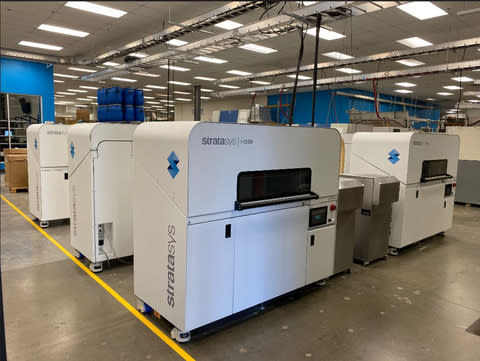
A perfect example of this is Stratasys’ announcement of a qualification program for its SAF PA12 material, in partnership with participants like Boeing and RTX.Stratasys’ Selective Absorption Fusion (SAF) process enables users to turn powder that would otherwise go to waste into usable feedstock, which lowers the cost of parts in addition to enhancing supply chain sustainability.In its latest project involving PA12, Stratasys and its industrial collaborators will work to qualify SAF for the nylon powder material in accordance with the Stratasys Advanced Industrial Solutions (AIS) pathway, which the company developed along with the National Center for Advanced Materials Performance (NCAMP).
NCAMP is part of Wichita State University’s National Institute for Aviation Research (NIAR), one of the nation’s leading centers of aerospace R&D.One key advantage of the AIS roadmap is that it brings service bureaus directly into the fold, effectively serving as a bridge between the two most important tiers in the aerospace and defense supply chain.Stratasys has made its ability to mediate between industrial giants and their suppliers a cornerstone of its business model, through initiatives like AIS and its Customer Advisory Board (CAB).
In a press release about Stratasys’s formation of a partnership to qualify PA12 for the SAF process, Killian Erickson, Founder and CEO of Bifrost, one of the service bureaus participating in the effort, said, “Bifrost is excited to participate in this effort to support our aerospace and defense partners, and most significantly this will provide engineers and designers with validated data, predictability and trust in additive for production components.We’re working together with Stratasys and the National Institute for Aviation Research (NIAR) to provide the knowledge and resources to eliminate the guess work for our clients, further cementing SAF as a keystone technology in our business.” Rich Garrity, the President and Chief Business Unit Officer at Stratasys, said, “SAF technology is designed to help manufacturers address the realities of production—throughput, consistency, and cost efficiency at scale.Validating SAF PA12 for industrial use cases reduces barriers to enterprise adoption by expanding where and how customers can apply the technology, giving them greater confidence to use SAF across functional prototyping, tooling, and production environments.” Parts made with Stratasys’ SAF process.
As I described in a recent post about AM’s potential in grid infrastructure, the global financial establishment has started to unify in full force around the idea that sustainability is security.The autonomy advantage afforded by improved resource efficiency is now being priced into the international marketplace, beginning with strategically critical sectors.Thus, if a company like Boeing can make more parts with the same amount of inputs, that’s no longer “just” an ESG play; it’s confirmation of Boeing’s inherent baseline of industrial resilience.
In the same vein, Stratasys’ ability to provide that resilience is no longer a “nice to have”: it represents what could become part of a moat for the company.The same can be said about qualification, in general.The AM industry has now moved fully past its testing phase for strategic allies like the Pentagon: AM companies are now in the execution phase, where the market will decide winners and losers based on the capacity to deliver qualified parts in a timely fashion.
This has already been happening to some degree, but the Pentagon’s increased spending on AM will now send the process into high gear.This should help dampen some of the sentiment that has emerged that low-cost desktop machines are a more or less suitable replacement for industrial-grade hardware systems.If a process hasn’t been qualified, then it can’t be used by the customers that matter.
That doesn’t invalidate the usefulness of low-cost desktop machines; it simply helps refine the role that they’ll be assigned to play in the broader advanced manufacturing ecosystem.Images courtesy of Stratasys Subscribe to Our Email Newsletter Stay up-to-date on all the latest news from the 3D printing industry and receive information and offers from third party vendors.Print Services Upload your 3D Models and get them printed quickly and efficiently.
Powered by FacFox Powered by 3D Systems Powered by Craftcloud Powered by Xometry 3DPrinting Business Directory 3DPrinting Business Directory
Read More