Last week I wrote about how a return to less strained relations between the US and the rest of the North Atlantic Treaty Organization (NATO), and a related resumption of greater NATO support for Ukraine, could act as a major accelerant to Western AM scaling, and this post is more or less a follow-up to that one.Specifically, it’s about one of the companies I mentioned in that earlier post, GKN Aerospace.Referring to a UAV demonstrator that GKN built without any parts subject to ITAR regulations, which the company unveiled over the summer, I noted that this was one example of how the technical maturation of AM across NATO is now sufficient to enable more opportunities for collaboration within the defense pact.
If NATO does indeed begin to engage more actively in AM-relevant industrial cooperation, then GKN will be indispensable to any such initiative, for many reasons beyond that one use case.There are three key factors here, with one simply being corporate geography and how that aligns with NATO’s needs: GKN is a British company with extensive US operations designed around serving the needs of American defense primes, and it also has a major aerospace presence in Sweden and Norway.Few companies with GKN’s technical capabilities also match its geographic profile, which matters not only for transport logistics but also for aligning the policies of different governments around a single objective.
GKN’s AM production facility in Trollhättan, Sweden.Another factor is the diversity of GKN’s AM competence.In addition to what the company has showcased with the UAV demonstrator, GKN has also worked closely with US primes like Northrop Grumman on applications like solid rocket motor (SRM) technology, which, as I’ve argued, is the first major AM scaling challenge for the US defense sector.
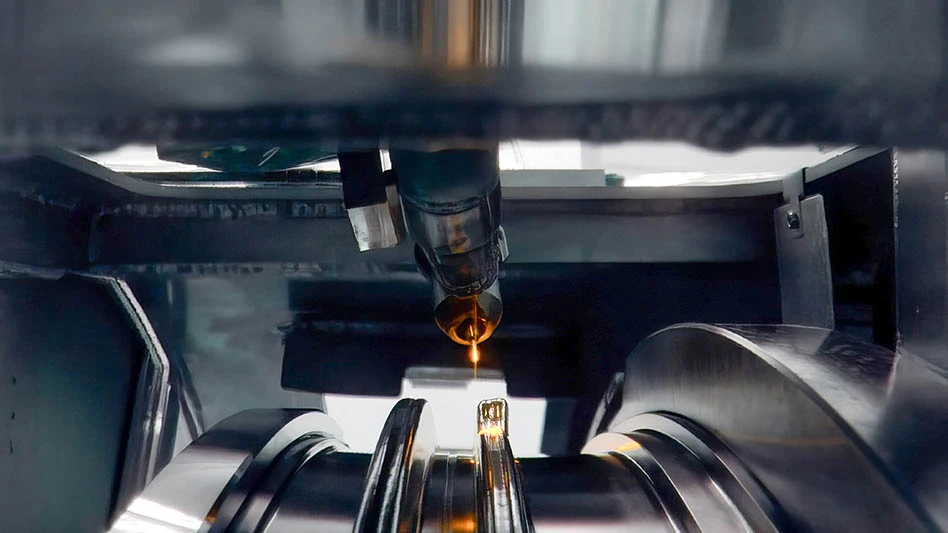
The work that GKN has done on that front benefits not just from the company’s know-how but also from its development of a proprietary DED production cell.And, over the summer, GKN announced it will work with Pratt & Whitney to deliver parts for the F135 engine by 2028.Finally, getting back to GKN’s DED system: the company just announced this week that it’s the world’s first company to achieve Nadcap accreditation for its DED process.
This should speed up GKN’s ability to use its technology to serve customers across the entire defense sector.In his post about the Pratt & Whitney collaboration, Joris Peels questioned why the contract didn’t go to Norsk Titanium, aptly noting, “One can only hope that there is some technical reason to go for GKN.” It would now appear that the expectation that GKN would soon be receiving Nadcap accreditation is at least one reason why the contract went to them.This post isn’t meant to flatter a single company, but to flesh out what would need to happen in order for there to be greater collaboration on AM between NATO partners, and, more broadly, greater collaboration between international partners on distributed manufacturing networks.
This is an especially complex objective because it involves public and private interests that are meant to both cooperate and compete.Given that there’s still such a small number of companies with the ability to deliver metal AM parts at scale in a production environment, once you add the caveat that those companies must also have realistic shots at being chosen to help initiate a NATO-wide distributed manufacturing network, the number of relevant companies dwindles down to a few for any given application.However, the situation should also start to change very quickly once the ball does actually get rolling.
That is, if NATO starts using AM as a team, this won’t be some private preserve that GKN will hoard for itself.The company’s position matters precisely because it’s the sort of partner that its own customers can trust to integrate other companies into the fold.Along these lines, GKN is a company that can help organize the small and medium enterprises (SMEs) in Europe into a new transatlantic production arrangement based on a distributed strategy.
GKN’s large-scale AM cell in Texas.It should be emphasized again, as I mentioned in the first post, that all this is still very tenuous, based on the signals (or rather the noise) coming from the US government.Even in the week or so since I wrote that first post, it has come out that the Pentagon has allegedly been telling EU nations to tone down their rhetoric on Russia.
I predicated the chance of increased NATO AM cooperation on the likelihood that, as soon as the US midterm elections are over, the US will begin a gradual pivot back toward a less chaotic relationship with NATO.On the other hand, you’d lose a lot of money betting against chaos, so the hypothetical that I’ve laid out should be viewed as simply one possibility among many.And even if NATO ultimately unifies around a new joint manufacturing strategy, the change would still likely take at least a couple of years to get off the ground.
It’s worth thinking about, though, because of how transformative it could be for AM adoption.Images courtesy of GKN Aerospace Subscribe to Our Email Newsletter Stay up-to-date on all the latest news from the 3D printing industry and receive information and offers from third party vendors.Print Services Upload your 3D Models and get them printed quickly and efficiently.
Powered by FacFox Powered by 3D Systems Powered by Craftcloud Powered by First Mold Powered by Xometry 3DPrinting Business Directory 3DPrinting Business Directory
Read More