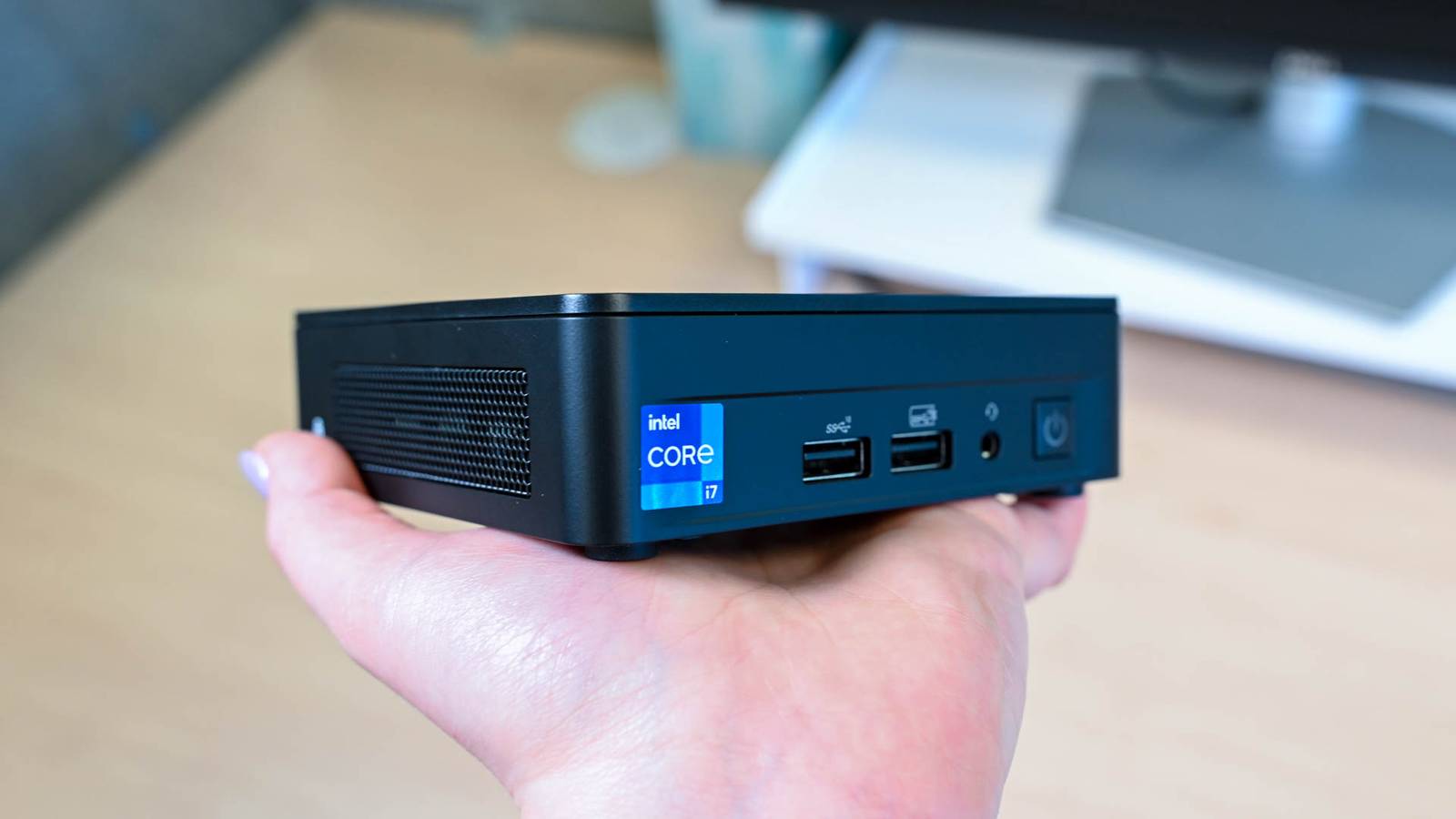
There is so much to love about mini PCs.These tiny little boxes pack all the capabilities that used to require a bulky desktop tower.I want one, I really do—I’ve just never had a practical need.
Even tiny desktops aren't mobile enough I need something I can really take anywhere I’ve only owned a desktop computer for a few years of my life.I was in high school, and it wasn’t that big a deal that I had to be in one place to get online.I didn’t have a car to go anywhere, and we had dial-up internet anyway.
It was a different time.But once I got my first laptop and access to Wi-Fi, it became hard to imagine limiting my computing to just one spot.I feel this way still, even though I’ve worked from home my entire career.
For most of those years, I didn’t have a dedicated home office.I’ve gone periods with small desks I could not imagine covering up with a desktop monitor.I’ve worked from kitchen tables, sofas, and beds.
I have a home office now, but my wife and I share it, and I regularly let them have the room during meetings.I’ve also been the primary caretaker parent during our kids’ early years.Sometimes the quiet moments I have to write are in my car as I wait in the pick-up line.
A desktop, even a tiny one, just feels like a giant limitation.A laptop can do the same things as a mini PC And most mini PCs run on laptop hardware, by the way Close What can a desktop do that a laptop can’t? For a writer, not much.Unless you require intense processing power, the other big benefit of a desktop PC is upgradeability.
But we’re talking about mini PCs here, and they have neither of those advantages.Mini PCs use smaller laptop components, and you typically can’t swap out the motherboard or graphics card.Your upgrades are limited to storage and RAM, just like on a laptop.
Desktops can be more comfortable to work at, so there's that.Having a monitor at eye level and a keyboard further from the screen is better for posture, but that can be achieved by using a laptop.A laptop with a dock is effectively a mini PC, only you can take it with you when you’re done at your desk.
A mini PC looks sleeker, and it can quietly sit there always on, but to own one I would still need a laptop.At that point, why not stick with the computer I already have or take the money I would spend on two devices and consolidate it to afford one good one? Quiz 8 Questions · Test Your KnowledgeMini PCs: History, hardware, hidden usesTrivia challengeFrom tiny boxes to powerhouse desktops — how much do you really know about mini PCs?HistoryHardwareBrandsUse CasesDesignBegin 01 / 8HistoryWhich company is widely credited with popularizing the modern mini PC form factor with its NUC (Next Unit of Computing) line, launched in 2013?AASUSBAppleCIntelDZotacCorrect! Intel introduced the NUC in 2013, defining what many consider the modern mini PC category.The NUC was roughly the size of a paperback book and used laptop-grade components to pack real computing power into a tiny chassis.Not quite — it was Intel that launched the NUC (Next Unit of Computing) platform in 2013.
While ASUS, Zotac, and others followed with their own mini PCs, Intel's NUC set the template that much of the industry would imitate for years.Continue 02 / 8BrandsThe Apple Mac mini, first released in 2005, was marketed with which memorable slogan emphasizing what buyers needed to supply themselves?A"Just add a screen"B"BYODKM" (Bring Your Own Display, Keyboard, and Mouse)C"Think small, compute big"D"The desktop, reimagined"Correct! Apple marketed the original Mac mini with "BYODKM" — Bring Your Own Display, Keyboard, and Mouse.It was a clever pitch aimed at Windows switchers who already owned peripherals, letting Apple offer a Mac at the then-low price of $499.The actual slogan was "BYODKM" — Bring Your Own Display, Keyboard, and Mouse.Apple used this catchy acronym to target Windows users who wanted to try a Mac without buying an entirely new setup, positioning the $499 Mac mini as an affordable entry point.Continue 03 / 8HardwareMost modern mini PCs use which type of processor, originally designed for laptops, to balance performance and thermal output in a compact chassis?ADesktop TDP processorsBMobile (U-series or H-series) processorsCServer-grade Xeon processorsDEmbedded ARM microcontrollersCorrect! Mini PCs almost universally rely on mobile-class processors — like Intel's U-series or H-series, or AMD's equivalents — because their lower thermal design power (TDP) means less heat and no need for large cooling systems.
This is the key engineering trade-off that makes the tiny form factor possible.The right answer is mobile (U-series or H-series) processors.Full desktop CPUs generate far too much heat for a small enclosure, while ARM microcontrollers are too underpowered for general-purpose computing.Laptop chips hit the sweet spot of performance and efficiency that mini PCs depend on.Continue 04 / 8Use CasesMini PCs are extremely popular for running home media centers.
Which open-source media software is most commonly installed on mini PCs for this purpose?AVLC Media PlayerBPlex Media ServerCKodiDJellyfinCorrect! Kodi (formerly known as XBMC) has long been the go-to open-source software for turning a mini PC into a full home theater PC (HTPC).It supports plugins, streaming services, and local media libraries, making it incredibly flexible for living room setups.While Plex and Jellyfin are also popular for home media, Kodi is historically the most iconic choice for mini PC home theater builds.Originally called XBMC (Xbox Media Center), Kodi has a massive plugin ecosystem and was practically synonymous with the HTPC mini PC use case for many years.Continue 05 / 8DesignWhat storage interface, originally designed for SSDs in laptops, became the standard internal storage connection in most mini PCs, replacing older 2.5-inch SATA drives?AmSATABM.2 NVMeCPCIe x16DCFexpressCorrect! M.2 NVMe slots became the dominant storage interface in mini PCs because the small card form factor fits easily inside compact chassis, and NVMe speeds far exceed what older SATA connections could offer.
Many modern mini PCs include one or two M.2 slots alongside an optional 2.5-inch bay.The answer is M.2 NVMe.While mSATA was an earlier compact storage standard, it has largely been phased out in favor of M.2, which supports the much faster NVMe protocol.M.2 drives are credit-card-sized and slot directly into the motherboard, making them ideal for space-constrained mini PC designs.Continue 06 / 8BrandsWhich Chinese brand, often compared to a "mini PC powerhouse," rose to global prominence around 2022–2023 with highly affordable mini PCs like the MinisForum Venus series?ABeelinkBMinisForumCGeekomDAcemagicCorrect! MinisForum became a standout name in the mini PC space around 2022–2023, gaining attention for packing AMD Ryzen and even discrete GPU options into compact chassis at competitive prices.
Their Venus series, featuring dedicated graphics, challenged the idea that mini PCs had to sacrifice gaming performance.The answer is MinisForum.While Beelink, Geekom, and Acemagic are all legitimate Chinese mini PC brands that gained popularity in the same era, MinisForum made the biggest splash with performance-focused models like the Venus series, which included discrete Radeon graphics in a palm-sized box.Continue 07 / 8Use CasesBeyond home use, mini PCs are widely deployed in commercial settings for one particular application.Which of the following is the most common enterprise use case for mini PCs?AHigh-performance 3D rendering farmsBDigital signage and kiosk terminalsCPrimary data center serversDProfessional video editing workstationsCorrect! Digital signage and kiosk terminals are one of the most widespread commercial applications for mini PCs.
Their small size lets them mount invisibly behind displays, their low power consumption keeps operating costs down, and their standard x86 architecture means they run ordinary Windows or Linux software without special configurations.The most common enterprise use case is digital signage and kiosk terminals.You'll find mini PCs hidden behind restaurant menu boards, airport information screens, and retail displays worldwide.They're ideal because they're discreet, energy-efficient, and capable of running standard software without the bulk of a traditional PC.Continue 08 / 8HistoryIntel discontinued its own NUC product line in 2023, handing the brand to a partner.
Which company took over the NUC brand and product line?AASUSBLenovoCMSIDHPCorrect! ASUS acquired Intel's NUC business in 2023, continuing the lineup under the ASUS NUC branding.Intel decided to exit the finished product business to focus on its core chip manufacturing and design operations, and ASUS — already a major NUC manufacturing partner — was a natural fit to carry the torch.It was ASUS that took over the NUC brand from Intel in 2023.Intel had long partnered with ASUS for NUC manufacturing, so the transition made sense.
Intel's decision to divest the NUC line was part of a broader strategy to concentrate on semiconductors rather than finished consumer hardware products.See My Score Challenge CompleteYour Score/ 8Thanks for playing!Try Again I don't actually need a home server or a streaming box Not yet, at least For years, I wanted a mini PC just to build my own home server.Rather than uploading files to the cloud, I could keep them in my home while still syncing them wirelessly.I tried setting up Nextcloud, but there were so many tiny administrative hassles to learn just to implement a solution that was ultimately more complex than I needed.
I don’t use Google Docs or Google Photos as it is, so I don’t actually need open source alternatives to those—and there are encrypted Google Photos alternatives like Ente I trust for when I do.I had slightly better luck with OpenMediaVault, which I got up and running as a Samba box for file-sharing.But since I was the only one using it, the slower transfer speeds actually made the experience feel like a downgrade from just using an external SSD.
We didn’t have a TV for years, but now that we do, I find the built-in software to be good enough that I see little point to building my own home theater PC.I don’t have enough media for a Plex server, as tempting as that sounds, and I suspect that Plex would have its own administrative headaches that I just don't have time for.I don't want to game at my desk Let me enjoy my big-screen TV I’m not a PC gamer.
Aside from a few years in high school when it felt novel, I’ve never felt drawn to the idea of gaming in the same place where I work.Plus, a PC and mouse still feel like work peripherals more than gaming ones to me.So even though there are mini PCs that now serve as a cheap way to get into PC gaming, I’ve passed on those.
The biggest temptation I felt was to build my PC to stream games via Steam Link or Moonlight, but it was cheaper to just use NVIDIA GeForce NOW, and I likely ended up with a better experience.I’m not a console gamer either.I don’t have the luxury of taking over the living room whenever I want to play.
That’s a shared space.So turning a mini PC into a game console is out, too.Related My mini PC runs on USB power—and 5 other tricks I missed USB-C power was only the beginning—these tiny computers hide far more versatility than I expected.
Posts By Patrick Campanale Maybe I'll change my mind one day.But not today I love mini PCs.I like that they often use very little energy.
I like the ability to mount them to the back of a monitor like a more upgradeable iMac.They’re one of those most versatile be-what-you-want-them-to-be devices that exist.Yet I can’t justify buying one.
These days I can’t even justify a personal need for a laptop either, not since buying a Samsung Galaxy Z Fold.I find this foldable phone's large internal screen and Samsung DeX to be all the PC I need.Why own a separate desktop, laptop, and phone when the latter is able to be all three?
Read More