Keeping houseplants can make being indoors feel more like being outside in nature.It only works if your plants stay alive.I used some cheap ESP32 boards and even cheaper soil moisture sensors to set up a system that alerts me when my plants actually need watering.
Watering on a schedule isn't the best idea Plants don't run like clockwork I set up a system using NFC tags to remind me to water my plants.The problem was that this method worked on a schedule, and plants don't always follow a regular pattern.Often, I'd go to water a plant, only to find that the soil was already really dry and could have done with watering sooner.
Other times, the soil would still be moist, so adding more water would risk overwatering the plant, which can damage it just like underwatering can.My system is useful for reminding me when to check my plants, but I regularly find myself having to wait a little longer before I water a plant that my system says is due to be watered.Since the soil moisture can vary from week to week, there's no simple way to find the ideal routine for watering.
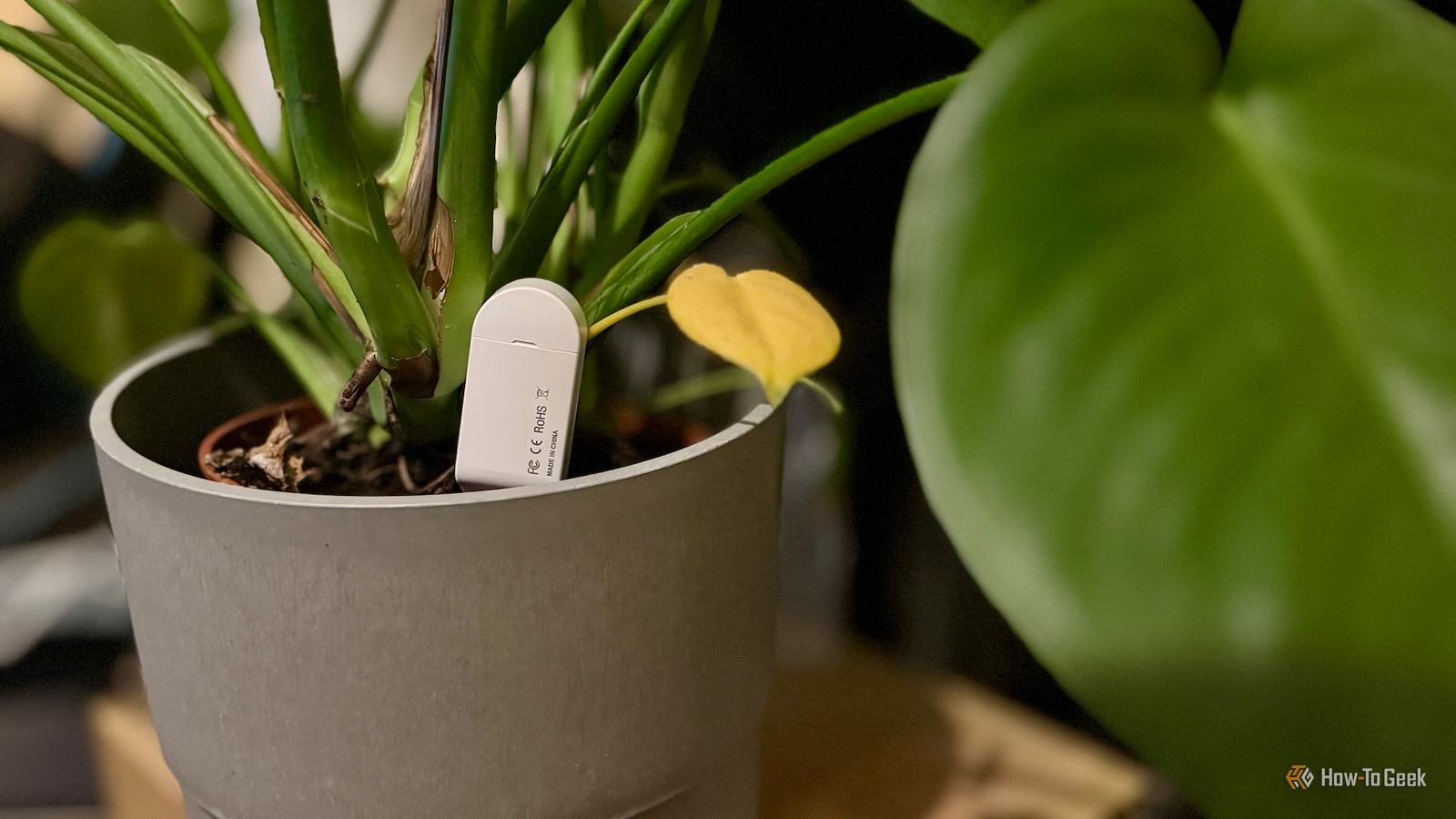
Related The best smart home sensors are the ones you'll never see Your smart home doesn't need to look like one.Posts 1 By Tim Brookes A moisture sensor can tell you when a plant needs water The sensor detects the moisture levels of the soil There is a much better solution, and that's to water your plants when they actually need it.In order to do this, you need to know how moist the soil is.
A soil moisture sensor can provide this information.These devices stick into the soil of your plants and report the moisture levels that they detect.You can set up automations that will alert you when the moisture of a plant's soil drops below a set threshold.
The threshold will vary depending on the type of plant and even the type of soil that it's in; there's no one-size-fits-all value that you can use.You can find advice online about when to water specific types of plants, and some will give you ballpark figures about which moisture levels to water at.Ultimately, the best method is to monitor moisture levels for each plant and figure out the rough moisture level that your sensors are reading when you think your plant could use more water.
I built my own moisture sensors using ESP32 boards An ESP32 and a sensor with no soldering required Close You can buy ready-made moisture sensors for your home that you can stick into your plant pots.These devices can expose their moisture levels to your smart home over Wi-Fi or other wireless connections.The trouble is that these sensors don't come cheap, and if you have a lot of plants in your home, the price can soon add up.
The good news is that you can make these sensors yourself for less.All you need are some ESP32 boards and some cheap soil moisture sensors.You can buy ESP32s for about $5, and basic soil moisture sensors can cost just a few dollars each.
If you buy in larger quantities, the prices get even more affordable.All you need to do is connect the GND pin from your soil moisture sensor to the GND pin of your ESP32, the VCC pin to the 3V3 pin, and the AOUT pin to any of the ESP32's ADC1 pins.On my standard ESP32-WROOM board, I used GPIO32.
Using ESPHome, you can then create a configuration file for a simple sensor that reads the voltage from the ADC1 pin, with appropriate attenuation configured, and a template sensor that converts the raw voltage into a soil moisture percentage.ESPHome will convert this into the firmware you can flash to the ESP32.Once you've got the sensor up and running, you can calibrate it by recording the voltage when the soil moisture sensor is dry, and the voltage when you immerse it in water up to the marked line.
This will give you a relative moisture scale from completely dry to completely wet.Seeed Studio XIAO ESP32C3 Brand Seeed Studio The Seeed Studio XIAO ESP32-C3 is the perfect budget-friendly microcontroller for smart home projects.With Wi-Fi and Bluetooth built-in, it also features a super deep sleep mode for low power usage when it isn't doing anything.
The compact size makes this ideal for building smart home projects, and ESPHome allows it to easily integrate into Home Assistant.$5 at Seeed Studio $10 at Amazon Expand Collapse My moisture sensors let me know when to water They still work as Bluetooth proxies I've set up several of these soil moisture sensors around my home, in the plants that are most susceptible to being under- or overwatered.I have automations set up in Home Assistant that send an alert to my phone whenever the soil moisture reading drops below a specific threshold, and I know that it's time to water.
They work well.Every time I've gotten an alert, when I've felt the soil, it's been dry enough to warrant watering without being completely dry.So far, all the plants I'm using them in are thriving, even during the middle of a heatwave.
The best part is that it's still possible to add further configuration in ESPHome to make the ESP32 act as a Bluetooth proxy.Your soil moisture sensor can then perform two jobs for the price of one.An ESP32 can help you build sensors for less Soil moisture sensors are far from the only sensors that you can build using an ESP32.
It's often the case that you can build useful sensors for far less than you'd pay for a ready-made product.
Read More