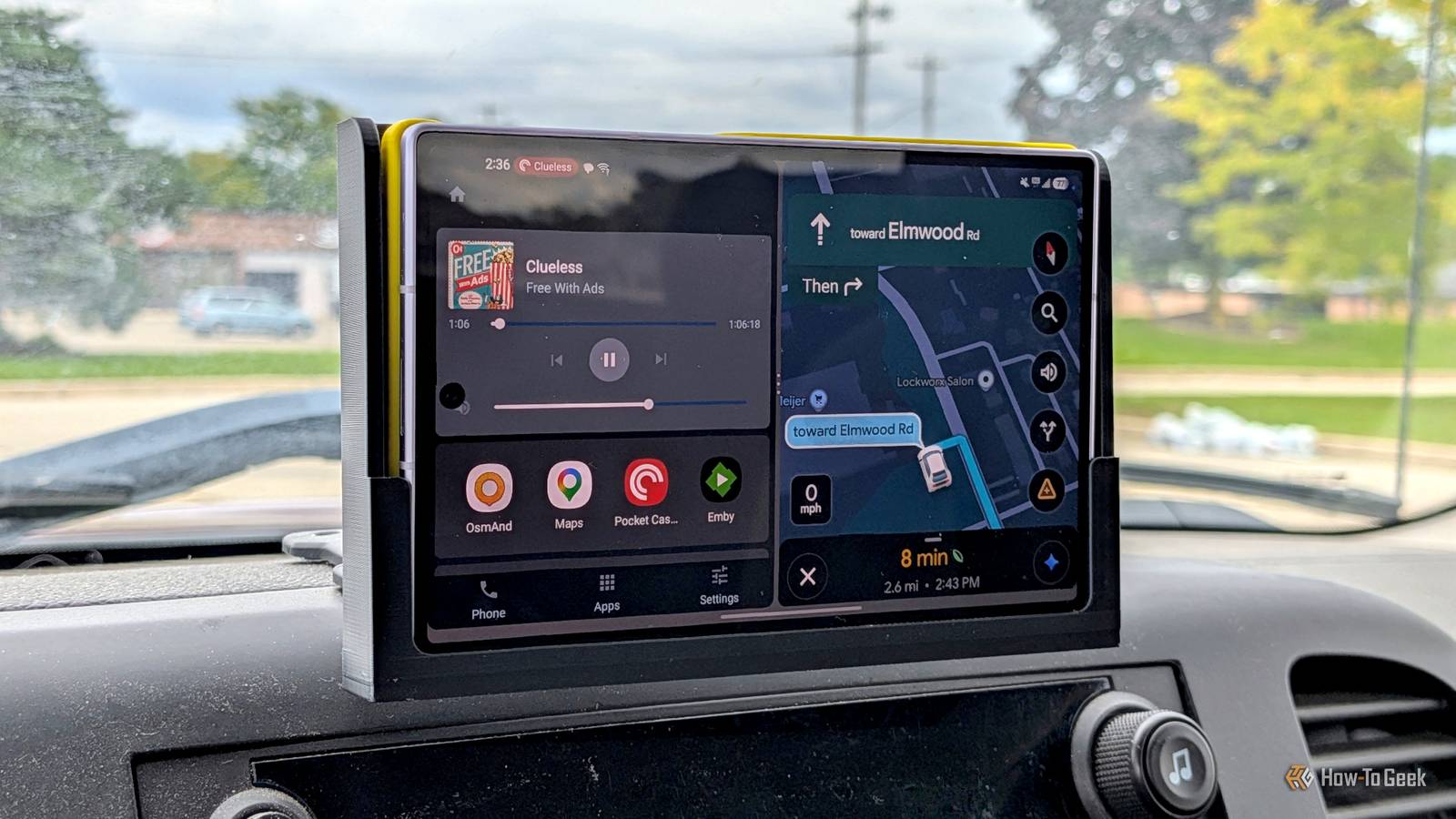
Some of us are still driving around in vehicles without fancy infotainment displays.There are several methods for bringing Android Auto into a car, but what if you just want to use your phone? I came up with a way to optimize my phone for the car without custom launchers or emulators.This was not my first attempt at using my phone as an Android Auto display.
However, recent changes caused me to reevaluate my previous setup.The good news is, I believe I now have something that works a bit better and more reliably.Before I get too far, I want to mention that I used Samsung's Modes & Routines app for this project.
It's only available on Galaxy devices.You may be able to replicate the process with third-party automation apps.Android 17 broke a cool Android Auto hack It's not as seamless anymore In the past, I've written about using an old tablet as a wireless Android Auto head unit and a phone itself as an all-in-one solution.
Both of these projects took advantage of an excellent app called "Open Headunit." The Open Headunit app is essentially an Android Auto emulator.It can receive transmission from a secondary device, like the display in a vehicle, or run Android Auto directly from the phone it's installed on.The latter was how I liked to use it.
I could simply slide my phone into a mount in my car and not worry about keeping some other device charged up.The thing that made this method even better was the easy automation.I could configure Open Headunit to automatically open into "Self" mode, and select the Bluetooth audio receiver in my car as the "trigger" to automatically open the app.
It was a very smooth, hands-off experience.Close Unfortunately, Android 17 — Android Auto 17.4 and newer, more specifically, added an extra layer in this process.Now, you have to enable the developer menu in Android Auto and manually start the headunit server.
Every so often, you have to re-enable this, and sometimes it prevents Android Auto from starting.Again, this only applies to "Self" mode — connecting a secondary device hasn't changed.It's a friction point that I don't want to deal with.
So, I set out to find a better solution.Related How I gave my old Android tablet a second life as an Android Auto display My old Amazon Fire tablet is a car display.Posts 9 By Joe Fedewa Harnessing Samsung's automation tools for the road You can do this on other phones, but it won't be as easy My first thought was to use a home screen launcher specifically made for head units.
Open Launcher is one of the nicest I've found.This would give me an Android Auto-like experience without the trouble of running an emulator.It was a good solution — until I opened an app.
The problem is, the launcher approach only really works if it's set as the default.Otherwise, I'll be bumbling around with the driving-unfriendly Android phone interface as soon as I open maps or a media app.Swapping default launchers every time I drive is far more cumbersome than starting the headunit server.
So, I had to take a different approach.As I mentioned, this heavily relies on Samsung's excellent Modes & Routines app.I believe you could accomplish something similar with MacroDroid, Automate, or Tasker, but it would not be as easy.
Here's what I came up with.First, when my Galaxy phone connects to the Bluetooth audio receiver in my car, it opens a car-friendly launcher called Dashline and enables reading notifications aloud for Google Messages.I chose Dashline for two reasons: it has a big media player with controls, and I was able to customize it to work well in portrait mode.
The latter is important for the next part.Dashline is configured with shortcuts to the apps I use while driving.I created routines that automatically put those apps and a few others into a split-screen app pair when they're opened while the Bluetooth device is connected.
This is how I got around the default home screen problem.Close The result of all these routines running together is a pieced-together Android Auto-like split-screen interface.Dashline automatically opens when I'm in my car, and the app automations ensure that Dashline stays on the screen when I venture out of it.
DIY is the way I'm not going to pretend this is a perfect outcome.Ideally, I'd be able to automate changing the default home screen, but that's not possible without more in-depth methods.Still, I'm pretty proud of the solution I was able to create with the built-in tools on my phone.
Related I built 3 custom MacroDroid automations that Android Auto should offer by default Android Auto's built-in automations are lackluster.Posts 3 By Joe Fedewa
Read More