In the usual GPU release cycle, we're long overdue for a refresh.Nvidia's not released any new graphics cards since the RTX 50-series finished rolling out.Normally, we'd have expected to see the Super refresh at CES 2026 with a launch soon after ...
so, now nearly eight months ago.There have been rumors, whispers, and many thoughts from industry insiders.But as a writer whose career is built around covering the GPU market, I'll say this: I don't think we're ever getting the RTX 50 Super, regardless of whether those cards are ready or not.
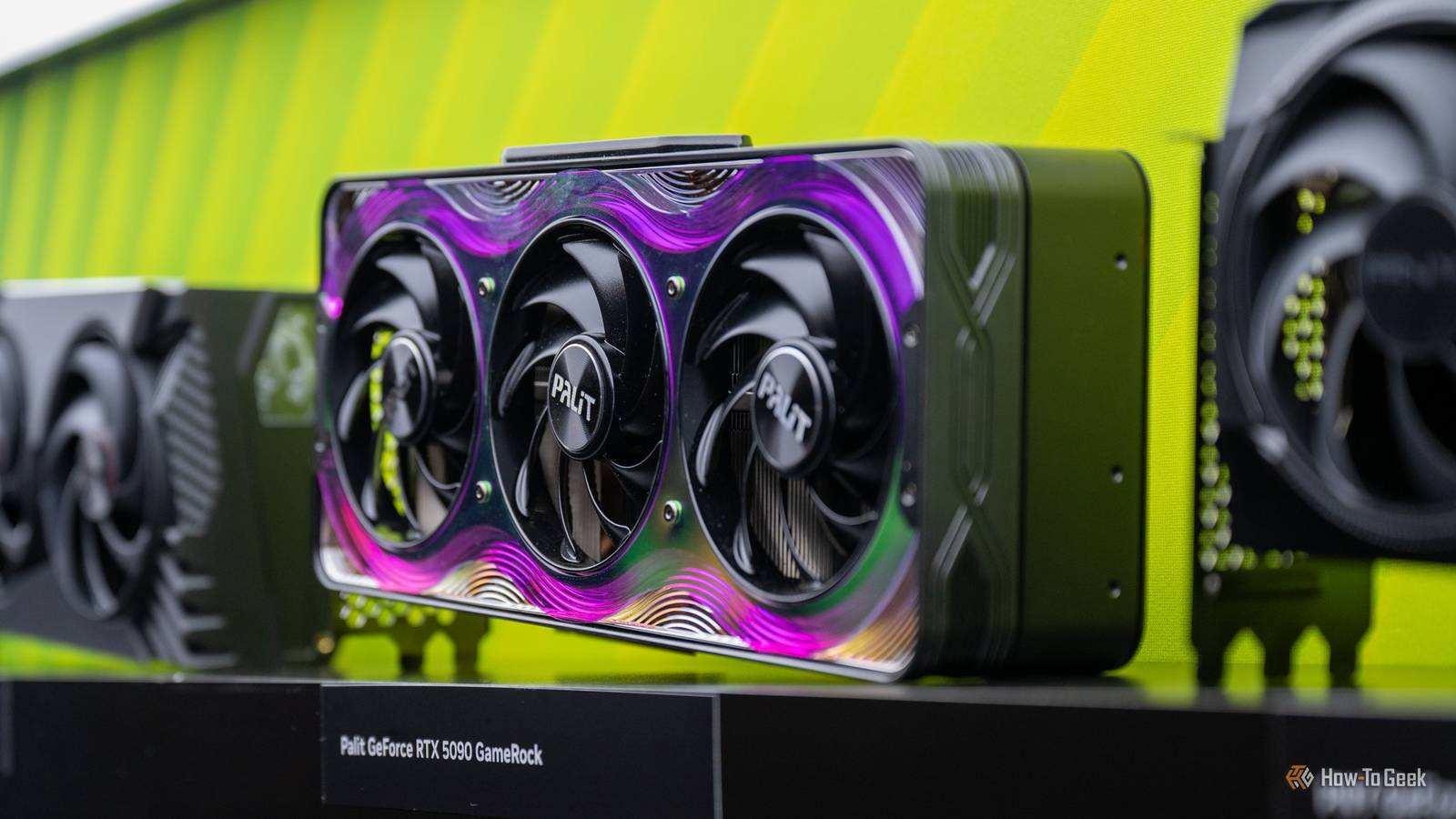
The Super series isn't exactly canceled But it is stranded Close The RTX 50-series debuted at CES 2025, which may not feel like long ago, but in Nvidia's recent GPU cycle, it is quite long ago.And yet, we haven't had any new GPUs to fill the gap between one generation and the next.The strangest part here is that the GPUs appear to exist.
Recent reporting from VideoCardz speculates that at least one Nvidia board partner has the physical RTX 50 Super graphics cards in hand, which is roughly as finished as a product gets without a launch date attached.Nvidia has reportedly told its board partners to sit on their hands and wait for now.No revised schedule appears to have been shared.
Now, I know that this isn't confirmed, and I don't want you to treat it as such.But it does fit the larger picture.Three GPUs are supposedly stuck in limbo; three cards we thought we'd get.
The RTX 5070 Super with 18GB, and the RTX 5070 Ti Super plus the RTX 5080 Super, both with 24GB of VRAM each.That's huge, and that's thanks to using 3GB memory modules as opposed to the 2GB being used in the non-Super RTX 50.In a way, putting these cards on an indefinite hold is worse than just cancelling them.
Board partners can't reallocate cooler inventory or PCB tooling to something else while they're waiting for a green light that may never come.Quiz 8 Questions · Test Your KnowledgeGPUs: Past to present and beyondTrivia challengeFrom early framebuffers to AI-powered rendering — how well do you really know the GPU?HistoryHardwareAI & GPUsPioneersTechnologyBegin 01 / 8HistoryWhich company released the GeForce 256 in 1999, marketing it as the world's first GPU?AAMDBIntelCNVIDIAD3dfxThat's right! NVIDIA coined the term 'GPU' (Graphics Processing Unit) with the release of the GeForce 256 in 1999.It was notable for offloading transform and lighting calculations from the CPU, marking a major shift in how graphics were processed.Not quite — it was NVIDIA that launched the GeForce 256 and trademarked the term 'GPU' in 1999.
This card was a landmark release because it moved transform and lighting calculations off the CPU and onto dedicated graphics hardware for the first time.Continue 02 / 8PioneersWhich company produced the Voodoo graphics card, one of the most iconic early 3D accelerators of the 1990s?AS3 GraphicsBMatroxCATID3dfx InteractiveCorrect! 3dfx Interactive's Voodoo cards dominated 3D gaming in the mid-to-late 1990s.The original Voodoo released in 1996 was so popular that 'Voodoo' became synonymous with PC gaming performance for several years, before 3dfx was ultimately acquired by NVIDIA in 2000.The correct answer is 3dfx Interactive.Their Voodoo line of 3D accelerator cards were the go-to choice for PC gamers in the mid-to-late 1990s.
3dfx was eventually acquired by NVIDIA in 2000, ending one of the most beloved names in early GPU history.Continue 03 / 8HardwareWhat does VRAM stand for, and what is its primary purpose in a GPU?AVariable Random Access Memory, used to adjust clock speeds dynamicallyBVideo Random Access Memory, used to store image and texture data for renderingCVirtual RAM, used to extend system memory when neededDVoltage Regulated Accessible Memory, used to stabilize power deliveryExactly right! VRAM stands for Video Random Access Memory, and it serves as the GPU's dedicated pool of memory for storing textures, frame buffers, and other rendering data.More VRAM generally allows higher resolutions and more detailed textures without performance penalties.The correct answer is B.VRAM stands for Video Random Access Memory, and it's the GPU's own dedicated memory used to hold textures, frame buffers, and rendering data.
Having more VRAM is especially important for gaming at high resolutions or with demanding texture packs.Continue 04 / 8TechnologyWhat is ray tracing in the context of modern GPU rendering?AA method of upscaling lower-resolution images using AI algorithmsBA technique that traces the path of light rays to simulate realistic reflections, shadows, and lightingCA process that reduces aliasing on the edges of rendered polygonsDA compression method used to reduce the size of textures stored in VRAMSpot on! Ray tracing simulates how light physically behaves by tracing the path of individual rays as they bounce around a scene.This produces highly realistic reflections, shadows, and global illumination, though it's computationally expensive — which is why dedicated RT cores on modern GPUs are such a big deal.Not quite — ray tracing is a rendering technique that simulates the physical behavior of light by tracing rays through a scene.It creates strikingly realistic reflections, shadows, and ambient lighting.
Modern GPUs from NVIDIA and AMD include dedicated hardware cores specifically designed to accelerate ray tracing calculations.Continue 05 / 8AI & GPUsWhat is NVIDIA's DLSS technology, and what AI technique does it primarily rely on?ADeep Learning Super Sampling — it uses AI to upscale lower-resolution frames to a higher resolutionBDynamic Lighting Shader System — it uses machine learning to improve shadow renderingCDirect Load Streaming Service — it uses AI to preload game assets fasterDDedicated Latency Suppression Software — it reduces input lag using neural networksCorrect! DLSS stands for Deep Learning Super Sampling.It renders frames at a lower internal resolution and then uses a trained AI model running on Tensor Cores to intelligently upscale the image, producing near-native quality visuals with significantly better frame rates.The right answer is A.DLSS stands for Deep Learning Super Sampling.
NVIDIA's technology renders games at a lower resolution and uses AI — specifically trained neural networks running on dedicated Tensor Cores — to upscale the image.The result is better performance without a dramatic loss in visual quality.Continue 06 / 8HistoryIn what decade did GPUs begin to be widely used for general-purpose computing tasks beyond graphics, a practice known as GPGPU?A1980sB1990sC2000sD2010sThat's right! GPGPU (General-Purpose computing on Graphics Processing Units) became a serious field in the 2000s.NVIDIA's launch of the CUDA platform in 2006 was a watershed moment, allowing developers to harness GPU parallelism for scientific computing, simulations, and eventually AI workloads.The correct answer is the 2000s.
While GPUs existed before then purely for graphics, the concept of using them for general computing — known as GPGPU — gained real traction in the mid-2000s.NVIDIA's CUDA platform, released in 2006, was instrumental in opening up GPUs for tasks like scientific research, physics simulations, and AI training.Continue 07 / 8HardwareWhat interface do modern discrete GPUs primarily use to connect to a motherboard?AAGP (Accelerated Graphics Port)BPCIe (Peripheral Component Interconnect Express)CISA (Industry Standard Architecture)DUSB4Correct! PCIe (Peripheral Component Interconnect Express) has been the standard interface for discrete GPUs since the mid-2000s, replacing AGP.Modern high-end GPUs typically use PCIe x16 slots, with PCIe 4.0 and 5.0 offering substantial bandwidth improvements over earlier generations.The answer is PCIe (Peripheral Component Interconnect Express).
AGP was the predecessor that was common through the early 2000s, but PCIe took over around 2004 and has been the dominant standard ever since.Today's GPUs use PCIe 4.0 or 5.0 slots, which provide massive bandwidth to keep up with ever-growing GPU performance demands.Continue 08 / 8AI & GPUsWhich of the following best describes AMD's answer to NVIDIA's DLSS upscaling technology?AFreeSync — an adaptive sync technology that eliminates screen tearingBFSR (FidelityFX Super Resolution) — an upscaling technique that works across a wider range of hardwareCSAM (Smart Access Memory) — a feature that gives the CPU full access to GPU VRAMDRSR (Radeon Super Resolution) — a driver-level sharpening filter applied after renderingWell done! AMD's FSR, or FidelityFX Super Resolution, is their upscaling technology designed to compete with NVIDIA's DLSS.A key differentiator is that FSR is open-source and hardware-agnostic, meaning it works on GPUs from AMD, NVIDIA, and even Intel — making it far more accessible than DLSS, which requires NVIDIA Tensor Cores.The correct answer is FSR (FidelityFX Super Resolution).
AMD developed FSR as their competitive response to NVIDIA's DLSS.One of its biggest advantages is that it's open-source and not limited to AMD hardware — unlike DLSS, FSR can run on GPUs from NVIDIA and Intel too, making it a more universally accessible upscaling solution.See My Score Challenge CompleteYour Score/ 8Thanks for playing!Try Again The VRAM problem The RAM-pocalypse isn't just our problem If all of this is true and Nvidia is indeed holding out on us, the reason is most likely that the RAM-pocalypse is still going strong.Strong as ever, even.
The whole appeal of the Super refresh is that it's supposed to be cheaper to build.The architecture doesn't change, and the improvements are slight.But this time around, swapping 2GB modules for 3GB ones bumps capacity by 50% without widening the memory bus, adding modules, or redesigning the board.
Sounds amazing, right? Except those 3GB memory modules are a pipe dream right now.The aforementioned VideoCardz report reveals that a 3GB GDDR7 VRAM chip costs between $60 and $70, versus $20 for the 2GB parts already in use.This means that eight 3GB modules on a 24GB RTX 5080 Super works out to somewhere around $480 to $560 in memory alone, versus about $160 for the same card's worth of 2GB chips, and that's before the die, the board, the cooler, the margins ...
you get it.Plus, those same 3GB modules are making bank in RTX Pro Blackwell and Rubin CPX products, and those sell at much higher margins.Related Nvidia quietly moved the legendary GTX 1080 Ti and 4 other classic GPUs to legacy status 5 iconic Nvidia GPUs you must replace now that official driver support is dead Posts 6 By Monica J.
White If Nvidia went ahead with it now, would we even want it? The market isn't exactly welcoming Let's say Nvidia said "hold my beer" and told its board partners to go right ahead.Would we even want these GPUs, though? The increase in VRAM is huge.Enormous, even.
But at what cost? GPU prices have just gone up yet again.We're seeing the RTX 5090 sell for $4,000-$5,000, and that's been the case for months now.The RTX 5080 doesn't drop below $1,200, and after price hikes, we may see models close to $2,000.
The Asus ROG Astral RTX 5080 OC actually retails for $2,099.99 at Best Buy.Add to that increased memory costs, and the RTX 5080 Super might launch with an actual MSRP of, I don't know, $1,800? Close to the RTX 5090, anyway.Who's going to buy that? I wouldn't.
Nvidia made it clear how important gaming is Well, kind of If you want to know where GeForce sits in Nvidia's priorities, skip the rumors and have a little peek at the Q1 FY2027 earnings release.(Not a typo -- Nvidia's fiscal year runs ahead of the calendar year, so its fiscal 2027 started in late January 2026.) It appears that Gaming isn't even its own segment anymore; it's been folded into Edge Computing, alongside workstations, robotics, automotive, game consoles, and AI-RAN base stations.The quarter before that, Gaming and AI PC were still their own line.
Nvidia posted $81.6 billion in revenue for the quarter, and $75.2 billion of that came from the Data Center segment, leaving a mere $6.4 billion for all Edge Computing combined.You can't blame Nvidia for being less inclined to care about us poor gamers when the fat profits are definitely elsewhere right now.The argument against my own position If the RTX 60-series is years away, does it help to kill the Super? Let's play devil's advocate here.
Do I think it's impossible that Nvidia will launch the RTX 50 Super? Not entirely.The RTX 60 series is reportedly not coming until 2028, potentially, which leaves a long gap.Launching the 50 Super, even in a limited capacity, would help tide us over until better days (read: until VRAM doesn't cost a bazillion dollars per module).
Unless Nvidia is truly okay with not launching any new hardware for the consumer segment for up to three years, we might still see the RTX 50 Super.The question is, will it even succeed if it does launch? The refresh we wanted would've crashed and burned in this market The RTX 50 Super, at current pricing, would just be more of the same.They'd be GPUs many gamers want, but few can justify actually buying.
With the RTX 5070 Ti selling for around $1,000-$1,100, close to the MSRP of the RTX 5080, gamers are left with budget cards or overpriced cards.The RTX 50 Super would just give us more of the latter; hardly the hero we all need right now.Intel Arc B580 Memory Clock Speed 2,760MHz Graphics RAM Size 12GB If you're desperate for a GPU that's actually decent value, shop Intel.
Yes, I'm serious.$370 at Amazon $310 at Newegg Expand Collapse
Read More