The single-board computing market is shifting rapidly, and we are moving into an era of unprecedented possibilities where edge AI, computer vision, real-time control, and rich sensor streams converge locally.Yes, it’s exciting – but even amidst this “explosion” of hardware, an age-old rule holds true: define what you want to build before picking your tool.No single board can (nor should!) excel at everything.
A low-power embedded sensor, an autonomous robot, and a high-throughput video server all demand different architectures.For example, if you are weighing hardware choices for a general-purpose Linux setup versus a hybrid microcontroller, read this in-depth review to evaluate how different design philosophies match your requirements.In concrete terms, it’s great to get a sense of what each board can do – and even better if you can look at a variety of cool projects at the same time! So here is a selection of what we are seeing developers build across key domains with the Arduino UNO Q board, leveraging its dual-brain to bridge high-level AI workloads with deterministic physical control. Dive into perception-driven robotics Robotics excels on hybrid platforms because physical movement requires tight, real-time microcontroller timing while visual recognition requires heavy AI processing.
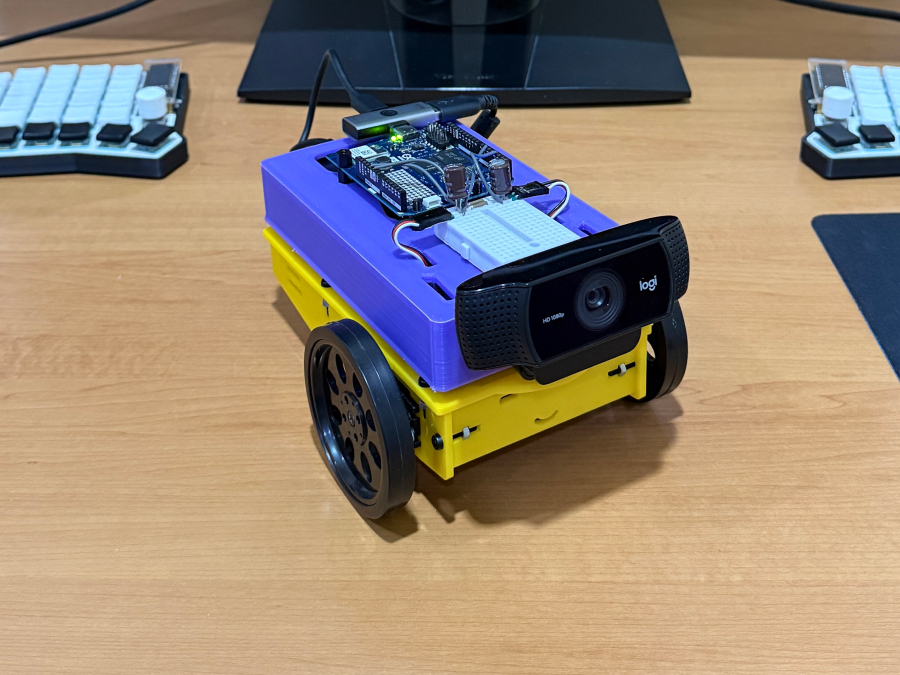
A robot arm that sees you: Uses camera vision designed to recognize people and a robotic arm built to deliver items, with a Modulino LED Matrix providing visual feedback.UNO Q Braccio: Integrates Edge Impulse AI and ROS 2 in a platform engineered to support robotic arm control, including simulation in Gazebo.Face-following robot: Uses Edge Impulse computer vision designed to track faces and convert tracking data into physical servo movements.
AI agent robot: Uses a local AI agent built to support physical navigation and decision-making tasks in real-world environments.Explore the world through computer vision and spatial sensing Instead of just streaming video, local machine learning turns cameras and sensors into environmental perception engines.Gesture-controlled input system: Uses a standard webcam and Edge Impulse in a workflow built to convert hand gestures into inputs for digital applications.
Real-time LiDAR room mapper: Pairs LiDAR sensors with Edge Impulse ML in a system engineered to help interpret spatial data and interpret room layouts locally.Create smart environments with interactive AI Local AI allows devices to run full “sense, interpret, decide, act” loops without relying on cloud latency or external servers.Talk to your house: An all-in-one smart home hub engineered to support wake-word detection, voice commands, sensor management, and a web interface.
Clawrophyll: A smart houseplant system designed to run a local AI agent directly on the board.We don’t need every platform to do the same thing The technological landscape is expanding, giving us more tools to build with: the goal was never to find one ultimate board “to rule them all”, but to match your project’s unique demands to the right architecture.Whether you need a raw Linux computing hub or a dual-brain setup like UNO Q, starting with a clear target can help you build smarter, faster, and more effectively.
Today, we have more options, more possibilities – and this may ultimately be the most exciting part in the current era of single-board computing.UNO Q is available on the Arduino Store, and can be ordered from DigiKey, Farnell, Mouser, Newark, RS Components, Robu.in, and other authorized distributors and resellers worldwide.
Read More