We’re starting with material distribution news in this weekend’s 3D Printing News Briefs, and then on to outer space.We’ll end with a story about an ancient board game.Read on for all the details! 6K Additive Names AMPERE Alloys as New European Distributor 6K Additive’s UniMelt enables the sustainable manufacture of high-performance metal powders, now more readily available to European manufacturers through AMPERE Alloys.
U.S.company 6K Additive produces high-performance, sustainable metal powders for additive manufacturing (AM), including refractory metals, titanium, and nickel-based superalloys.It recently announced that it’s appointed AMPERE Alloys as an official distributor of its powders for the European market.
AMPERE is a premier European specialist in metals and ferro-alloys for industrial applications, and by partnering with 6K Additive, it will expand its product offering.European manufacturers will enjoy direct, streamlined access to 6K Additive’s suite of metal AM powders, which are made using the company’s proprietary UniMelt microwave plasma production system.AMPERE brings to the table its regional expertise, extensive distribution logistics, and strong commercial network, and its commitment to quality system management makes the specialist a great fit for 6K Additive’s technology.
Per the agreement, AMPERE Alloys will handle powder sales, localized distribution, and first-line technical support from its 12 European warehouses.“Expanding our footprint into Europe requires a partner that shares our uncompromising dedication to quality, regulatory compliance, and customer satisfaction.AMPERE Alloys is the ideal partner to champion our sustainable metal powders in Europe.
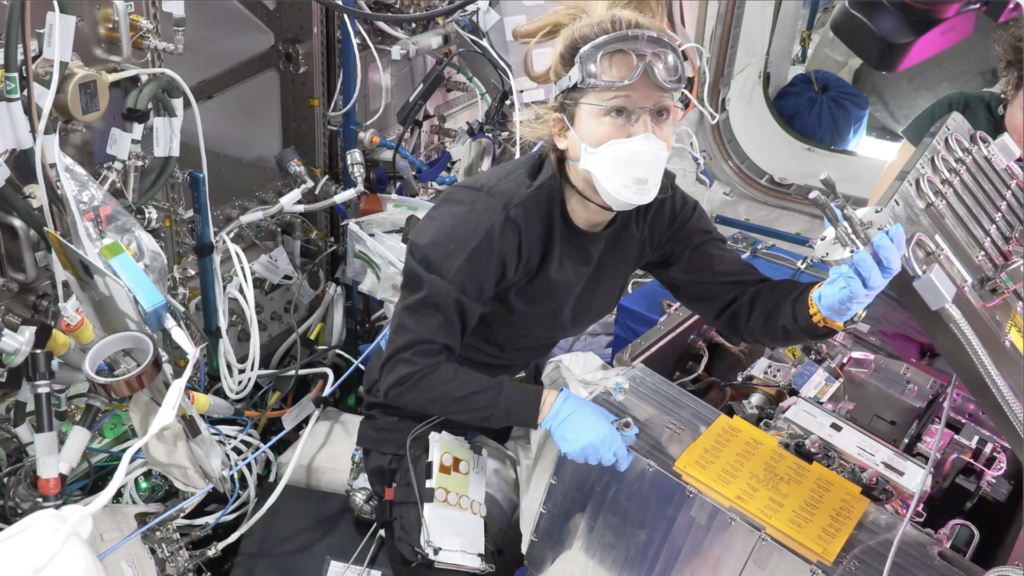
Their established logistical network and technical expertise will ensure that aerospace, defense, medical, and energy customers across the continent can rapidly integrate our premium materials into their production workflows,” said 6K Additive CEO Frank Roberts.ESA’s Metal 3D Printer Technology Demonstrator Produces 5th Sample ESA astronaut Sophie Adenot showing the fifth printed sample to the ground teams during the activity.ESA/NASA In 2024, the first metal 3D printer in orbit, ESA’s Metal 3D Printer Technology Demonstrator, was launched to the International Space Station.
Now, the fifth sample has been produced on that printer, and retrieved during the Epsilon mission by ESA astronaut Sophie Adenot.On long missions, it’s impractical to carry large amounts of spare parts, and resupply is not always possible, so that’s why onboard 3D printing could be useful here.By working with the Demonstrator, astronauts gain important experience, and better understand the potential of metal 3D printing in space.
Each print that’s completed on the ISS focuses on a different aspect of the technology’s performance and capability, and three metal 3D printed samples have already been sent back to Earth to be analyzed at ESTEC and the Technical University of Denmark.Those results will be published soon.As for the fifth sample, it was sent back to Earth on board the CRS SpX-34 spacecraft and will also be tested.
“3D printers are far from being simple gadgets and I’m delighted to have worked on this European technology demonstration for the future of human spaceflight,” said Adenot.“Congratulations to everyone involved and thank you to the CADMOS User Support Centre teams who guided me throughout the process!” Ancient Board Game Brought Back to Life with 3D Scanning and Printing The 3D printed board based on scans of the original game board discovered at Vindolanda.Image: Newcastle University In 2019, a stone board was excavated at an archaeological site in England called Vindolanda, a Roman frontier fort and town that was occupied between about 85 C.E.
and 200 C.E.It was split into five pieces, and while it was later used as a flagstone, the artifact was originally a popular board game called Ludus Latrunculorum.It was found outside the fort, which suggests that women and children played it too, and not just the soldiers.
If you’re interested in playing the strategy game, you just need to visit the Roman Army Museum! Researchers at Newcastle University used a handheld Artec 3D Spider to scan each piece and create a virtual 3D model, before 3D printing a playable replica of the game out of PLA.“It was amazing to be involved in the actual scanning process and to see something so complex and historical be realistically recreated.It will be very beneficial for the Vindolanda Trust to have a replica Roman game board and 3D interactive model, both whilst the original Roman board is on loan and to create a more engaging, tactile experience for the visitor,” said Sophie Westlake, the activity and diversity officer of the Vindolanda Trust.
There’s not an existing set of rules for Ludus Latrunculorum, but historical descriptions make researchers believe that it’s similar to checkers, with two players attempting to capture their opponents’ pieces by trapping them in between their own pieces.Subscribe to Our Email Newsletter Stay up-to-date on all the latest news from the 3D printing industry and receive information and offers from third party vendors.Print Services Upload your 3D Models and get them printed quickly and efficiently.
Powered by FacFox Powered by 3D Systems Powered by Craftcloud Powered by First Mold Powered by Xometry 3DPrinting Business Directory 3DPrinting Business Directory
Read More