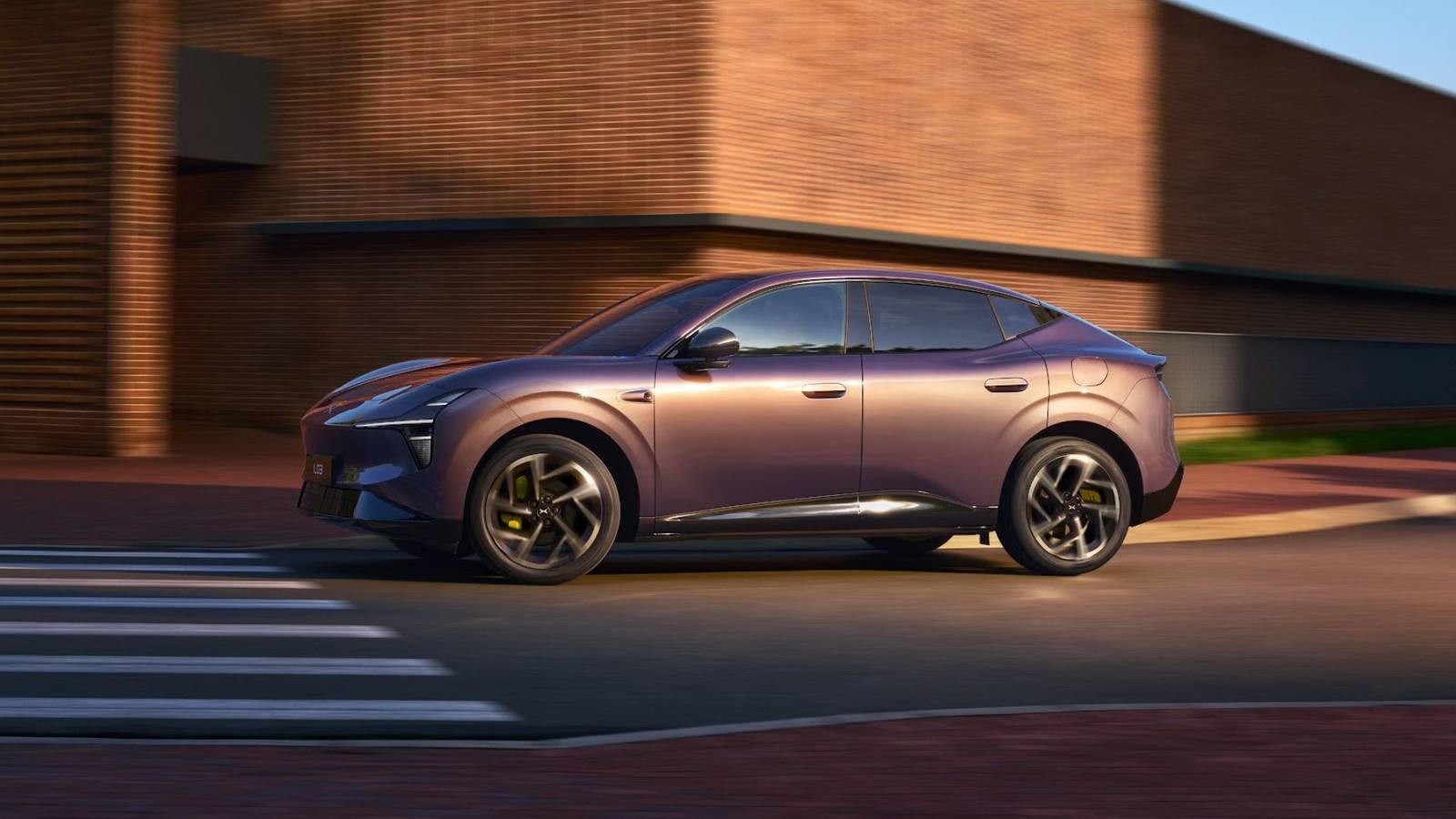
When XPENG invited me to Munich for the global debut of the L03, I expected to see another electric SUV launch.Instead, I found myself looking at a company trying to redefine what a car can be, with AI-powered vehicles, robots, robotaxis, and flying machines all part of the same plan.The L03 is XPENG’s most globally focused vehicle yet, combining a sleek SUV coupe design, premium interior, and advanced driver assistance technology into one package.
But after spending time with XPENG in China earlier this year and seeing its latest developments in Europe, I came away feeling that the L03 is only one part of a much larger strategy.For readers in the US, there is one important caveat: XPENG still doesn’t sell vehicles there, although Canada could eventually be a more realistic opportunity.Even so, what I saw in Munich showed why the company is worth watching as the automotive industry moves toward an AI-driven future.
XPENG covered the cost of travel, accommodation, and meals for this trip.As always, editorial decisions—including the opinions expressed in this article—remain entirely my own.Related I went to China with EV brand XPENG, and the tech blew my mind XPENG flew me out to China for four days, and what I saw—flying cars, a humanoid robot, and self-driving tech—completely changed my thinking.
Posts By Adam Gray The L03 could be XPENG’s most important car yet A stylish EV designed to take XPENG mainstream The L03 is the car XPENG hopes will introduce more buyers to the brand.Unlike some of the company’s more premium models, this is designed as a mainstream global vehicle, combining the practicality of an SUV with the sportier shape of a coupe.Designed under the leadership of former Ferrari exterior design chief JuanMa Lopez, the L03 has a low, wide stance, frameless doors, and a fastback silhouette that gives it a more premium look than many EVs in this price range.
Its 0.228 drag coefficient is also impressive, helping improve efficiency without sacrificing the SUV proportions buyers want.Seeing the L03 in person, I was struck by how polished the design felt.It doesn’t feel like a tech demo on wheels—it feels like a vehicle designed to compete directly with established global brands.
Inside, XPENG has focused on creating a cabin that feels more premium than its price point suggests.The L03 combines lounge-style seating with a 15.6-inch central display, head-up display, ambient lighting, intelligent climate control, and plenty of practical storage.XPENG claims the L03 offers 37 storage spaces, generous cargo capacity, and up to 3,300 lbs of towing capability.
Those details show the company understands that technology alone won’t sell cars—buyers still need something practical enough for everyday life.Related The Best Luxury SUVs With Innovative Tech Features for the Price We've handpicked the best 2025 luxury SUVs that blend cutting-edge tech with premium comfort—without the six-figure price tag.Posts By Adam Gray The L03 turns the cabin into an AI experience XPENG wants your car to feel more like a smart assistant Close The biggest difference between the L03 and many traditional SUVs becomes obvious when you start interacting with it.
XPENG isn’t just adding more screens and controls—it’s trying to make the vehicle feel like a smarter, more responsive assistant.The centerpiece is XPENG’s new Global Intelligent Cockpit Experience, running on XOS 6.Its upgraded AI voice assistant is designed to understand natural conversation, context, and intent instead of relying on fixed commands.
That means drivers don’t have to remember exact phrases or dig through menus to adjust settings.XPENG says the system can understand requests like making the cabin slightly cooler or opening the window next to the person speaking, using voice recognition to identify who gave the instruction.The L03 is also the first XPENG vehicle outside China to feature the company’s Google Maps integration.
Instead of relying on smartphone mirroring, XPENG is building Google Maps Auto SDK directly into its own navigation system.For drivers, that means access to Google’s mapping technology while staying inside the XPENG interface, including EV route planning, charging information, and navigation features designed around the vehicle.This is where XPENG’s approach starts to become clearer.
The company isn’t competing purely on battery range or horsepower—it believes software and intelligence will become just as important in defining the next generation of vehicles.Related I Won't Buy a New Car Without These 10 Tech Features From advanced safety features to driver assistance features and connectivity, these are the tech features I can't live without.Posts 33 By Adam Gray The real story is XPENG’s AI brain XPENG’s VLA 2.0 is the technology behind the L03’s biggest ambitions While the L03 is the vehicle buyers will see first, XPENG’s biggest ambitions are happening underneath the surface.
The company’s focus is on using AI to create vehicles that can better understand their surroundings and make decisions in the real world.That approach became much clearer when I visited XPENG’s headquarters in China earlier this year.What stood out was that XPENG wasn’t talking about AI as a single feature—it was building its vehicles around the idea that software would define the next stage of mobility.
At the Munich event, XPENG highlighted the latest progress with its VLA 2.0 system, the next generation of its intelligent driving technology.The goal is to move beyond traditional driver assistance systems and create AI that can better understand complex real-world situations and respond more naturally.XPENG says VLA 2.0 has already been deployed in China, where it handled more than half of all driving mileage on equipped vehicles within its first month.
Testing in Munich showed the system adapting to European road conditions, including pedestrian behavior, road signs, roundabouts, and the unpredictable situations that challenge autonomous driving systems.For drivers outside China, there is still a wait.XPENG says global deployment is planned for 2027, but regulators will ultimately decide how quickly these advanced driving features can reach customers.
Related 10 Most Technologically Advanced Vehicles In 2025 From AI to autonomy, sustainability to futuristic tech, these are the 10 most technologically advanced vehicles of 2025.Posts By Adam Gray XPENG’s AI is the real story behind the L03 XPENG sees the L03 as part of a much bigger AI strategy The L03 is just one part of XPENG’s wider Physical AI strategy, which connects its vehicles with the company’s work on autonomous driving, robotics, and future mobility.During the Munich event, XPENG focused heavily on Physical AI, its vision of using a shared intelligence platform across different types of machines, from passenger vehicles to humanoid robots and flying vehicles.
This is the same approach I saw during my visit to China earlier this year, where XPENG’s headquarters felt less like a traditional car company and more like a technology company that happens to build vehicles.The idea is ambitious: instead of developing separate software for every product, XPENG wants one AI system that can adapt across different machines and environments.For the L03, that means XPENG is using its latest intelligent driving technology to push beyond traditional driver assistance systems.
Its NGP system, powered by VLA 2.0, is designed to interpret complex environments rather than rely only on predefined rules.The big question, especially outside China, is whether regulators and consumers will be ready for these more advanced systems.XPENG believes 2027 will be a key year for overseas deployment, with Europe expected to be among the first major regions to receive its full-stack intelligent driving capabilities.
Related 76% of drivers say luxury badges aren't worth it anymore—here's what they want instead Respondents prioritized financial security over a fancy new car.Posts By Carl Anthony XPENG’s self-driving tech is the part I can’t stop thinking about NGP (VLA 2.0) is the XPENG technology I can’t stop thinking about One of the biggest reasons XPENG has caught my attention isn’t the L03 itself—it’s what happens when you experience the company’s intelligent driving technology.NGP, powered by VLA 2.0, is the system that gave me the clearest idea of what XPENG is trying to build.
I got an early look at what XPENG’s AI could do during my China trip earlier this year, when I spent around 45 minutes in a P7 Ultra navigating Beijing traffic with the system engaged.What surprised me wasn’t that the car could drive itself—it was how natural the experience felt.The car handled dense traffic, roadworks, cyclists, scooters, lane changes, and unpredictable drivers without feeling nervous or overly robotic.
The experience felt less like testing an advanced driver assistance system and more like sitting in a car being driven by someone calm and confident.That experience put XPENG’s Munich announcement into perspective.The company is now testing NGP (VLA 2.0) on European roads, adapting the system for different driving cultures, regulations, and road layouts.
During testing in Munich, XPENG said the system successfully handled scenarios including narrow European streets, construction detours, tight roundabouts, changing road signs, and interactions with vulnerable road users such as pedestrians and cyclists.XPENG’s goal is to begin overseas deployment of the full NGP (VLA 2.0) capability in 2027, once regulatory approvals allow it.The company believes evolving automated-driving frameworks could help accelerate adoption in markets outside China.
What makes XPENG’s approach different is that the company sees this technology as more than a driver assistance feature.VLA 2.0 is intended to become the intelligence layer behind multiple future products, from vehicles to other forms of mobility.The same architecture is also designed to support XPENG’s wider ambitions, including robotaxis, humanoid robots, and flying vehicles.
For me, this is where XPENG starts to feel different from many EV companies.It isn’t just adding AI features to a car—it’s building an AI platform where cars are one of the applications.Related BMW's redesigned 7 Series includes an i7 EV with 447-mile range Neue Klasse design and new tech come to BMW's flagship sedan.
Posts By Jon Fingas XPENG doesn’t just build cars—it’s building an AI ecosystem XPENG’s robots and flying cars show where it wants to go next One of the biggest takeaways from spending time with XPENG is that the company’s ambitions go far beyond the L03.During my visit to China and the Munich launch, the company repeatedly showed how its AI technology could extend into other types of machines.That includes everything from humanoid robots and robotaxis to flying vehicles.
It’s an ambitious vision, but it’s also something I saw first-hand during my visit to XPENG’s headquarters in China earlier this year.The company’s IRON humanoid robot was one of the biggest surprises of that trip.Standing on the showroom floor, interacting with visitors, and moving far more naturally than many people expect from a robot, it felt less like a technology demonstration and more like an early glimpse of XPENG’s future.
XPENG’s argument is that the same AI systems developed for vehicles could eventually help other machines operate in the physical world.That is also where ARIDGE, XPENG’s flying car division, fits into the picture.The company’s “Land Aircraft Carrier” combines a road vehicle with a detachable electric aircraft, allowing the flying module to be transported, stored, and recharged by its carrier vehicle.
I saw the system fly during my China visit, and watching something that looked like a concept vehicle actually take off, maneuver, and land in front of me was one of the most memorable moments of the trip.The technology is still aimed at early adopters rather than everyday transport, and there are obvious hurdles around regulation, infrastructure, and public acceptance.What makes XPENG interesting is that many of these ideas have moved beyond simple concepts.
The company is already testing and manufacturing technologies that go well beyond traditional vehicle development.Related How Automotive Technology Has Evolved Over The Last 10 Years From EVs to AI-driven safety, the past decade has reshaped cars with smarter tech, better efficiency, and groundbreaking innovations.Posts 5 By Tyler Dupont The biggest challenge for XPENG might be convincing the world XPENG’s biggest challenge is turning impressive tech into global success After seeing what XPENG is building, the biggest question isn’t whether the company can create impressive technology.
The bigger challenge is whether it can bring that technology to enough markets and convince buyers outside China that its approach to mobility belongs in their everyday lives.For readers in the US, there is a major limitation: XPENG vehicles are not currently sold there.The company has global ambitions, but North America remains a complicated market because of regulations, trade barriers, and the challenges facing Chinese automakers trying to establish themselves.
Canada could eventually become another opportunity, but for now XPENG’s overseas expansion is focused elsewhere, particularly Europe, the Middle East, and other regions where the company is building a presence.Europe is already becoming a key market for XPENG.The company has opened a dedicated R&D center in Munich and is adapting its vehicles and software for European roads, regulations, and customer expectations.
But launching an AI-focused vehicle globally requires more than simply shipping cars.Advanced driving systems need regulatory approval, and customers need confidence that these technologies are safe, reliable, and genuinely useful.That is especially true for systems like NGP (VLA 2.0) and future autonomous driving features.
The technology may be impressive, but regulators and drivers will ultimately decide how quickly it becomes part of everyday life.The interesting thing is that XPENG appears to understand this challenge.The company is not relying only on range, pricing, or vehicle design—it is trying to differentiate itself through software and AI.
There’s still a long road ahead, especially outside China.Regulations, consumer trust, and proving long-term reliability will matter just as much as the technology itself.But after experiencing XPENG’s system firsthand in China and seeing its European ambitions in Munich, I understand why the company is so confident about where this is heading.
Related How BMW Takes the Fight To Tesla With the New 2026 iX3 BMW has just revealed its all-new 2026 iX3, a sleek electric SUV designed to rival Tesla with cutting-edge tech, bold design, and impressive range.Posts 1 By Tyler Dupont XPENG’s future is bigger than the L03 The L03 is just the beginning of XPENG’s bigger bet on AI The easiest way to look at XPENG is as another automaker trying to expand into new markets.After spending time with the company, I think that misses the bigger picture.
The L03 matters because it gives XPENG a vehicle that can introduce more buyers to the company’s wider technology strategy.But the reason XPENG is interesting goes far beyond one SUV.What stood out to me in China and Munich was how connected everything feels.
The car, the self-driving technology, the robots, and the flying vehicles are not separate experiments—they are all part of the same idea: using AI to create machines that can interact more intelligently with the world around them.That vision is still a long way from being fully realized.There will be regulatory hurdles, safety questions, and plenty of competition from companies with far deeper roots in global markets.
But what I saw in China and Munich reinforced one thing: the capabilities of companies like XPENG are moving faster than many people outside the industry realize.Even if you’re in the US and can’t buy an XPENG today, the technology the company is developing could influence the vehicles, AI systems, and mobility products that eventually reach markets around the world.After seeing the L03 in Munich and experiencing XPENG’s technology first-hand, I came away convinced that the company deserves a closer look.
The future of cars is becoming about far more than transportation, and XPENG is one of the companies pushing that idea forward.
Read More