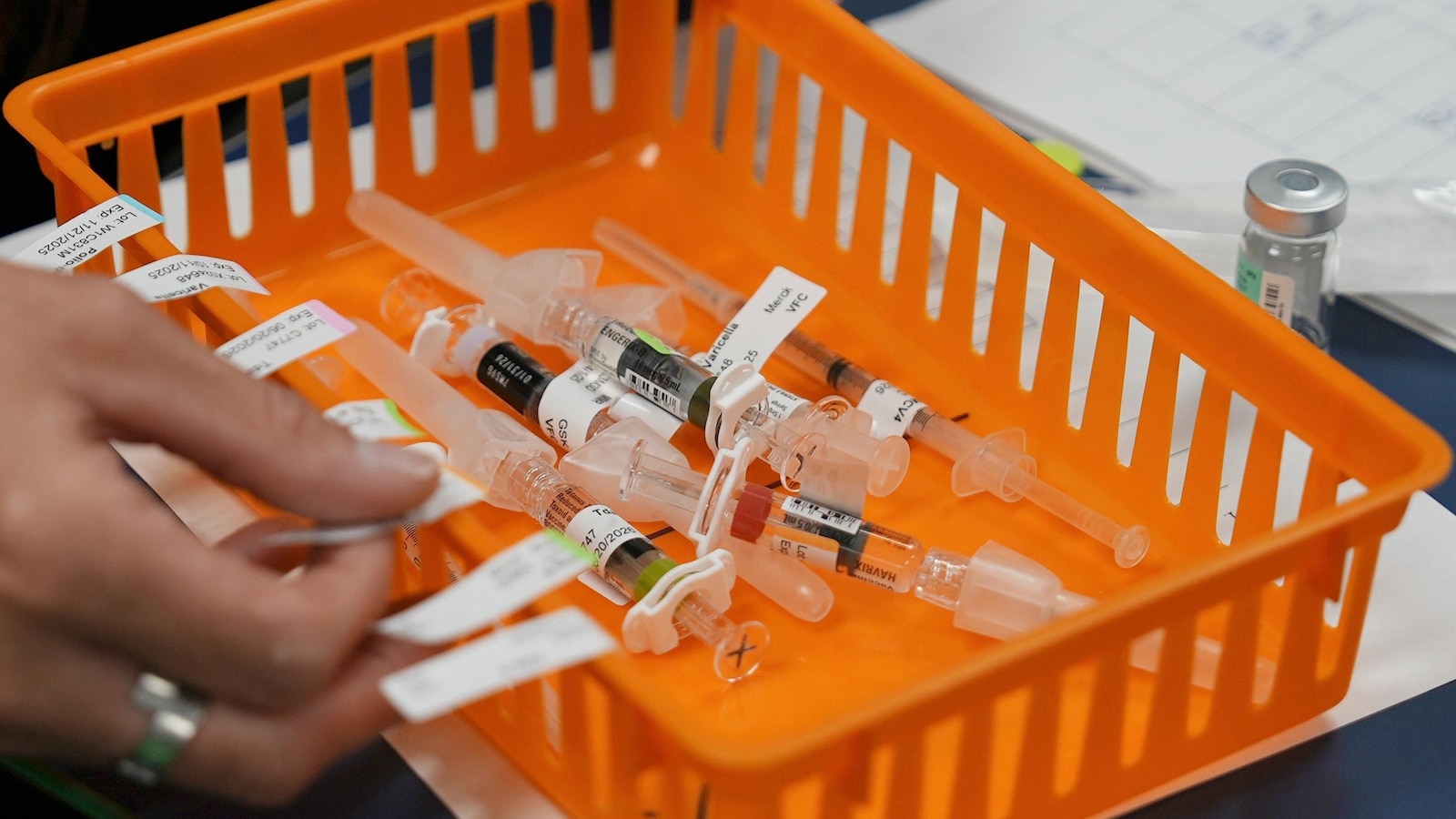
Dr.Molly O’Shea has noticed growing skepticism about vaccines at both of her Michigan pediatric offices and says this week's unprecedented and confusing changes to federal vaccine guidance will only make things worse.One of her offices is in a Democratic area, where more of the parents she sees are opting for alternative schedules that spread out shots.The other is in a Republican area, where some parents have stopped immunizing their children altogether.The phrase, experts say, is confusing and dangerous: “It sends a message to a parent that actually there’s only a rarefied group of people who really need the vaccine,” O’Shea said.
“It’s creating an environment that puts a sense of uncertainty about the value and necessity or importance of the vaccines in that category.”Health Secretary Robert F.Kennedy Jr., who helped lead the anti-vaccine movement for years, said in announcing the changes that they better align the U.S.with peer nations “while strengthening transparency and informed consent.”But doctors say they are sowing doubt — the vaccines have been extensively studied and proven to be safe and effective at shielding kids from nasty diseases — at a time when childhood vaccination rates are already falling and some of those infectious diseases are spreading.On Friday, the American Academy of Pediatrics and more than 200 medical, public health and patient advocacy groups sent a letter to Congress about the new childhood immunization schedule.O’Shea said she and other pediatricians discuss vaccines with parents at every visit where they are given.
But that’s not necessarily “shared clinical decision-making,” which has a particular definition.In this context, health care providers include primary care physicians, specialists, physician assistants, nurse practitioners, registered nurses and pharmacists.Only about 2 in 10 U.S.adults knew that one meaning behind shared decision-making is that “taking the vaccine may not be a good idea for everyone but would benefit some.” And only about one-third realized pharmacists count as health care providers to talk with during the process, even though they frequently administer vaccines.Shortly after the federal announcement Monday, Dr.Steven Abelowitz heard from half a dozen parents.
“It’s causing concern for us, but more importantly, concern for parents with kids, especially young kids, and confusion,” said Abelowitz, founder of Ocean Pediatrics in Orange County, California.Popular ReadsVenezuela live updates: US forces board 5th oil tanker linked to VenezuelaJan 9, 1:28 PMMinneapolis ICE shooting live updates: New video shows different vantage pointJan 10, 4:28 AMFBI releases images of seized motorcycles as search for Ryan Wedding continuesDec 30, 4:51 PMUnder the new guidelines, O'Shea said, parents seeking shots in the shared decision-making category might no longer bring their kids in for a quick, vaccine-only appointment with staff.They'd sit down with a health care provider and discuss the vaccine.And it could be tougher to have a flu clinic, where parents drive up and kids get shots without seeing a doctor.Megan Landry, whose 4-year-old son Zackary is one of O’Shea’s patients, is among them.“It’s my responsibility as a parent to protect my child’s health and well-being,” she said.
“Vaccines are a really effective and well-studied way to do that.”She plans to keep having the same conversations she’s always had with O’Shea before getting vaccines for Zackary.“Relying on evidence and trusted medical guidance really helps me to make those decisions,” she said.“And for me, it’s not just a personal choice for my own son but a way to contribute to the health of everybody.”But for other families, confidence about vaccines is waning as trust in science erodes.O'Shea lamented that parents are getting the message that they can't trust medical experts.“If I take my car to the mechanic, I don’t go do my own research ahead of time," she said.
“I go to a person I trust and I trust them to tell me what’s going on.”Abelowitz, the California doctor, likened the latest federal move to pouring gasoline on a fire of mistrust that was already burning.“We’re worried the fire’s out of control,” he said.“Already we’ve seen that with measles and pertussis, there are increased hospitalizations and even increasing deaths.So the way that I look at it — and my colleagues look at it — we’re basically regressing decades.”___The Associated Press Health and Science Department receives support from the Howard Hughes Medical Institute’s Department of Science Education and the Robert Wood Johnson Foundation.
The AP is solely responsible for all content.