Writer/Director Ric Roman Waugh and VFX Supervisor Marc Massicotte discuss how they depict a shattered Earth’s damage, danger, and rebound from an extinction-level meteor strike, in Lionsgate’s ‘Greenland’ sequel, now in theaters.Not much time had to be spent on the prologue for Lionsgate’s sequel, , now playing in theaters.“Luckily, we weren't making a movie like , where you have to completely invent the rules of who people are and so forth,” explains Ric Roman Waugh, the sci-fi action adventure’s producer and director.
“At least [we have] the mythology, backstory and logic of knowing what would happen to us as a real planet if we were hit by an extinction event, a meteor, asteroid, or comet, and where we would be left.At least you have that to hang onto.If there was an extinction level event that happened on Earth, and you were reduced to bunker life, at least you're not reinventing what the real world is.
You get to start layering in what had happened before.I always felt like the journey of the Garrity family would be a two-part series.It would be getting them to the bunker and then letting the audience know we weren't lying.
The Earth is going to get hit, and it is going to become this cataclysmic event.Then the second movie would pick up afterwards.Now, what would you do to pick up the pieces? What would be the journey, and it would not be just about your life, but the legacy of mankind. How would you carry it forward?” Here's the film’s final trailer: A sense of journey had to be conveyed. “Because of the places that we were going to shoot, we could use as much of the real topography in the United Kingdom as we could and then augment it with set extensions and real set design of how would the Earth rebound after five years of being scorched to the ground,” remarks Waugh. “You start looking at real stuff.
We looked at the fires that happened in Australia.There were ones in Northern California at that time, not the Los Angeles ones.You begin looking at real events of how fast Mother Nature grows back. How long does that evolution take? How do cities become overwhelmed by Mother Nature? What doesn't grow back? You start incorporating these things.
At the end of the first movie, you see the world completely decimated, and there's nothing out there but scorched ground.The idea in this one was that you can see Mother Nature is doing everything it can to rebound back.What I thought was important to show is what we deal with as a modern society.
We use nuclear power for a lot around this world, not just for weapons, but hospitals and all kinds of different things.What happens when the safeguards go away? What happens when electricity doesn't exist anymore and radiation starts leaking? How does that change the foliage? That was one of the things we looked at with Chernobyl.The Red Forest grew from being saturated in radiation.” Much of the film’s visual effects needed to be hidden to make it look as grounded and real as possible.
According to Waugh, “This one was a challenge because there are shots that we're using that are full CG, because you need to create things that are not of this world or where cameras can't go.But you're still trying to give it as grounded a feel as possible.The most important part for me of blending the real world and visual effects is light.
It's how the lighting schemes work and where they can be integrated together.Pioneers like James Cameron are brilliant at that with franchise and .” Ideas were developed through concept art, storyboards, previs and postvis. “It gives you what I call my incubation period,” Waugh says.“It gives you a chance, like storyboards do, where you start thinking about how things are going to go together. And then you're like, ‘But what if we did this or that?’ You get all this incubation time to elevate your creative to a different level before you actually go and start to execute it.” Over a period of four to five months, between 400 and 500 visual effects shots were created. “I usually go for the strength of various vendors,” explains Marc Massicotte, Visual Effects Supervisor, . “The supervisor we worked with at Pixomondo had worked on.
He worked on water simulations. I needed some strength there.Pixomondo had a robust background on doing that at scale.Hybride Technologies is a strong partner with ILM, and I've worked with them in the past.
Hybride is strong at building environments so that was a good fit for the for the trench and passing the channel. The other ones were taking every other little sequence, obviously because you have to consider budgets. Alchemy.24 is a studio that I've worked with for a long time on many projects, and I've always known that they can do a lot of good comps, assembly, environments, and matte paintings.All of those things would go to them.
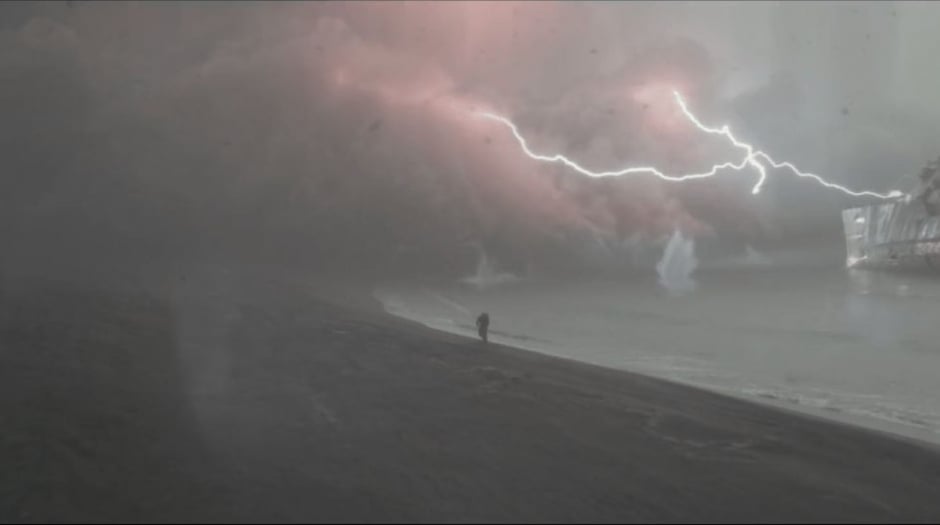
Same thing with Crafty Apes, who did the arrival in England.That was the first time I was working with them; we were supposed to collaborate on the first one, but it didn't work out. I wanted to work with them on the second one.They did a great job overall.” Meteor showers are a constant threat as pieces of the Clarke Comet are being pulled into Earth’s atmosphere. “There was a meteorite that struck over Siberia, and they had multiple cameras on it” recalls Waugh. “You saw people in cars watching it go by and windows being blown out of buildings.
CCTV cameras caught it.You start taking all that real world authenticity, and then you try to give it a cinematic license.How can we play with the same thing? And then also, which was crazy to watch and hear, is the one that went over Siberia.
You heard the sonic boom.You heard it coming into the Earth's atmosphere.You heard the sonic footprint of it as well.
We wanted to give a lot of that to the sequences where they were all hidden in the forest.” The ghost ring was a new addition. “There was an idea for post-impact when Clarke hit the Earth, and all of the ejecta may have gone past the Earth's orbit and gravity pull, but a lot of it would have stayed in, creating this ring,” remarks Massicotte. “This was an idea that I had. With the director, I was like, ‘It would be cool to have this ring, and to constantly have this element of danger for the inhabitants that survived. You constantly have these chunks that would come back into orbit and fall back onto Earth.” “The English Channel is spectacular because that was completely created from scratch,” Waugh notes.“How do you drain the English Channel? How do you create a fissure of the depth of a mini-Grand Canyon? How do you get across it? Dealing with such a massive CG world involved many practical sets.All of the three peninsulas, the England side, the center, and then the French side, those were all practically built onstage, high in the air, so that you can dangle people and let them fall from the ladders down into pits and wind machines. We did all the action practically on those ladders.
Everything was done for real.When people fell, they fell for real.When Nathan almost falls to his death and his dad and mom grab him, that was done for real.
Then you're creating a world around it. I'm proud of how that came out.Hybride, the main visual effects company that did that sequence, knocked it out of the park.They were great to work with on this. I can't wait for people to see that sequence.” Following some real, physical logic was important.
“Obviously, the oceans didn't empty themselves so it’s just a section we show,” says Massicotte. “Through massive quakes, tectonic plates moving around and continents shifting through the impact, we were able to justify that. Sections lifted and probably created water displacement where the channel was emptied. The two geographical masses got closer and through massive earthquakes we got this crevasse.” At first, a sense of danger was lacking.But a solution was found. “I proposed that the inside of the crevasse would be its own microclimate,” reveals Massicotte. “There would be shifts in temperature that would create some kind of fog or cloud.We would see that traveling at high speeds and with the wind. We'd feel it. It worked well.” Destruction of the bunker in Greenland involved a combination of practical and digital effects. “It's definitely a combination [of CG] with Terry Glass and his brilliant special effects team,” explains Massicotte. “I've worked with Terry on several projects.
He's amazing.We always collaborate closely.There’s a handshake of who does what.
We always push and strive to capture as much in camera as possible.We had a shaker floor for the interior of the bunkers, creating all the tremors.A lot of the objects moving and falling were in camera, and then we accentuated and made things a lot more dramatic than they were on the set. Going outside, we also had set extensions that tied up from the bunker sets in England to the sets in Iceland.
We had a limited section that was dressed in Iceland, and then we expanded on that in visual effects to complete the look of the bunker.” Simpler to produce was the Clarke Crater. “We started by always rooting back to what we have on Earth and expanding on that,’ remarks Massicotte. “It was a straightforward matte painting. Alchemy.24 worked with us on that, and they're knowledgeable and proficient at building environments. They built the whole environment through matte paintings, 2.5D projections and with animated elements to give it some life.” The product did benefit from some serendipity.“We have a scene at the beginning of the film when John is traveling outside of the bunkers, and sees a lava field,” states Massicotte. “The lava fields aren't visual effects.
We were lucky enough that there were a lot of eruptions in Iceland.I was flying back and forth between London and Iceland to go and shoot these with the drone teams.We got some good plate footage that we were able to use, and we comped those into the shots.” Two particular sequences were complex to execute. “The escape from Greenland with the lifeboats and the meteor impacts in the forest were quite tough,” observes Massicotte. “Those two were definitely more challenging to accomplish, in terms of always readjusting for scale, for the meteor impacts, and for the escape from Greenland with the lifeboats.
These were definitely technically challenging, just to get them to look correct.” As much as actors get paid for their ability to imagine things, dealing with visual effects can get rather surreal onset. “We all hear the analogy of, ‘I'm staring at a tennis ball trying to be afraid on a greenscreen stage,’” Waugh says.“My job is to create as much realism as possible.And a lot of times, what I'll do, and I've done it on this picture, is bring huge poster boards out with all of the concept art.
When I'm talking to the actors, I have it surrounding us so they can actually envision what is around them, what the world looks like, and what they reacting to; versus just saying, ‘Over here you see, like, the Grand Canyon.’ Or ‘Over here, you think a comet went down.’ We'll show them the concept art in big, large format, so that then they visualize that as best they can.This is why actors get paid. They have to perform to the imagined, but at least you're giving them something to attach to that's real.” Waugh concludes by sharing how the passion for the original film carried over to the sequel.“The first movie was shot in the U.S.
in Atlanta,” he says.“There were a number of people who did go onto the second movie, but there were a lot of brand-new faces with my UK and Icelandic crews, and new cast members.I love that everybody had a tremendous amount of passion to do it right.
You don't do it as a director by yourself.It's about everybody together.It's the sum of all parts.
That was great, the feel and energy of people's love for the first movie, and their efforts to continue and do something prolific with the second one.I hope we pulled it off.But I can tell you, everybody gave it their all, and we're invested in doing it right.” Trevor Hogg is a freelance video editor and writer best known for composing in-depth filmmaker and movie profiles for , , and . The Visual Effects, Practically Speaking, of ‘Gen V’ Season 2 Designing the Grit, Decay and Emotional Impact of ‘The Penguin’ Pixomondo Unveils PXO AKIRA Vehicle Shooting System at CES Watch: Christopher Nolan’s Epic ‘The Odyssey’ Official Trailer Netflix Drops ‘Stranger Things 5’ Series Finale Trailer
Read More