Cloudflare is a great DNS service if you value simplicity and speed, and Cloudflare's infrastructure makes it extremely reliable.However, if you want greater control of your network, that simplicity-first approach can be a bit limiting.In order to save myself time and effort tinkering with a Pi, I swapped my DNS server to another service that offers greater control.
Cloudflare's DNS service is great but limited Cloudflare is popular for a reason Cloudflare is one of the most commonly recommended DNS servers for good reasons.It is fast, the server address (1.1.1.1) is easy to remember, and, thanks to Cloudflare's infrastructure, very reliable.Additionally, Cloudflare offers support for DNS Over HTTPS (DoH), which encrypts your DNS requests so they can't easily be read by your ISP.
Quiz 8 Questions · Test Your KnowledgeFun facts and quirky history of the internetTrivia challengeFrom the first email to the birth of the web — how well do you really know the internet's wildest moments?OriginsMilestonesProtocolsCulturePioneersBegin 01 / 8OriginsWhat was the name of the first operational packet-switching network, widely considered the precursor to the modern internet?AMILNETBCSNETCARPANETDNSFNETThat's right — ARPANET! Funded by the U.S.Department of Defense's Advanced Research Projects Agency, ARPANET sent its first message in 1969.The network pioneered packet-switching technology, which remains the backbone of how data travels across the internet today.Not quite — the answer is ARPANET.
Launched in 1969 with funding from the U.S.Department of Defense, ARPANET was the first network to use packet-switching at scale.MILNET, CSNET, and NSFNET all came later and built upon ARPANET's groundbreaking foundation.Continue 02 / 8MilestonesWhat was the content of the very first message ever sent over ARPANET in 1969?AHELLOBLOCTESTDLOGINCorrect! The first intended message was 'LOGIN', but the system crashed after just two letters — making 'LO' the unintentional first message ever sent over the network.
It's a fittingly quirky beginning for something that would change the world.The answer is actually 'LO' — and it was an accident! Programmers at UCLA were trying to type 'LOGIN' to connect to a system at Stanford, but the receiving computer crashed after just the first two characters.The internet literally crashed on its very first message.Continue 03 / 8PioneersWho is credited with inventing the World Wide Web in 1989?AVint CerfBTim Berners-LeeCBob KahnDMarc AndreessenSpot on! Tim Berners-Lee, a British scientist working at CERN, proposed the World Wide Web in 1989 as a way to share information among researchers.He also created the first web browser and the first website, and he has never sought to profit from his invention.The correct answer is Tim Berners-Lee.
While Vint Cerf and Bob Kahn co-invented the TCP/IP protocols that underpin the internet, and Marc Andreessen later created the influential Mosaic browser, it was Berners-Lee who invented the Web itself — HTML, HTTP, and all — at CERN in 1989.Continue 04 / 8CultureWhat was the first item ever sold on eBay, back in 1995?AA baseball cardBA used laptop computerCA broken laser pointerDA Pez dispenserYou got it! eBay founder Pierre Omidyar listed a broken laser pointer as a test item and was stunned when it sold for $14.83.He even contacted the buyer to confirm they understood it was broken — and the buyer replied that they collected broken laser pointers.A perfect start for the internet's biggest auction site.The first item sold on eBay was actually a broken laser pointer, which fetched $14.83 in 1995.
Founder Pierre Omidyar listed it as a test, fully expecting no one to buy a broken item.The Pez dispenser story is a popular myth that eBay itself once promoted, but it has since been debunked.Continue 05 / 8ProtocolsWhat does the 'HTTP' in a web address stand for?AHypertext Transfer ProtocolBHybrid Text Transmission ProcessCHyperlink and Text Transmission ProtocolDHigh-speed Text Transfer ProgramCorrect! HTTP stands for Hypertext Transfer Protocol, the foundational system that defines how messages are formatted and transmitted across the web.It was designed by Tim Berners-Lee in 1989 and remains the basis for data communication on the World Wide Web today.The correct answer is Hypertext Transfer Protocol.
HTTP is the set of rules governing how web browsers and servers communicate with each other.The 'S' in HTTPS stands for 'Secure', meaning the connection is encrypted using SSL or TLS technology to protect your data.Continue 06 / 8HistoryIn what year was the first ever spam email sent?A1971B1978C1983D1991Well done! The first spam email was sent in 1978 by Gary Thuerk, a marketer at Digital Equipment Corporation.He blasted an unsolicited advertisement to 393 ARPANET users to promote a new computer — and received both angry complaints and actual sales.
The age of spam had officially begun.The first spam email was actually sent in 1978 by Gary Thuerk of Digital Equipment Corporation.He mass-emailed 393 ARPANET users advertising a new product, causing considerable outrage among the network's tight-knit community.Thuerk is sometimes nicknamed the 'Father of Spam' — not exactly a title to be proud of.Continue 07 / 8MilestonesWhich country had the first national top-level domain (ccTLD) ever assigned on the internet?AUnited StatesBJapanCUnited KingdomDIcelandCorrect! The United Kingdom's '.uk' domain was among the very first country-code top-level domains assigned in 1985.
Interestingly, the U.S.already used generic domains like '.edu' and '.gov' rather than a country code, which is why '.us' was rarely adopted domestically.The answer is the United Kingdom, whose '.uk' domain was one of the first country-code top-level domains assigned in 1985.The U.S.
had little need for a '.us' domain since American institutions already used generic domains like '.edu', '.gov', and '.com' from the very beginning.Continue 08 / 8CultureWhat is the name of the very first website ever published, and it is still accessible today?Ainfo.cern.chBwww.w3.orgChome.cern.chDweb.mit.eduExcellent! The world's first website was published at info.cern.ch by Tim Berners-Lee on August 6, 1991.It was a simple page explaining what the World Wide Web was and how to use it.CERN has lovingly restored the original page, and you can still visit it today as a piece of living internet history.The correct answer is info.cern.ch, the address of the very first website ever published, created by Tim Berners-Lee at CERN on August 6, 1991.
The page simply explained what the World Wide Web project was.CERN has preserved and restored it so that anyone curious can visit a genuine piece of internet history right now.See My Score Challenge CompleteYour Score/ 8Thanks for playing!Try Again 1.1.1.2 and 1.1.1.3 give you basic filtering options Cloudflare's most basic DNS server, 1.1.1.1, is a DNS server.You enter a web address, Cloudflare returns the corresponding IP address so that you can connect.
However, there are two other Cloudflare servers that do more.Cloudflare's 1.1.1.2 DNS server will automatically block DNS lookup requests for malicious domains.In practice, that means if you try to connect to a phishing site or a server known to serve malware, you'll just never connect at all.
It doesn't work, since new exploits and new malicious sites are constantly appearing, but when it does work, it stops malware before it even has a chance to infect your PC.1.1.1.3 takes everything that 1.1.1.2 offers and adds a filter that excludes adult content.If you're picking a DNS server that will be used by kids or any public network where you want to restrict the content, it is a pretty good option.
UniFi Dream Router 7 9 Brand Unifi Range 1,750 square feet Wi-Fi Bands 2.4/5/6GHz Ethernet Ports 4 2.5G The Unifi Dream Router 7 is a full-fledged network appliance offering NVR capabilities, fully managed switching,a built-in firewall, VLANs, and more.With four 2.5G Ethernet ports (one with PoE+) and a 10G SFP+ port, the Unifi Dream Router 7 also features dual WAN capabilities should you have two ISP connections.It includes a 64GB microSD card for IP camera storage, but can be upgraded for more storage if needed.
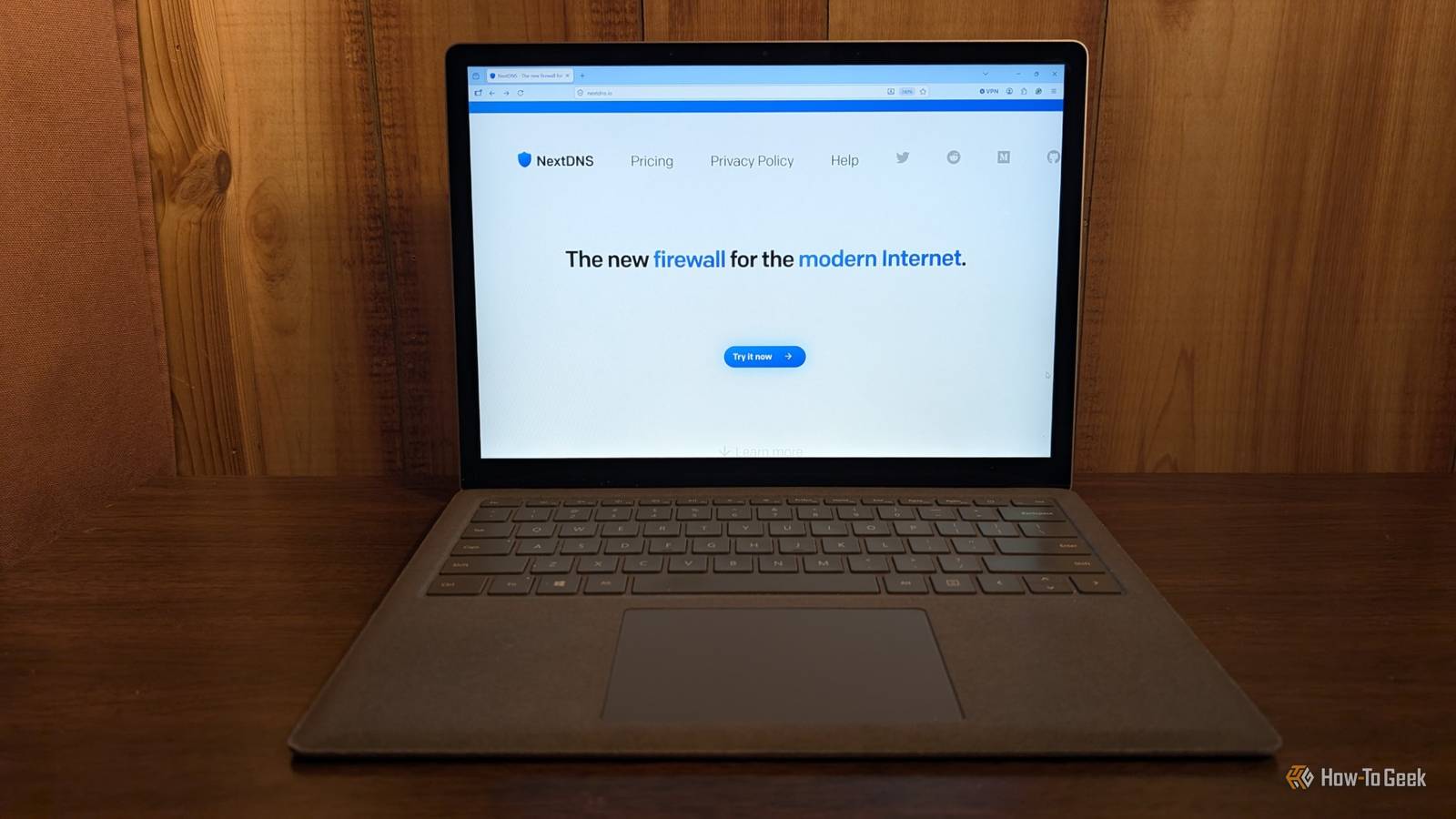
With Wi-Fi 7, you'll be able to reach up to a theoretical 5.7 Gbps network speed when using the 10G SFP+ port, or 2.5 Gbps when using Ethernet. $279 at B&H Photo Video $279 at Unifi Expand Collapse NextDNS takes a different approach to a DNS server A DNS with extra controls NextDNS is a DNS service that, on the surface, does the same basic job as any other DNS service: linking websites to IP addresses.However, it also gives you a very detailed view of the DNS requests coming from your network.You can see what domains are being contacted, how frequently, where the server is located, and which device is sending the DNS request.
That alone is interesting and potentially useful.If you have a program collecting data and sending telemetry, and you don't know it, inspecting your DNS records could make that immediately obvious.From there, you can take action.
You could block the app from accessing the internet using Windows' built-in firewall or uninstall the application entirely.However, NextDNS also gives you the ability to be proactive about your security.Granular DNS control for your entire network You can also configure NextDNS to block content you don't want to allow.
The controls available are flexible; there are 13 different security filters you can apply, including filters that protect you from typosquatting, homograph attacks, cryptojacking, and a general malicious domain list.On the privacy front, you can choose to block trackers, ads, affiliate links, choose from a set of more specific blocklists, or even create your own.If you're using NextDNS as a parental control, the blocklist feature can be used to block specific websites or games, specific categories, apply global safe search, or limit the amount of time a device can be on the internet.
It even has a tool that will block most VPNs, proxies, and TOR.It is a very flexible platform that can increase your privacy, security, and safety, all with a user-friendly interface.NextDNS is free—to a point NextDNS has a free tier that gives you 300,000 DNS lookups per month with all your custom filters applied.
Once you run out of those queries, your custom filters are disabled, and you revert to a basic DNS service.Join the newsletter to take control of DNS privacy Subscribing to the newsletter gives in-depth, practical guides and clear comparisons for DNS decisions, from configuring privacy-focused services to setting granular filters, so you can confidently choose and control services like NextDNS and Cloudflare.Get Updates By subscribing, you agree to receive newsletter and marketing emails, and accept our Terms of Use and Privacy Policy.
You can unsubscribe anytime.NextDNS's unlimited plan costs $2 per month or $20 if you pay yearly, which is pretty reasonable for what you get.You accomplish the same thing NextDNS offers with a Pi-hole, but you'd spend at least $20 on components, and a Pi-hole requires significantly more hands-on management than NextDNS.
Related 7 things I wish I knew before running a Pi-hole Don't be like me, make sure to prepare for these things before deploying Pi-hole the first time.Posts 5 By Patrick Campanale NextDNS is a security package rolled into a DNS server Cloudflare is still a good option if you just need a basic DNS server, but if you want more granular control, NextDNS is hard to beat.The cost of the service is very reasonable, the user interface is easy to understand, and the features are well explained.
If you want more control over your network but don't want to set up a Pi-hole or other DNS-filtering system manually, NextDNS is one of the best options available.
Read More