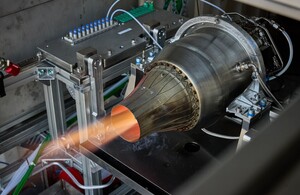
The UK’s Ministry of Defense has worked with Alloyed to develop a 3D printed, UK-made turbojet engine.From idea to testing took seven months.The duo will make a family of turbojets for different platforms.
They now want to scale up engine production and will use over 100 staff to do so. The idea was to develop a “sovereign propulsion capability for future defense systems, strengthening the UK’s ability to design, manufacture, test and sustain critical defense capabilities independently and at scale, while delivering highly skilled jobs and boosting UK supply chains.” Wow, do you even speak American? This is just like the chorus of voices across the pond that are scaling up production of sovereign 3D printed military component solutions for missiles and drones.And I can’t be the only one thinking that this is essentially a UK version of Beehive.Alloyed’s 3D printed turbojet engine during testing.
Image courtesy of Alloyed.Maybe they can call it apiary? In the driving seat is the MOD’s Strategic Capabilities Office.Alloyed ponied up matched funding for the program and hopes to scale across the next year. Minister for Defence Readiness and Industry, Luke Pollard MP, stated, “Taking a jet engine from concept to flight-ready in just a matter of months shows how defence and industry can work together to deliver capabilities at the speed required by today’s world.
The threats we face demand the ability to produce cutting-edge technology on demand and at scale – this programme delivers that, combining sovereign manufacturing, digital engineering and industrial innovation to ensure our Armed Forces retain an operational advantage, while delivering good jobs for working people here in the UK.” The turbojet family goes from 30N to 2000N thrust.The Beehive Frenzy family goes from around 445 N to 1,335 N in thrust (100 to 1000 pounds).They’re now flight testing a 300N-class engine, and another 1,100N engine is meant to be flight-ready in seven months.
The 300N class would be a good option for one-way attack missiles such as Ukraine’s Palianytsia, but also brand-new jet interceptors such as the Alexa Spatium.The Palianytsia has a range of around 800 kilometers and can be used for precision strikes on targets for $250,000 or less.It’s essentially a quick-to-build, inexpensive cruise missile.
The missile and its successors have been used for precision strikes on airbases.The Alexa is a much-needed platform to engage the latest Shahed and Geran drones.Its composite body, turbojet power, and 1.5-by-1.7-meter size are designed for rapid launch from a field.
The Alexa could provide expanded air defense coverage.Rather than only providing point defense, it could also support area air superiority.And because it’s highly mobile and easy to set up, it could provide an “instant corridor defense” capability or a shoot-and-scoot air defense option to ambush fighters and fast drones like the Geran 5.
Another interesting possibility is using the Alexa as a tactical SSM to strike surface targets.With a flexible setup, the drone could be quickly deployed, launched, and used to surprise artillery or other targets.It could then be a cost-effective alternative to Atacams with less worry about losing your launch team.
If it could be fired remotely, it would be a very interesting medium-range artillery weapon with less worry about losing artillery teams. Michael Holmes, Chief Executive Officer of Alloyed, said: “Working alongside the Ministry of Defence has enabled Alloyed to bring to bear its world-leading metals technologies to mature and demonstrate advanced propulsion systems at remarkable pace while building a lasting capability in the UK.This programme shows the power of combining defence expertise, digital engineering and industrial innovation.” This is a super smart move by the UK.On the one hand, they seem to be developing a capability that Ukraine really needs.
Production of thousands of these engines at scale could really help Ukraine advance against the latest iterations of Russia’s drones.At the same time, this kind of capability is sorely needed for its own future.Every advanced country on the planet should be running this program.
And anyone who isn’t is seriously missing out.Quick to print, quick to invent, and quick to scale, 3D printing is essentially the only option for making tens of thousands of missiles and drones at scale.Any European country not undertaking a similar program is doing its citizens a disservice.
Subscribe to Our Email Newsletter Stay up-to-date on all the latest news from the 3D printing industry and receive information and offers from third party vendors.Print Services Upload your 3D Models and get them printed quickly and efficiently.Powered by FacFox Powered by 3D Systems Powered by Craftcloud Powered by First Mold Powered by Xometry 3DPrinting Business Directory 3DPrinting Business Directory
Read More