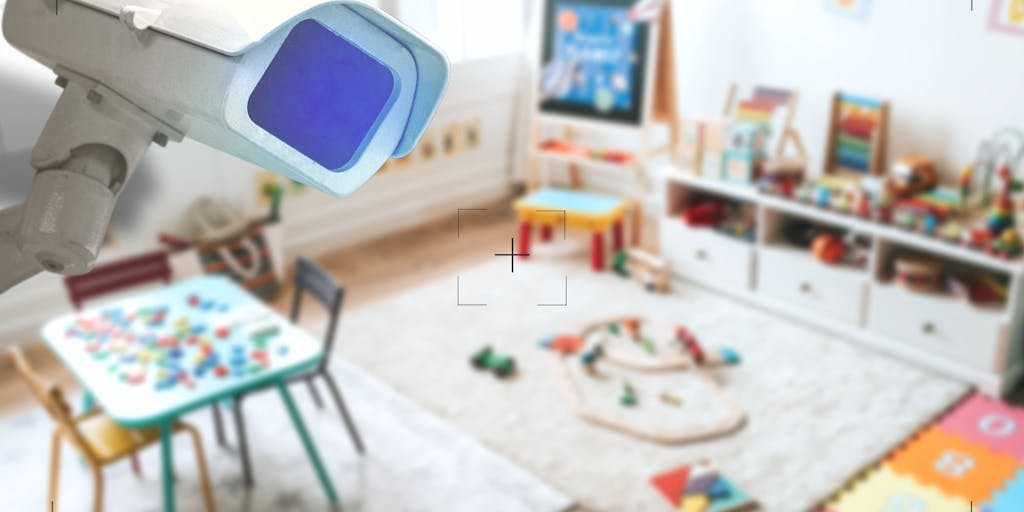
As federal and state legislation swirls over the usage of cellphones and personal devices in classrooms, there is a renewed push for another form of technology: surveillance cameras.Legislators in Florida, Iowa, Maryland, South Carolina and Tennessee introduced video surveillance bills this year, proposing placing cameras into self-contained special education classrooms, which are rooms solely for students with special needs.The move comes as a handful of states – Louisiana, West Virginia, Georgia and Alabama – adopted the legislation over the last decade in an attempt to curb harmful physical practices.
That includes teachers using restraints on students with behavioral issues and, in some cases, placing them in seclusion rooms or resorting to physical violence.“There’s usually an impetus for why these pieces of legislation are being introduced, and it's often because something happened where an educator probably felt overwhelmed, or didn't quite know what to do in a situation,” says Lindsay Kubatzky, director of policy and advocacy at the National Center for Learning Disabilities.The latest surge of legislation comes amid a wave of technology crowding in — and getting pushed out — of the classroom.
Districts are busy banning cellphones in classrooms as parents and experts debate the ethical use of education technology.Installing cameras, however, is something many parents of children in special education support.“This protects everyone; this is your eyewitness in the room, that no one can say [someone] got it wrong,” says Jacqui Luscombe, who leads the Exceptional Student Education advisory board in Broward County School District.But the move is controversial, even among disability advocates.
Some believe it poses a privacy risk for both students and teachers, and further alienates an already “othered” population.“What the big struggle seems to come down to is the tension of invading privacy versus the benefit of stronger accountability,” Denise Marshall, CEO of the Council of Parent Attorneys and Advocates, says.The Controversy The push for cameras in special education classrooms is not new.
Texas was the first to pass legislation in 2015, and four other states (Louisiana, West Virginia, Georgia and Alabama) eventually followed. But as technology use of all kinds has grown in classrooms, there’s been a surge recently to include classroom cameras.“I do think we’re in the technology age where it’s not as cost-prohibitive as it used to be, and there’s all these apps that lend [themselves] to greater use,” Marshall says.
The Broward County School District in Florida had a three-year pilot program beginning in 2021.Under the pilot program, a parent could request a camera be placed in any classroom serving students solely with special needs.As the program neared its end in 2024, Luscombe urged the school board to make it permanent.
“The feedback I received was never anything other than, ‘Let’s have cameras,’” she says.“I’m sure there were plenty of parents saying, ‘We don’t need that,’ but for those who wanted it, it was empowering.” The board approved a permanent version of the program, and the district has installed cameras in 80 of its more than 1,000 Exceptional Student Education classrooms.Florida legislators attempted to make it a statewide move, but the measure failed to make it out of the Senate committee.
Tennessee, Maryland, South Carolina and Iowa are in the process of reviewing legislation.Tennessee is the only state of the bunch that would require a majority of parents to sign off on the cameras.The latter three propose placing cameras in all special education classrooms.
Louisiana recently expanded its existing law.Initially, it allowed cameras to be installed at a parent’s request.Now the law requires cameras in all self-contained special education classrooms – rooms dedicated to special education students.
West Virginia also requires all self-contained special education classrooms to have cameras, while Texas requires it only by parental request.Georgia allows schools to use their own discretion for placing cameras in self-contained special education classrooms, while Alabama requires cameras in classrooms where over half the students have special education needs.Some of the legislation proposed, and Louisiana’s recently expanded law, explicitly ban restraints and seclusion rooms.
Broward County’s does not, although the district requires teachers to learn de-escalation training.Luscombe acknowledges the district could do more training, particularly in under resourced schools.“I personally have had conversations with the superintendent about more professional training, of, let’s not shove someone in a classroom, say ‘In you go,’ and then it becomes an exercise for survival,” Luscombe says.
Each state also has its own methods for reviewing footage, with some including footage leading up to and after a disputed incident.Others allow only administrators – not parents – to review footage.It plays into the concern of student privacy.
All states with current laws, except South Carolina, reference the federal Family Educational Rights and Privacy Act, better known as FERPA, in their legislation.That was passed in 1974 and serves as the standard for student privacy.Most advocacy groups – including the Council of Parents Attorneys and Advocates and the National Center for Learning Disabilities – have not taken an official stance on the issue.
“[In 2015] was the first time we’ve started to really debate even how we felt about it,” COPAA’s Marshall says, adding that opinions in the group are mixed.“I think it’s too early to tell with the research what the effects are, and I don’t think the states are collecting the data to help understand.” TASH, a Nashville-based disability advocacy group, condemned the decision when it was first up for debate after Texas passed its law.The group declared in a statement at the time that the video surveillance has become “an easy substitute for and distraction from the ongoing hard work of cultivating schoolwide inclusion, communication, trust and community.
What is needed instead is a systemic framework from which to approach a culture shift around issues of safety.” Necessity or Distraction? There is no hard data, for Broward County or others, about whether the cameras have a direct impact on the number or intensity of incidents in classrooms.There are also concerns mandatory cameras in classrooms could discourage people from entering the profession of special education – worsening an already depleted workforce.According to federal data from the 2024-25 school year, special education had the most reported teacher shortages, affecting 45 states.
But Jacquelie Rodriguez, CEO of the National Center for Learning Disabilities, says she believes that argument is a distraction.“The fact that we have what is considered a leaky bucket pipeline, where we have more people coming into the field and yet, we still don't have enough to fill the vacancies, that's not a product of video cameras,” she says.“I think that when people say that, they're addressing a symptom, not the root cause of the concern.” Rodriguez says instead of focusing on recording incidents, districts should concentrate on training teachers better to handle high-stress situations.
“I don't even think [cameras are] a Band-Aid; I think [they’re] a red herring,” Rodriguez says.“I think it's the ability for someone to check a box and say they did something about it, when either they do know that they're not doing anything about it, or they don't realize that this is not going to solve the problem that they're actually trying to address.”
Read More