Modern cars are packed with technology.Touchscreens control everything from climate settings to drive modes, computers constantly adjust suspension and power delivery, and increasingly sophisticated driver-assistance systems are always watching what happens around you.Even the humble manual transmission is rapidly disappearing.
These modern tech-laden cars have many automotive enthusiasts dreaming of the good old days of the 1990s.Back then, the Lamborghini Diablo was one of the most outrageous supercars on the planet.It was wide, low, and raw.
It was powered by a naturally aspirated V-12 engine and controlled with a manual transmission.And while the Diablo is much easier to live with than its Countach predecessor, it is called The Devil for a reason.An original Diablo can be a bit too analog and too far of a step back in time for some owners.
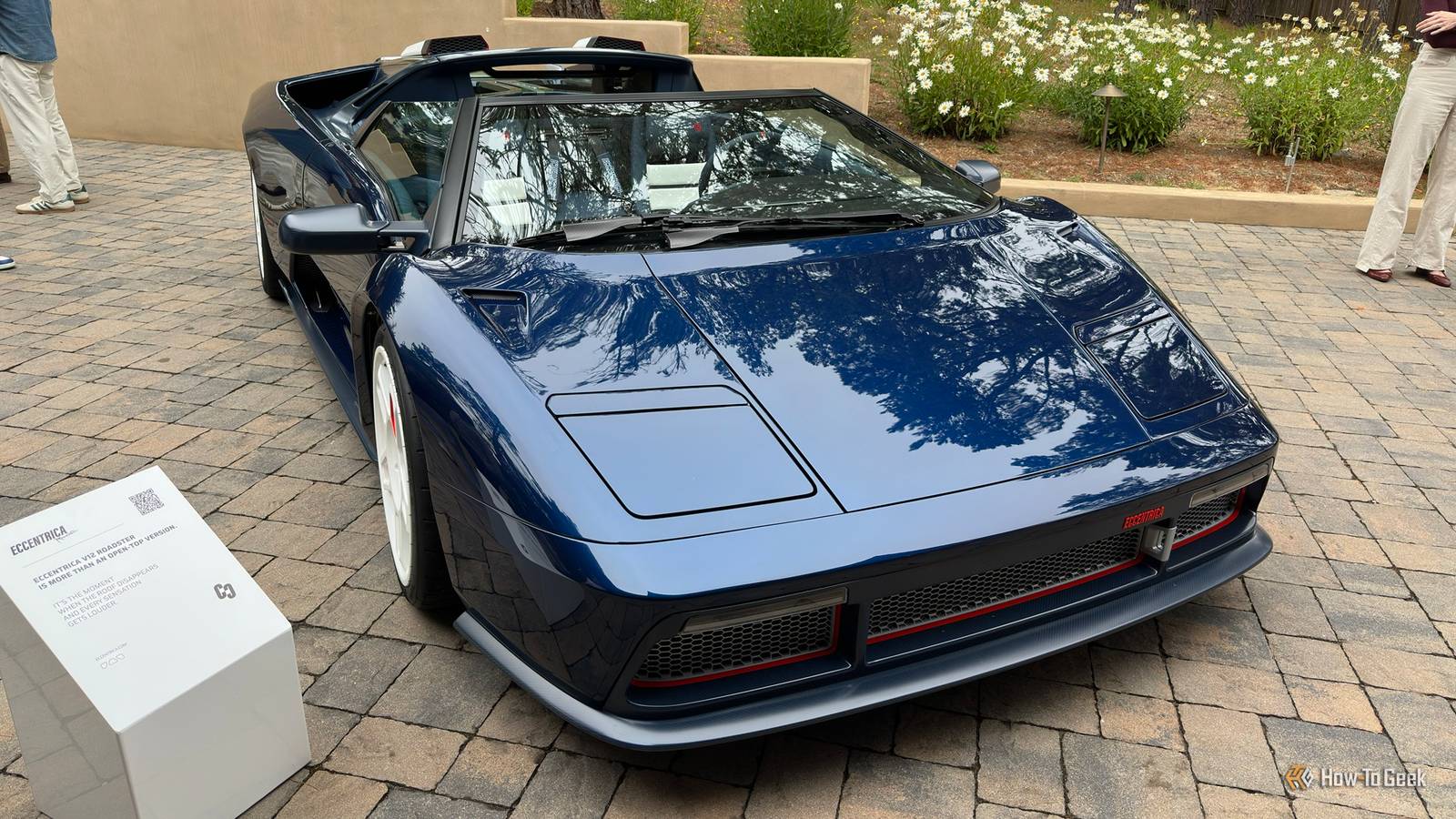
Eccentrica has a solution.They built a modernized version of the Diablo.But they are not looking to jam the car full of technology, pump out 2,000 horsepower, and call it a day.
Eccentrica takes a much more subtle and refreshing approach.Modern engineering,1990s attitude Better to drive, but still a Diablo Close During Monterey Car Week, I had the opportunity to meet with Eccentrica Board Member Andrea Colombo.We discussed their overall philosophy and their recently revealed Roadster.
From our discussion, I learned that the Eccentrica Diablo illustrates something increasingly rare in the automotive world.Technology is being used selectively to improve the experience rather than define it.As Colombo told me, “This is a car you really feel.
It is very rooted in the ‘90s in terms of sound and rawness.” Well, that sounds promising.The original Lamborghini Diablo wasn't exactly known for being easy to drive.Early examples combined a naturally aspirated V12, rear-wheel drive, heavy controls and relatively primitive electronics with the sort of ergonomics you'd expect from an exotic Italian supercar designed during the late 1980s.
Eccentrica has reinforced the chassis, upgraded the braking and cooling systems, revised the suspension, and made numerous other changes intended to make the Diablo more stable and predictable.Colombo described the finished car as “very honest, very direct.” Yet the company didn't want those improvements to make the Diablo feel like a 2026 supercar wearing a 1990s costume.The car is still deliberately rooted in the 1990s.
The modern engineering addresses shortcomings rather than erasing the original car's personality.That's a surprisingly difficult balance to achieve and one that many don’t even attempt.Related The Miura SV arrived in 1971 for $13,800—and taught Lamborghini how to build its best cars An instant sensation that was later credited as the first supercar.
Posts By Carl Anthony Six gears, three pedals No fake manual needed Close Nothing demonstrates Eccentrica's philosophy better than its transmission.The Diablo originally used a five-speed manual transmission, but Eccentrica developed a six-speed.That created an interesting problem.
How do you add another forward gear while maintaining the beautiful gated shifter that's such an important part of the experience? Eccentrica's answer mixes old-school mechanical interaction with a small dose of modern electronics.All six positions in the gated shifter are dedicated to forward gears.Reverse is selected electronically using a separate button.
Press it, and the transmission allows the shifter to engage in reverse.And yes, there's still a clutch pedal.Colombo laughed when I asked him to confirm that detail, then pointed at the pedals in the footwell: “One, two, three.” That might seem almost comical, but it's significant.
Modern high-performance cars have largely moved to automated dual-clutch transmissions because they're faster and more efficient.Even Lamborghini abandoned the traditional manual transmission years ago.And some of the newest “manual transmissions,” such as the one in the Ferrari 12Cilindri Manuale is actually hooked up to a standard eight-speed dual-clutch automatic gearbox.
Eccentrica uses no such trickery.Eccentrica isn't chasing horsepower The driver still has a job to do Close The same philosophy applies to the engine.Eccentrica retains the Diablo's 5.7-liter naturally aspirated V-12 rather than replacing it with a modern turbocharged engine or adding hybrid assistance.
The engine isn't untouched, however.Colombo says it receives new pistons, valves, camshafts and a new flywheel, among other upgrades.Individual throttle bodies further sharpen the response.
Eccentrica could presumably chase much larger horsepower numbers.It deliberately doesn't.“Two thousand horsepower? It's not our game,” Colombo told me during our conversation.
The V12 Roadster makes 550 horsepower.A modest amount in 2026, but plenty to have fun with, and the whole point of this car is fun.There's another increasingly unusual ingredient: the Eccentrica is rear-wheel drive.
Modern supercars frequently use all-wheel drive to put enormous amounts of power to the pavement.Computers can distribute torque between the wheels, compensate for traction loss, and help drivers on the track in ways that would have been extremely difficult to manage a few decades ago.Again, Eccentrica could have gone down that road.
It didn't.Keeping the car rear-wheel drive maintains an important element of the early Diablo's character.Combine that with the naturally aspirated V12 and six-speed manual, and you've got a car that demands more from its driver than many modern exotics.
Colombo described that difficulty as part of the statement the car makes.It's approachable enough to enjoy, but driving it still gives its owner the satisfaction of mastering something.In other words, the technology doesn't do everything for you.
Related Zenvo's new hypercar is powered by something we thought was going extinct Zenvo Aurora uses a V12 engine capable of nearly 2,000 horsepower.Posts 1 By Joe Kucinski Some modern technology is worth having Fix the problems, preserve the personality None of this means Eccentrica believes old technology is inherently better.The original Diablo had shortcomings that become much less charming when you're actually living with one.
Cooling is a good example.Colombo described the original Diablo cooling system as somewhat problematic, so Eccentrica extensively revised it and fitted modern PWR radiators.The braking system has also been upgraded, the chassis reinforced, and the suspension revised.
That's where modern technology makes the biggest difference.Nobody misses overheating.Nobody wants inadequate brakes simply because they're historically authentic.
And unpredictability isn't necessarily the same thing as character.Eccentrica is effectively drawing a line between the limitations that made old cars frustrating and the characteristics that made them interesting.The most surprising thing Colombo told me wasn't about horsepower, transmissions, or electronics.
It was mileage.Eccentrica has a company car finished in rose gold that Colombo says has accumulated roughly 27,000 to 28,000 miles.That's significant for any exotic car, never mind an ultra-low-production Diablo restomod costing seven figures.
“We're really testing it heavily,” Colombo said.That real-world use is important because Eccentrica doesn't want these cars to exist exclusively as static collectibles.The company also appears to recognize that unusual cars require unusual customer support.
Colombo says owners can have routine work performed through Eccentrica's dealer network or by qualified independent mechanics, with the company providing technical assistance when necessary.For more serious issues, Eccentrica can send what Colombo calls its “flying doctor” to the vehicle.“Cars are cars,” he said.
Problems can happen whether you're dealing with a Chevy, a Ford, or a smaller manufacturer like Eccentrica.What matters, he argues, is how quickly and effectively the manufacturer responds.Exclusivity is admittedly a huge part of the appeal, too.
Eccentrica plans just 19 coupes and 19 roadsters.Colombo says the company has production capacity for roughly one vehicle per month, while constructing an individual car takes around seven months.The coupe starts around $1.25 million, while the roadster costs approximately $100,000 more.
That's before considering the extensive customization requests.Colombo estimates roughly 60% of Eccentrica customers are American, with the remainder spread across Europe, Japan, and the Gulf region.Sometimes less technology is more The Eccentrica Diablo is obviously an extreme example.
A $1.25 million restomod won't change how mainstream cars are designed.But the thinking behind it deserves attention.For decades, faster was automatically better.
More horsepower, quicker shifts, and faster acceleration were obvious signs of progress.Technology helped engineers push those numbers further and further.We're now reaching a point where speed itself is almost becoming commoditized.
You don't need a temperamental Italian supercar to experience brutal acceleration anymore.Family-friendly EVs can deliver performance that would have embarrassed exotic cars not long ago.If almost any sufficiently powerful modern car can be fast, what makes a sports car special? Eccentrica's answer is involvement.
A clutch pedal.A metal gated shifter.A naturally aspirated V12.
Rear-wheel drive.Steering and chassis behavior that communicate what the car is doing rather than filtering everything through layers of electronics.At the same time, Eccentrica isn't rejecting progress.
Better cooling is good.Better brakes are good.A stronger chassis is good.
Technology isn't the enemy.The trick is knowing when it makes the experience better and when it's better to get out of the driver's way.Eccentrica seems to have that figured out.
Read More