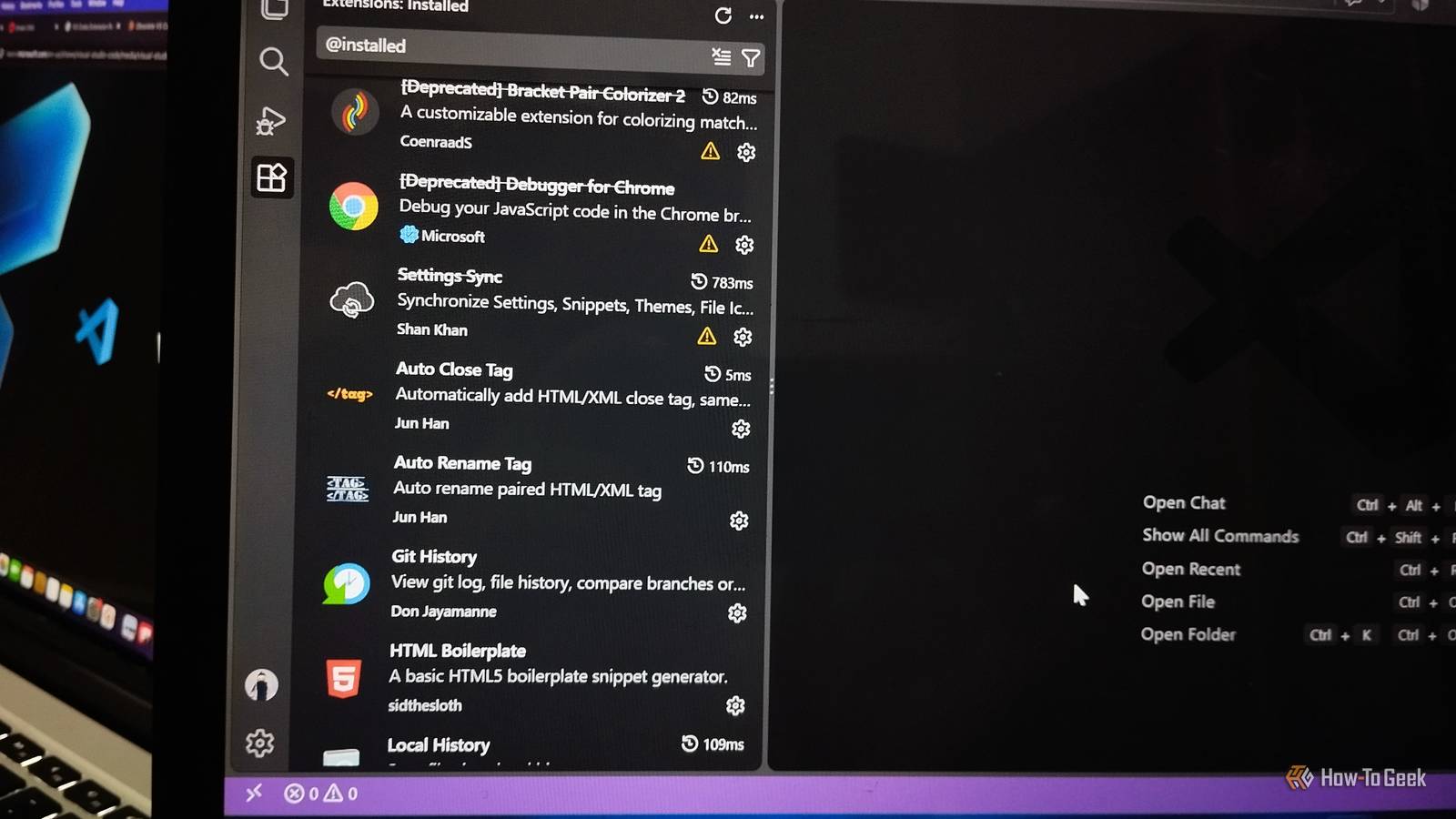
Every extension you install adds startup time, uses memory, and gives you one more thing that can break after an update.Over the years, VS Code has absorbed many once-essential extensions by replacing them with built-in features.That means you might be running an extension for something VS Code can already do natively, making your setup more cluttered than it needs to be.
Before you install another extension, check out this list of popular ones you can ditch right now and see how VS Code can do the same thing on its own.Bracket Pair Colorizer VS Code's built-in bracket colors are good enough to make this extension obsolete No doubt, Bracket Pair Colorizer (versions 1 and 2) was a staple from 2016 to 2021, with millions of installs.It was a go-to extension for many developers that made VS Code feel dramatically better the moment you installed it.
It colored matching brackets, making deeply nested code much easier to follow.You don’t need it anymore because VS Code added native bracket pair colorization in version 1.60 and turned it on by default in 1.67.Eventually, the extension’s author deprecated it because the built-in version is much faster.
Simply uninstall it if you still have it, and bracket colors should already be working since they’re enabled by default.If not, head to Settings > Text Editor > Bracket Pair Colorization and make sure the setting is enabled.Also, if needed, you can enable it through your settings.json file by adding the following line: "editor.bracketPairColorization.enabled": true Settings Sync VS Code can sync your entire setup without a third-party extension Close Settings Sync (developed by Shan Khan) was a must-have extension for users who regularly moved between computers.
It was popular from 2015 to mid-2020 and let users synchronize their VS Code settings using GitHub Gists, saving them from manually recreating their setup.Then, VS Code introduced built-in Settings Sync as a preview in late 2019 and made it stable in version 1.48 in 2020.It syncs settings, keybindings, snippets, extensions, and UI state, and it also works with Profiles.
To enable Settings Sync, click the Accounts icon and select Backup and Sync Settings, then choose what you want to sync and click Sign in & Turn on.Select Sign in with GitHub to authenticate in your browser, or if you’re already signed in, simply click the Accounts icon and turn on Settings Sync.Once enabled, the menu will show Settings Sync is On.
Once this setting is on, you can choose what VS Code exactly syncs.Debugger for Chrome / Debugger for Edge Browser debugging is now handled by VS Code without any extension Remember when Microsoft itself offered extensions like Debugger for Chrome and Debugger for Edge for debugging web apps from inside the editor? Both reached millions of installs, but they're now deprecated.VS Code replaced them with its built-in JavaScript Debugger around 2020–2021.
It lets you debug JavaScript and Typescript applications directly from the editor.To select a debugger, click the Run and Debug icon, then click the Run and Debug button.Choose Web App (Chrome) or Web App (Edge) from the Select debugger list.
Auto Close Tag VS Code already knows when your HTML tags need closing If you write HTML, there's a good chance you installed Auto Close Tag years ago.It automatically added the closing tag whenever you typed an opening one.To replace it, VS Code introduced built-in HTML auto-closing tags in version 1.16.
Later, it also added native support for auto-closing tags in JSX.This feature is turned on by default.If you turned it off, go to Settings > Extensions and search for Auto Closing Tags to enable it for HTML, JavaScript, and TypeScript, or set html.autoClosingTags, javascript.autoClosingTags, and typescript.autoClosingTags to true in your settings.json file.
Auto Rename Tag Linked Editing keeps matching HTML tags in sync Auto Rename Tag is another popular extension you must have used or heard of if you have HTML experience.It renames the closing tag as you edit the opening one.VS Code introduced the same feature in 2019 under a different name, which was later rebranded as Linked Editing in version 1.44 (2020).
The Linked Editing feature works well for plain HTML.In JSX and TSX, support depends on your TypeScript version and setup, so test it in your own projects before you uninstall the extension.It’s off by default, but you can enable it by going to Settings > Extensions and searching for Linked Editing, or by adding the following line to your settings.json file: "editor.linkedEditing": true Local History VS Code can recover your old edits with the built-in Local History feature The Local History extension was popular because it kept snapshots of your files, letting you recover earlier versions without relying on Git.
Local History doesn’t replace Git.It’s handy for recovering recent changes.VS Code added its own Local History in version 1.66 (2022).
It is on by default.You can find it in the Timeline view at the bottom of the Explorer sidebar, where you can compare an saved version with the current file or restore it.If disabled, you can manage it from Settings > Workbench.
HTML Boilerplate Emmet can generate HTML boilerplate with a few keystrokes There was a time when creating an HTML file meant either typing the boilerplate by hand or installing an extension to generate it.However, VS Code introduced Emmet (around 2016), a powerful abbreviation engine that can generate HTML and CSS from short expressions.You’ve probably used Emmet without knowing it.
Remember typing ! to generate a basic HTML document structure? That’s Emmet.It can even generate complex structures from short abbreviations.Emmet is enabled by default for HTML files.
To use it with another language, configure Include Languages under Settings > Extensions > Emmet.Git History Built-in Source Control and Timeline cover much of the same ground Git History became popular because it gave VS Code users an easier way to explore Git commits, branches, and file history without constantly jumping to the command line.VS Code has now covered most of it with two built-in views.
The Timeline view (arrived in 2020) shows per-file history, while the Source Control Graph (added in 2023) lets you explore commits, branches, and comparisons.Although Git History isn’t completely replaced by VS Code’s built-in features, check them out to see if they cover your workflow well enough to ditch the extension.You may need to clean your setup You don’t have to uninstall everything at once.
Remove one extension, try its built-in replacement, and move on to the next.If something doesn’t work, you can always reinstall it.As VS Code keeps adding and improving features, it’s worth browsing its built-in features before reaching for another extension.
Read More