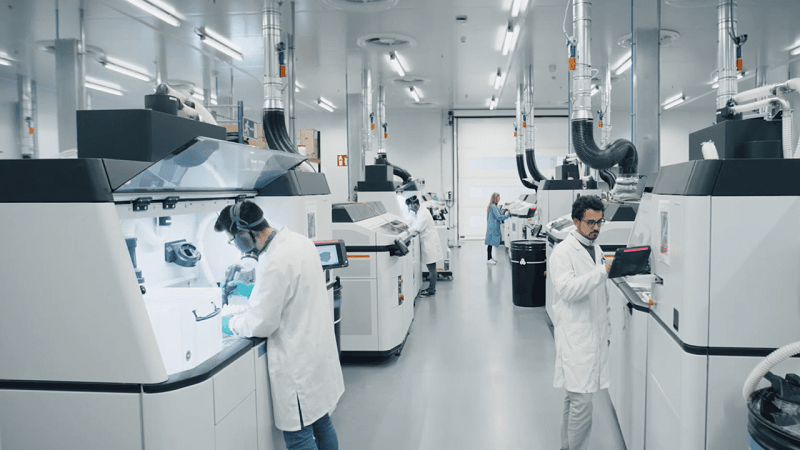
Polymer additive manufacturing is seeing less investment, attention, and disruption than metal additive manufacturing currently.Less crucial for defense needs, it has of late had far fewer new entrants.But, vat polymerization in particular is becoming entrenched in dental manufacturing, alongside its traditional strongholds in jewelry intermediates and hearing aids.
Here, competition is fierce.Low-cost vat polymerization machines are making their presence felt in all sorts of industrial use cases.LPBF is progressing with incremental improvements.
Material extrusion is seeing more materials and a gradual expansion of use cases.On the horizon, the effects of better desktop material extrusion systems are coming.These are seeing wholesale adoption in enterprises, depressing some prototyping use, and being used for more and more end-use part production in industrial customers.
Many in the industrial polymer manufacturing space worry about desktop 3D printers, and they should.But, at the same time, they are likely to significantly expand 3D printing in firms, which may, in some cases, lead to follow-on investments in larger systems.2026 is likely to be a good year for the industrial incumbents, but in 2027, increased pressure from desktop systems will alter this segment’s competitive landscape considerably.
EOS’ Fabian Alefeld, Director Business Development and Academy, Global Additive Minds, thinks differently than I do.He believes that, “Low-cost polymer 3D printing and industrial polymer AM will continue to diverge.In industrial polymer AM, one of the defining themes of 2026 will be defense and other high-performance applications.
As defense departments and unmanned vehicle manufacturers scale their programs, technologies like SLS will see accelerated adoption—not only for their ability to scale production output, but also for delivering the part performance required for demanding use cases such as long-range drones.At the same time, even as total cost of ownership continues to decrease, I expect the industrial polymer sector to also follow the footsteps we’ve already seen in metals, with growing demand for custom process parameters, tailored machines, and engineered materials to meet very specific application requirements.” HP‘s François Minec, VP & Global Head of Sales and Business Development, HP Additive Manufacturing Solutions, told us that, “Over the next year, cost-per-part on powder-bed systems will continue its steady decline – an inflection that will unlock a new wave of production adoption.This momentum is being driven by cumulative gains in both process efficiency and materials maturity.
As the economics improve, service bureaus will expand their installed base to meet growing demand from end-customers, particularly in orthotics and prosthetics, defense, and other sectors that demand rapid iteration and dependable throughput.In tandem, we will see additive manufacturing integrating more deeply into traditional supply chains.Digital inventory models and connected workflows – exemplified by HP’s new AMN program and our recent strategic alliance with Würth Additive Group – are already proving their worth in simplifying global operations.
As this approach scales, manufacturers will be able to localize production, shorten lead times, and build more agile, resilient operations.With these forces converging, the industrial polymer market is poised to return to double-digit growth.What’s changing now is the increasing practicality of additive manufacturing; production at scale is becoming a commercially rational choice rather than an experimental one.” Both are very bullish about defense and drones, probably the fastest single area of adoption along with prosthetics and orthotics at the moment.
HP’s path seems intertwined with digital inventories, while EOS seems more optimistic about custom machines for specific parts and use cases.For LPBF specifically, these are the twin sirens of the moment.A: match current parts broadly as best we can and allow global production of MRO and austere parts, or B: drill down on specific settings, materials, and machine combinations for specific parts and sector production.
Both these paths maximize on the throughput, investment, and business cases for LPBF machines, and a mix of both is the most likely successful way forward.Additionally, both firms are very focused on lowering cost per part, which is great news and will make success more likely.Tadej Pogačar won this year’s Tour de France riding on a custom-made Fizik 3D printed saddle that was produced using Carbon technology.
In vat polymerization, meanwhile, Carbon‘s Chief Product Officer, Phil DeSimone, thinks that, “2026 will mark a meaningful shift toward higher-volume consumer applications as more industries recognize the competitive edge offered by additive manufacturing paired with advanced materials.Brands will move beyond niche, premium offerings and begin launching broader, more accessible product lines at compelling price points, while still outperforming conventional options.We expect continued acceleration in 3D-printed footwear as additional brands deliver innovative designs to market.” Carbon’s approach of, in effect, being a systems integrator that unites design, software, machine, and materials in specific parts that outperform, is paying off for the firm in bike saddles, military helmets, sports helmets, backpacks, and beyond.
More firms should adopt a similar approach where they can, with partners, be a one-stop shop for faster, less risky additive implementation.FIT’s Toyota console box.What about the contract manufacturing market and their view? Fabian Grupp is the Senior Go to Market Manager of FIT Additive Manufacturing Group, one of Germany’s largest service bureaus, known for industrializing cutting-edge technologies and applications.
“We are currently already in a phase of very high capacity utilization in industrial polymer AM manufacturing with SLS.This will not only continue but increase further in the first half of 2026.PA12 is so well-established that it’s still often the first choice for functional components.
However, finishing processes such as dyeing and vapor smoothing are increasingly being used to get as close as possible to the appearance and feel of injection-molded parts.In the photopolymer sector, we’ve observed a certain consolidation among the big players, who already enjoy user trust through their established brands.Smaller, specialized suppliers are increasingly focusing on material certifications to build this trust: New resins for food contact, medical applications, with flame retardancy, or approved for toy manufacturing are coming to market monthly.
Many already work with very low activation energy and thus on a broad range of affordable machines.SLS with PEEK will make a comeback if thermal degradation of residual powder can be limited.Surface treatment is usually not necessary for SLA, DLP or MSLA parts; therefore, after an initial focus on SLS and FDM, vat polymerization will also see increased adoption.
Overall, we must be able to combine reliability with agility and inventiveness.” Grupp believes in more materials, and even though most of the large chemical companies are now apathetic to our fortunes, we are seeing a lot of innovation in fit-for-purpose materials.Finishing processes have made a lot more business cases possible, and this is an important but overlooked force multiplier for services.At the same time, I love that he is closely following what is happening in entry-level, VP, and other machines.
I think that evaluating this market and seeing if, in some cases, these low-cost machines can make sense, is the smart play for services today.3D Spark‘s Customer Success Manager Jochen Loock, a leading mind in additive parts industrialization, said that, “It will be interesting to see how powder bed players respond to the industrialisation of simple FFF printers in 2026.While end-users now own many FFF machines, they may soon reach capacity or performance limits in‑house and turn to external providers.
Established powder bed players may hesitate to cannibalize their own business.This opens the door for new service bureaus to grow, especially considering the low investment barriers.” This is a salient point to make.If services don’t enter this business, they could have a lot of novel print farming businesses in their competitive field.
These players will generally have lower CapEx and lower costs per part for particular parts.To me, services and OEMs have to anticipate such a future and create low-cost offerings.If industrial manufacturing continues to maintain a focus on quality and lowering cost per part, then it will increase the marketable and expand in the traditionally made parts arena.
But, an integrated application development/systems integration approach, where a large company can come to you with a need and you can provide the design, material, software, people, parts, machines, service, and a path to industrialization, is the way to making millions of completely new parts possible.OEMs and services, with partners, should put together alliances that can, in tandem, hack out a footpath in the jungle for both of these parties.Many applications, niche materials and parts, and novel structures actually share a lot of requirements needed by broader industrial MRO companies.
Matching up roadblocks and milestones across machine, material, and service roadmaps, while tackling them together for key markets in mass manufacturing, replacement and new parts, is to me the path forward.2026 is not going to be easy, but for this market, it is a year of grace in disguise.If you make the hard choices now, then 2027 will be a good year for you.
If you procrastinate and continue to see dreamscapes in the clouds, be sure to keep that LinkedIn profile nice and spiffy and broad, because you could be looking for work elsewhere.Subscribe to Our Email Newsletter Stay up-to-date on all the latest news from the 3D printing industry and receive information and offers from third party vendors.Print Services Upload your 3D Models and get them printed quickly and efficiently.
Powered by FacFox
Powered by 3D Systems
Powered by Craftcloud
Powered by Xometry
3DPrinting Business Directory
3DPrinting Business Directory