I've owned a lot of houseplants in my time and killed many of them.The biggest issue has always been knowing when to water them.Wi-Fi moisture sensors can help, but if you have a lot of plants, the cost can soon add up, and if your Wi-Fi goes down, they become useless.
Using an ESP32, you can make a moisture sensor that works offline and is a fraction of the price.Plants don't always fit a neat schedule Watering too often can be as bad as watering too little I've tried a lot of things to help keep my plants alive.I have NFC tags stuck to the bottoms of my plant pots that I can scan when I water them.
An automation then reminds me to water them again after a set period of time.The problem is that plants don't work that way.You can't just water them every two days and expect them to thrive.
Depending on the circumstances, sometimes they might need water sooner, and other times they might not need water for much longer.The problem is that over-watering plants can be just as bad for them as under-watering them.If you stick to a strict schedule, your plants might be going thirsty some days and be over-watered on others.
The best way to know when to water them is by determining how moist the soil is.Related The best smart home sensors are the ones you'll never see Your smart home doesn't need to look like one.Posts 1 By Tim Brookes Wi-Fi moisture sensors can help, but they're not perfect A power cut made me realize how fragile they can be The common advice for some plants is to stick your finger into the soil and water if the top inch of soil feels dry.
This sounds simple enough, but in reality, judging the moisture levels throughout the soil using your finger isn't that easy.I can never tell what counts as feeling "dry" and how deep that dryness goes.A more accurate option is to use Wi-Fi soil moisture sensors.
These are sensors that you can push into the soil of your plant to measure the moisture levels of the soil.The data is shared over Wi-Fi to an app or your smart home.While Wi-Fi soil sensors work well, they have some issues.
I recently went away on vacation, and while I was away, there was a power cut which killed my Home Assistant server.When I got home, I didn't know which plants needed watering because I couldn't access the information until my smart home was back up and running.The other issue with buying Wi-Fi moisture sensors is that they're not that cheap.
If you have a lot of plants, you ideally want a moisture sensor for each pot, and this can soon become quite expensive.An ESP32 has all you need to monitor your plants It can work completely offline Close In an effort to add moisture sensors to more of the plants in my home without breaking the bank, I bought some cheap moisture sensor modules that are compatible with ESP32 boards.By hooking these sensors up to some ESP32s, I was able to make my own moisture sensors for far less than buying a ready-made Wi-Fi sensor.
My initial setup used Wi-Fi to send the moisture readings to Home Assistant.An automation then monitored these readings and sent a notification to my phone when a moisture sensor dropped below a set value.I then knew that I needed to go and water that plant.
These DIY moisture sensors worked great, but I still had the same problem when I returned from vacation.With Home Assistant down, I had no way to access the moisture readings, and the same would be true if my home Wi-Fi network went down, since the ESP32 boards send their data to Home Assistant over the local Wi-Fi.I realized that I didn't need to rely on Wi-Fi at all.
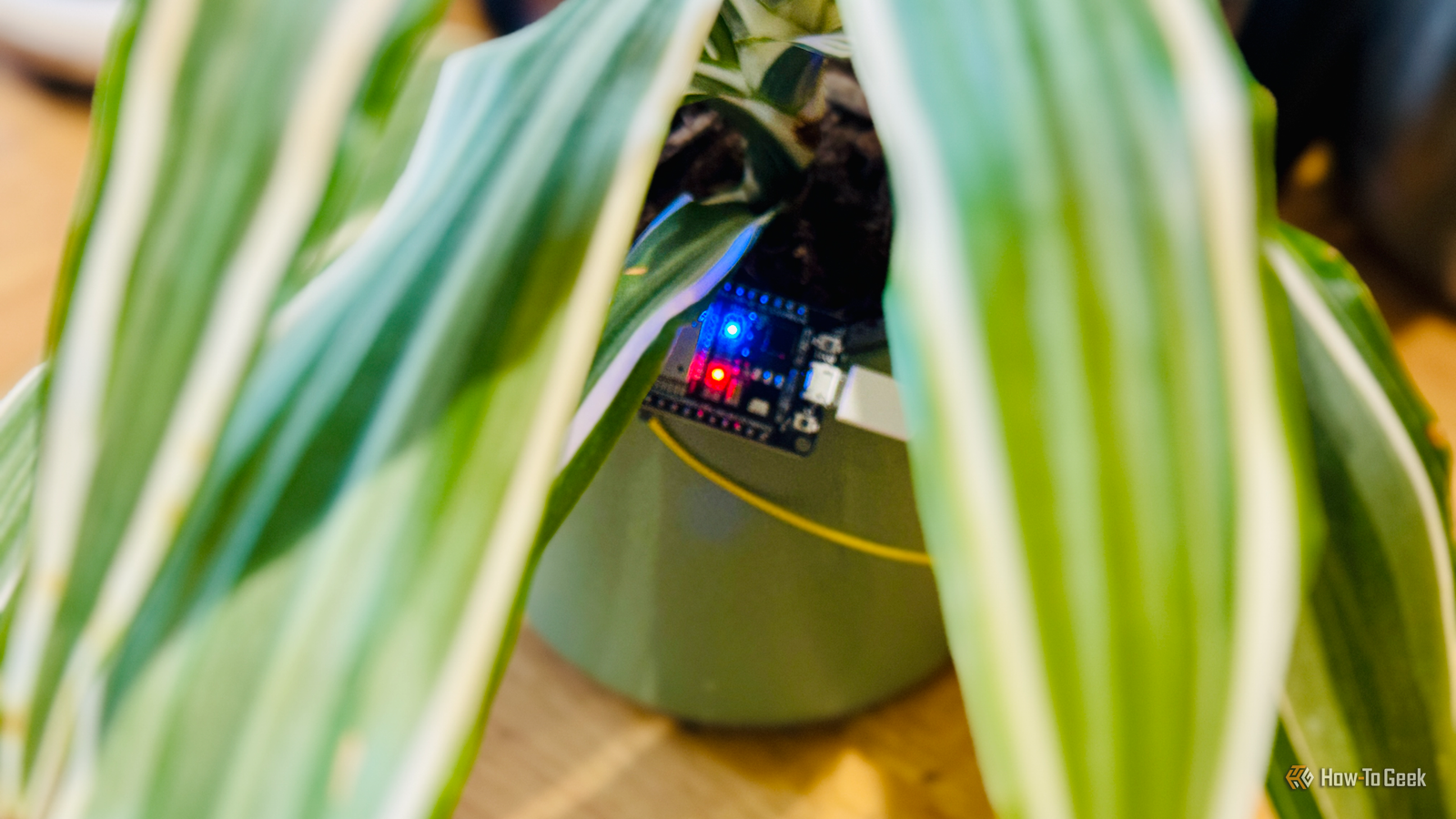
All I really needed to know was when the plants needed watering.Using ESPHome, I edited the ESP32 firmware so that when the effective moisture level (actually a voltage measured by the sensor) crossed a set threshold, the LED on the ESP32 would start to flash.My moisture sensors now work completely offline.
Even if the Wi-Fi or Home Assistant is down, the ESP32 will continue to flash if the soil is too dry, as long as the ESP32 has power.The only way to stop it flashing is to water the plant until the moisture level rises back above the threshold.I'm still using my plant monitors as Bluetooth proxies Even if Wi-Fi goes down, the monitor will still work I haven't completely disconnected the ESP32s from Wi-Fi.
They still work as Bluetooth proxies and still send the soil moisture readings to Home Assistant, so that I can monitor the plants from a dashboard.The only difference is that there's now a third part to the firmware that flashes the LED when the moisture level gets too low, and this part will keep working offline, even while the other parts fail.It means that I'm effectively getting three devices for the price of one, with the ESP32 acting as an offline soil moisture monitor, a Wi-Fi soil moisture monitor, and a Bluetooth proxy.
Not bad for a board that can cost just a few dollars.In an online world, sometimes offline solutions are best Making these changes to my soil moisture monitors means that even if my Wi-Fi isn't working or Home Assistant is down, I'll still be able to see when my plants need watering.It's a simple solution, but sometimes those are the most robust.
Read More