I spent years putting up with Phone Link when it kept letting me down.The connection kept dropping, notifications didn't show up, and most of the time the find phone feature didn't work.I eventually found a different app that I now use every single day.
Add How-To Geek on Google Add as Preferred Source Follow on Google Discover Phone Link doesn't always hold up KDE Connect does it differently Close Microsoft's cross-device tool started out on Windows 10 as "Your Phone" and later got a new name, Phone Link, for Windows 11.The whole idea is to plug your phone right into the Windows desktop without a cord.While it works a lot of the time, it is pretty annoying to use because it messes up so often.
The core issue is that Phone Link depends on Microsoft's cloud servers and makes you sign in with a Microsoft account.Even simple tasks, like locating your phone on the network or keeping data in sync, rely on Microsoft's cloud.The good stuff, like app streaming, screen mirroring, and viewing recent phone apps on your PC, is restricted to certain flagship phones.
I have a Samsung, so it works on mine, but everyone with a less popular brand only gets basic notification mirroring and SMS access.Phone Link doesn't exist on Linux or macOS, so there's nothing to try on other systems.I've used Phone Link for years, and just about every single day I've had connection issues.
It isn't my phone or my Ethernet.It's the app acting up.It's annoying, and it happens too often.
It's almost like this wasn't built by a trillion-dollar company.KDE Connect goes the other direction entirely.It started in 2013 as a Google Summer of Code project by a developer named Albert Vaca, working inside the open-source KDE community.
It's really cool because instead of routing everything through corporate servers, KDE Connect works on your local network and talks straight between your phone and PC.No third-party server ever sees your data.It uses ports 1714 to 1764 to find and talk to other devices.
Since everything stays on your local network, it even works with no internet, and you don't have to sign up for anything.The security design is smart as well.When you first pair a phone and PC, each device generates its own security certificates, and they exchange them.
The connection gets encrypted, and a short verification code appears on both screens so you can confirm you're linking to the correct device.It also blocks anyone from reusing an old connection attempt later.I stopped using Phone Link because this app is so good.
Getting KDE Connect running is easy The plugins are where it gets good Close Getting started takes a couple of minutes.On Windows, you can get KDE Connect from the Microsoft Store.On Android, it's on the Google Play Store.
Both devices have to be on the same Wi-Fi or wired network.Once you launch KDE Connect on Windows, it starts searching for nearby devices on its own.When your phone appears on the list, you send a pairing request, confirm the matching verification code on both screens, and that's it.
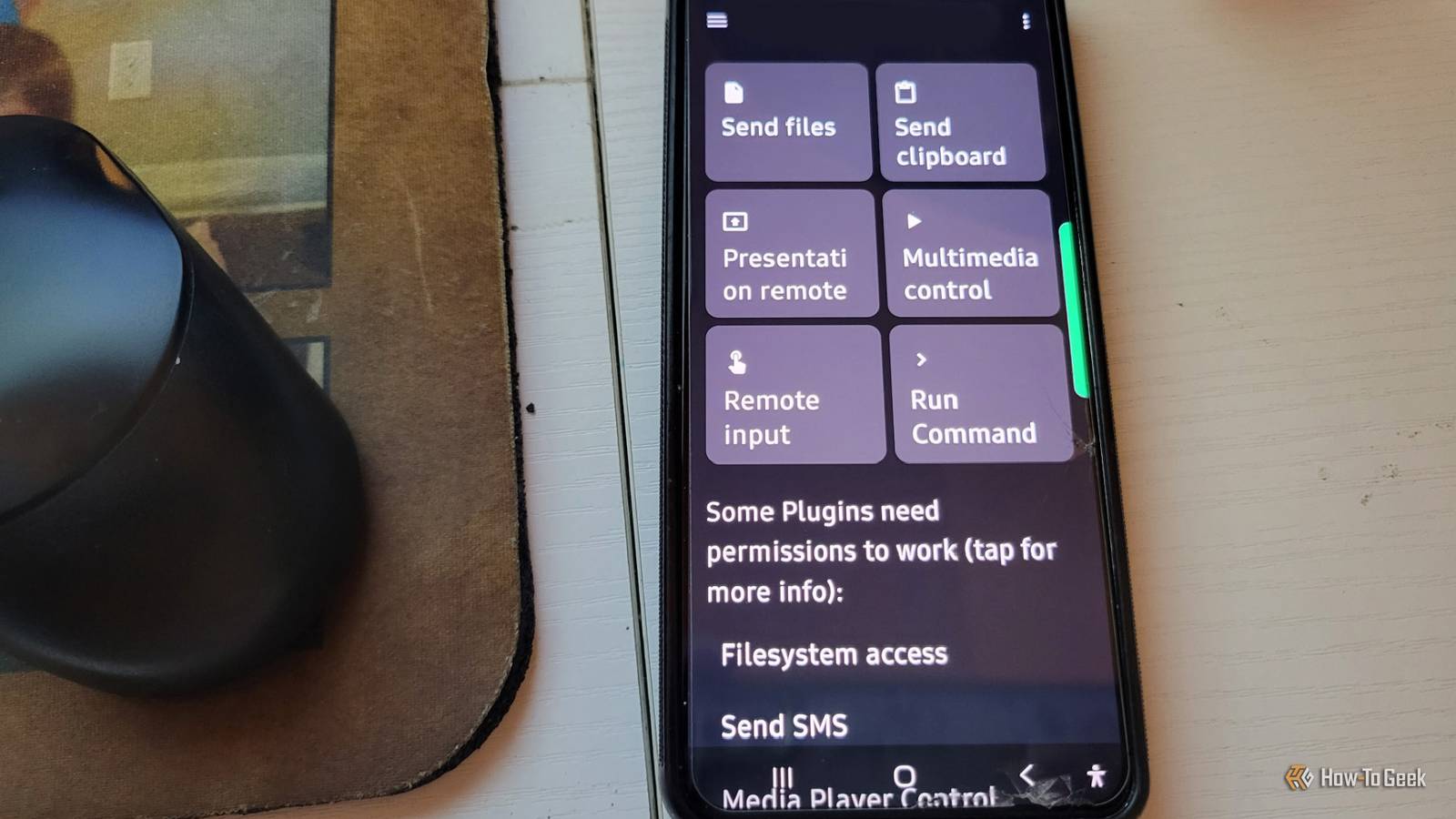
That connection stays trusted and encrypted from then on.After pairing, you turn on the features you want in KDE Connect's plugin settings.Clipboard sync means anything you copy on your phone shows up right away when you paste on your PC, and vice versa.
If you want to send a file or photo from your phone to your PC, you can do it right from your phone's share menu, and it moves directly over your local network without touching any cloud service.This is the main reason I left Phone Link for KDE.Notifications from your phone appear on your PC too, and you can reply to messages right from the pop-up without touching your phone.
Other than that, you can use your phone as a trackpad and keyboard for your PC, which is surprisingly handy when you're across the room.For presentations, your phone can work as a slide clicker.You can also control music and system volume on your PC from your phone, and power users can set up custom commands so one tap on your phone can lock the PC, shut it down, or launch an app.
It feels like what Phone Link should have been.You'll give up a few things Phone Link still has some advantages Switching from Phone Link to KDE Connect does mean giving up some things, which I don't love.The biggest thing KDE Connect can't do is mirror your phone screen or stream apps to your PC.
Phone Link can pull this off because Microsoft works directly with phone makers to include special software at the system level, something a regular app like KDE Connect just can't copy without root access.That isn't a dealbreaker for me, but it's so nice to have.Setup is also a bit harder with KDE Connect on Windows.
Unlike Phone Link, which comes pre-installed and already has firewall permissions taken care of, KDE Connect makes you manually open the right ports in Windows Defender Firewall.If your router has wireless isolation turned on, devices won't be able to find each other at all.Also, on Android, KDE Connect needs to run as a persistent background service to stay connected, which means a small, ongoing battery drain.
Phone Link basically works right after installation.So that's a big difference for a lot of people.I'd still pick KDE Connect over Phone Link I prefer KDE Connect over Phone Link because I want my app to always work.
If you care most about screen mirroring, app streaming, and things just working through the cloud, Phone Link is probably the better pick.But if you care about keeping your data local, want something that works across different operating systems, and like the idea of open-source software you can actually trust, switching to KDE Connect is well worth it.KDE Connect OS Windows, Mac, Linux Mobile App Yes Cost Free KDE Connect is an open source alternative to Phone Link for Windows, Mac, and Linux.
Get it here! Get it here! Expand Collapse
Read More