
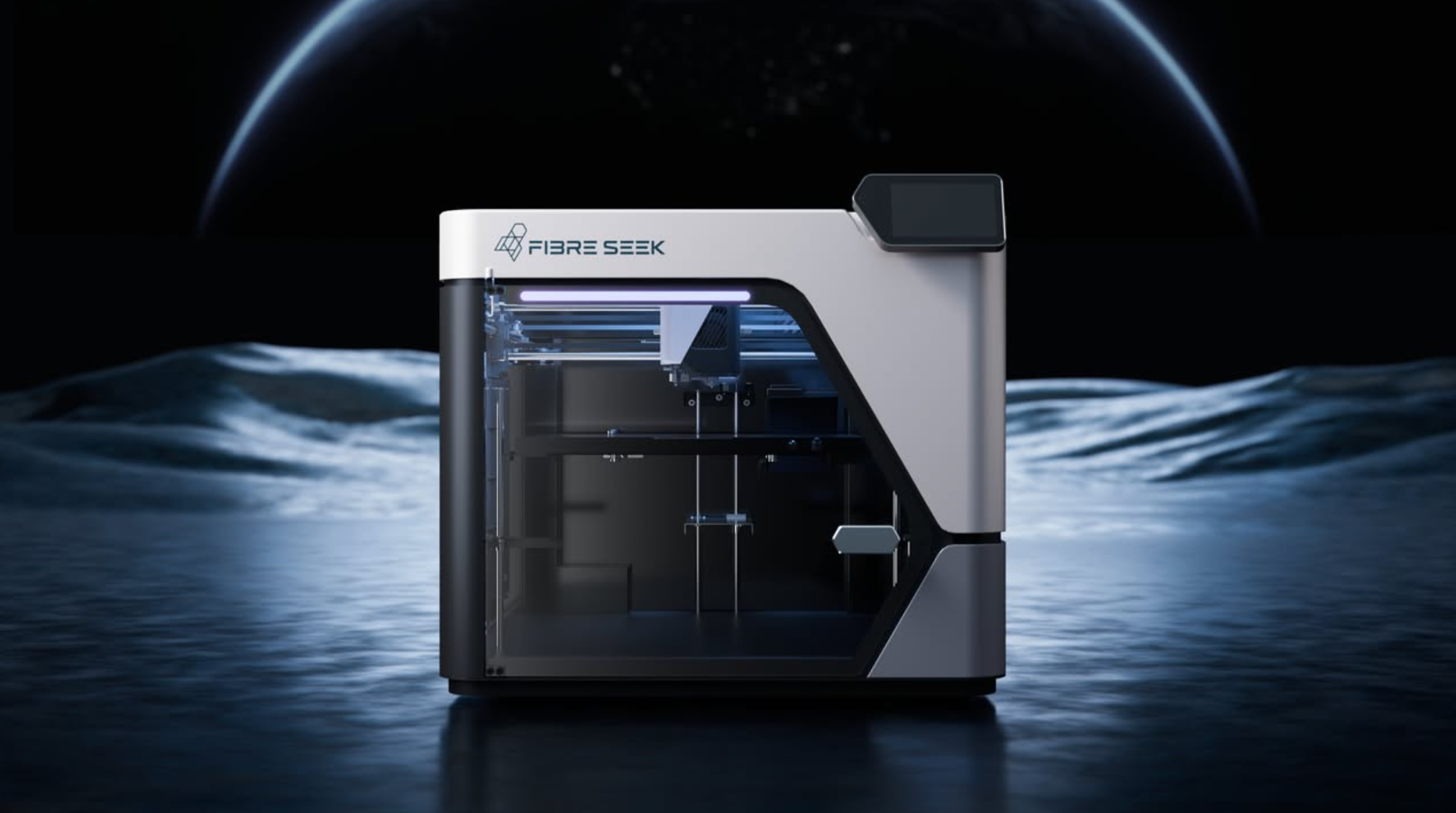
Continuous carbon fiber 3D printers offer a way to produce strong, lightweight parts, but the cost of industrial systems has kept it beyond the reach of many individual engineers and small teams.FibreSeek, a pioneer in desktop continuous fiber 3D printing, developed the FibreSeeker 3 to bring that capability to a wider audience, combining continuous fiber reinforcement with thermoplastic printing in a consumer-focused system.Building on Anisoprint’s industrial continuous fiber technology, FibreSeek connects professional composite manufacturing with the needs of individual engineers, makers, and small R&D teams working on functional parts, from drone frames and robotic joints to RC airplane parts.
The Kickstarter campaign received $4,698,825 in pledges from 1,539 backers worldwide.That response demonstrated demand; the next stage has been turning the funded design into manufactured machines and a more accessible purchasing and delivery process.FibreSeek has now opened its U.S.
online store.Its current product listing identifies the printer as in stock and specifies domestic fulfillment arrangements, giving prospective buyers more concrete information about how an order will reach their workshop.For teams planning their next development cycle, that connection between manufacturing capability and availability matters: a printer’s value depends on both the parts it can produce and when it can be put to work.
From Crowdfunding to Production and U.S.Fulfillment FibreSeek’s desktop platform builds on Anisoprint’s track record as a pioneer in continuous fiber 3D printing.Founded in 2015, Anisoprint introduced its first desktop Composer system in 2018, establishing a foundation in composite printing before the development of FibreSeeker 3.
That experience supports an approach that brings hardware, slicing software, and reinforcing materials together for users working on functional parts.The company’s development has also attracted institutional investment.Anisoprint received funding from Sequoia Capital, in 2023.
That backing adds a financing track record to the industrial technology heritage behind FibreSeek’s desktop platform, while the FibreSeeker 3 campaign demonstrates interest from engineers and individual users worldwide.Following community feedback during crowdfunding, the team undertook an engineering evaluation and upgraded the product from Version 1.0 to Version 2.0.The changes involved additional supply-chain costs and adjustments to the original delivery plan.
That history helps explain the development timeline without treating a successful campaign as proof of completed fulfillment.With a technology base spanning industrial systems and consumer desktop printers, the business addresses both enterprise engineering needs and individual users.This reach gives FibreSeek a foundation for expansion across professional and consumer applications as it moves from crowdfunding to wider commercial availability.
Continuous Fiber Changes How a Part Carries Load Many familiar carbon-fiber-filled printing filaments contain short, chopped fibers mixed into a thermoplastic.Depending on the formulation and printing conditions, those fibers can improve stiffness and dimensional stability, but they do not form an uninterrupted reinforcing path through the part.The FibreSeeker 3 uses Composite Fibre Co-Extrusion (CFC) to combine continuous reinforcing fibers with thermoplastic during printing.
Keeping the fibers continuous allows reinforcement to follow selected paths within the geometry, helping transfer loads along the fiber direction.This gives designers another way to balance strength, weight, and geometry.A robotic joint can receive reinforcement around its load-bearing regions, while a drone component can concentrate material where rigidity is needed.
The engineering value comes from controlling where reinforcement contributes, rather than simply adding more material everywhere.Making Composite Printing a Usable Workflow Continuous fiber placement adds decisions that conventional plastic printing does not require.Users need to consider where forces act, how fibers travel through the part, and which regions need reinforcement.
Software therefore plays a central role in turning the hardware’s capability into a repeatable preparation process.FibreSeek’s Rocket Slicer combines customizable toolpaths with native machine integration in an accessible workflow, from model preparation and reinforcement planning to print setup.Engineers can plan reinforcement within the part while retaining control over the settings that affect its construction.
Three modes address different production priorities.Speedy uses conventional FFF printing for quick iterations; Reinforced combines thermoplastic printing with selective continuous fiber reinforcement; Fortified focuses on continuous-fiber composite construction.Users can choose the approach according to the part’s purpose and material requirements.
The platform combines support for common thermoplastics with dedicated continuous carbon and glass fiber materials.That flexibility allows an early geometry check and a reinforced functional version to remain within the same equipment workflow.Hardware That Supports the Process The FibreSeeker 3 pairs a dual-nozzle system with a 300 × 300 × 245 mm build volume.
A 65°C actively heated chamber, automatic leveling and calibration, and an integrated monitoring camera support preparation and print oversight.These features address practical steps in producing a part: managing the build environment, preparing the first layer, and observing progress.They complement reinforcement planning, while material preparation and suitable print settings remain part of the process.
Speed also needs to be understood in context.The listed maximum of 500 mm/s applies to FFF printing; the continuous fiber process is rated separately at up to 20 cc/h.A reinforced part’s production time depends on its geometry, material choices, and the extent of fiber placement.
Where Small Teams Can Put It to Work A small engineering team developing a drone frame must consider stiffness, mass, mounting geometry, and the time required to test the next revision.Desktop continuous fiber printing allows the team to explore reinforced designs in-house and adjust the geometry and reinforcement between tests.Robotics presents similar demands.
Arms, joints, and mounting components may benefit from targeted reinforcement without making every region equally dense.For RC aircraft, the same design approach can support lightweight brackets and structural components shaped for a particular assembly.FibreSeek’s published examples include robotics joints, drone frame, and engineering functional testing.
These applications illustrate the platform’s intended role across functional prototyping and small-batch production, where customized geometry and short iteration cycles can matter as much as production volume.A More Concrete Route to the Workbench With its U.S.store and domestic fulfillment network, FibreSeek is making the FibreSeeker 3 more accessible to American engineers and makers.
In-stock orders normally ship within one to two business days after payment confirmation.The launch connects FibreSeek’s industrial composite printing experience with the practical needs of smaller teams: access to equipment, control over reinforcement, and the flexibility to develop parts in-house.By bringing hardware, Rocket Slicer, and continuous fiber materials into one desktop workflow, the FibreSeeker 3 gives those teams a way to move from an initial design to reinforced functional parts—and refine them as their projects evolve.
Subscribe to Our Email Newsletter Stay up-to-date on all the latest news from the 3D printing industry and receive information and offers from third party vendors.Print Services Upload your 3D Models and get them printed quickly and efficiently.Powered by FacFox Powered by 3D Systems Powered by Craftcloud Powered by First Mold Powered by Xometry 3DPrinting Business Directory 3DPrinting Business Directory
Read More