For military units operating in remote locations, getting a replacement part isn’t always easy.A missing bracket, damaged fixture, or broken component can leave troops waiting days or even weeks for replacement parts to arrive.But what if troops could manufacture some of those parts themselves, using plastic waste already available on-site? That’s the idea behind the work of Austin, Texas-based re:3D, a large-format 3D printer manufacturer developing systems that can turn recycled plastics into usable parts.
America Makes says re:3D is working to make it easier for military personnel to produce the parts they need on-site, rather than relying on shipments from distant suppliers.At the center of this effort are re:3D’s GigabotX 2 printer and its GigaLab, a portable manufacturing system that combines plastic recycling with large-format 3D printing.GigabotX 2.
Image courtesy of re:3D.Turning Waste Into Manufacturing Material Unlike conventional fused filament fabrication (FFF) systems, which use spools of filament, re:3D’s GigabotX 2 uses fused granulate fabrication (FGF) to print directly from plastic pellets and other suitable materials.As re:3D senior engineer Patrick Ferrell explained to America Makes, this allows the company to work with plastics that would be difficult or expensive to turn into filament, including flexible and recycled materials.
The company’s GigaLab takes that capability a step further by putting the manufacturing process inside a deployable container.The system is designed to process plastic waste through several stages, including grinding, drying, and 3D printing.Interior view of the mobile container unit with the Gigabot X and power systems.
Images courtesy of re:3D/USAF.Discarded plastic water bottles, for example, could be recycled and used to 3D print tools, fixtures, drone brackets, or temporary replacement parts.For military personnel working in remote locations, that could mean making certain components on-site instead of waiting for new supplies to arrive.
There are limits to what recycled plastic can be used for, of course.Not every military part can be 3D printed, and the materials still need to meet the requirements of each application.But for less demanding components, producing parts locally could save time and reduce the need for shipments.
Taking 3D Printing Into Remote Operations The technology has already attracted interest from the U.S.Air Force.Personnel at an Air Force Special Operations Command wing tested a GigaLab system housed inside a shipping container, exploring how discarded plastic could be turned into useful parts in the field.
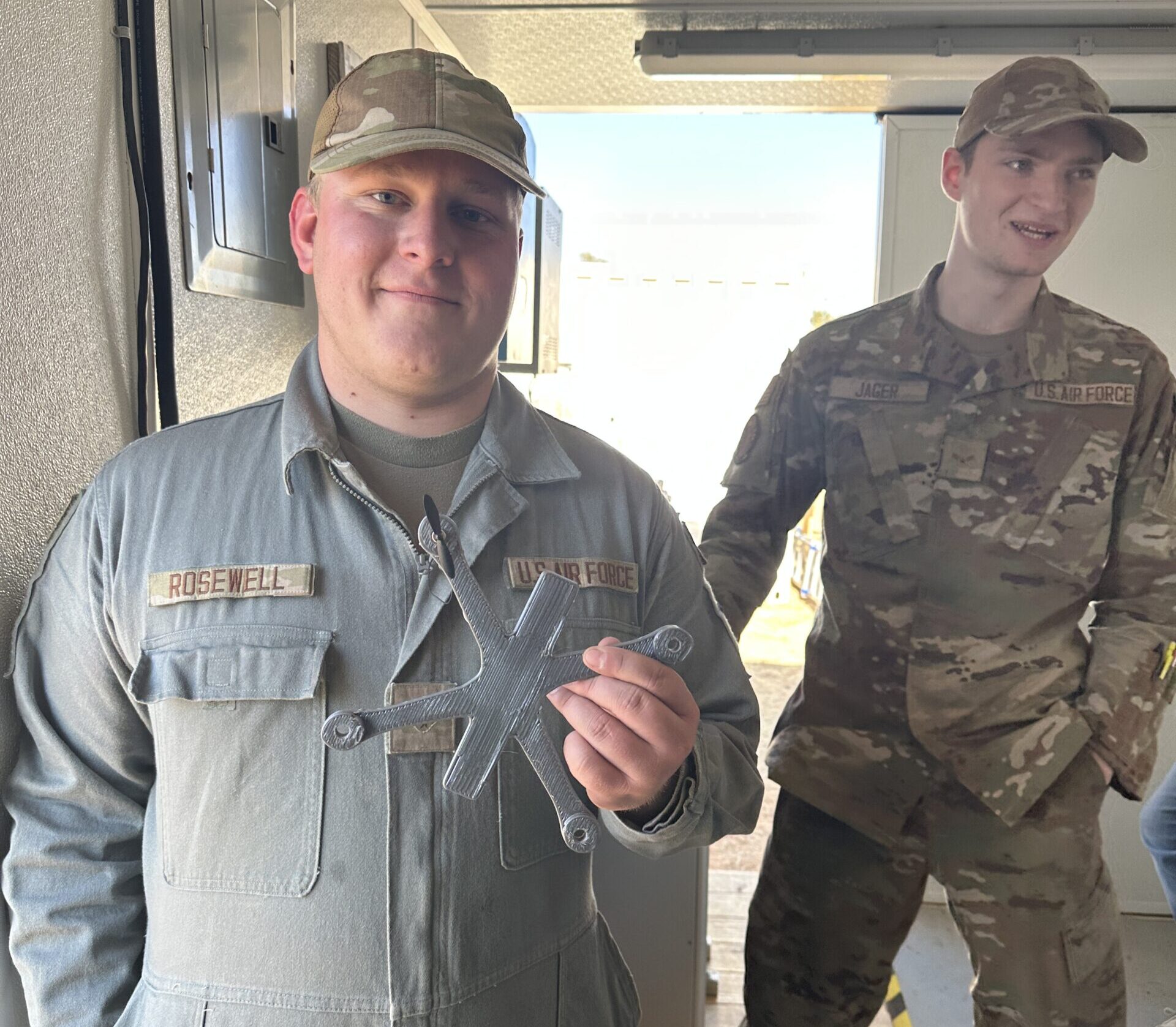
Airman holding early prototypes of recycled 3D-printed drone frames.Images courtesy of re:3D/USAF.The GigaLab can operate off-grid, allowing military personnel to turn plastic waste into useful tools and parts even in locations without reliable power or manufacturing facilities.
It’s also part of a growing effort to bring 3D printing closer to where military equipment is being used.Instead of relying only on large manufacturing facilities, defense organizations are looking at ways to give personnel the tools to make what they need directly in the field.Of course, there are still challenges to overcome before systems like this can be used more widely.
The recycled materials need to be processed properly, the printed parts need to meet quality standards, and military teams need to know which components can safely be made this way.America Makes and the Next Generation of AM Skills Beyond its hardware development, re:3D is also working with America Makes on additive manufacturing (AM) education and workforce development.The company participated in the Institute’s Train-the-Trainer workshop, which helps organizations expand access to AM education through the Additive Edge curriculum and microlearning resources.
re:3D also connected several educational organizations with the America Makes AMNation Pipeline Portal.These included Brookwood in Georgetown, which supports adults with intellectual and developmental disabilities; Seabrook Intermediate Science Magnet School, serving more than 50 students; and Houston Community College, where 12 students piloted an industry certification exam.re:3D co-founder Samantha Snabes.
Image courtesy of America Makes.For re:3D co-founder Samantha Snabes, who brings military experience to the company, education is an important part of making advanced manufacturing more accessible.The company sees training educators, community colleges, and other organizations as a way to build the skills needed for broader adoption of AM.
That training also matters in military settings.Deploying a 3D printer is one thing, but personnel need to know how to operate it, handle different materials, and determine which parts can safely be manufactured in the field.A Different Approach to Military Supply Chains For re:3D, the focus is on making better use of materials that might otherwise be thrown away.
Its GigaLab system brings recycling and 3D printing together in a portable setup, offering military teams another way to produce tools and replacement parts when conventional supplies are difficult to access.The work also fits into America Makes’ broader efforts to support new manufacturing technologies and expand AM training.While there are still questions around material quality, reliability, and how widely these systems can be deployed, re:3D’s approach offers one example of how recycling and 3D printing could play a larger role in military manufacturing.
Subscribe to Our Email Newsletter Stay up-to-date on all the latest news from the 3D printing industry and receive information and offers from third party vendors.Print Services Upload your 3D Models and get them printed quickly and efficiently.Powered by FacFox Powered by 3D Systems Powered by Craftcloud Powered by First Mold Powered by Xometry 3DPrinting Business Directory 3DPrinting Business Directory
Read More