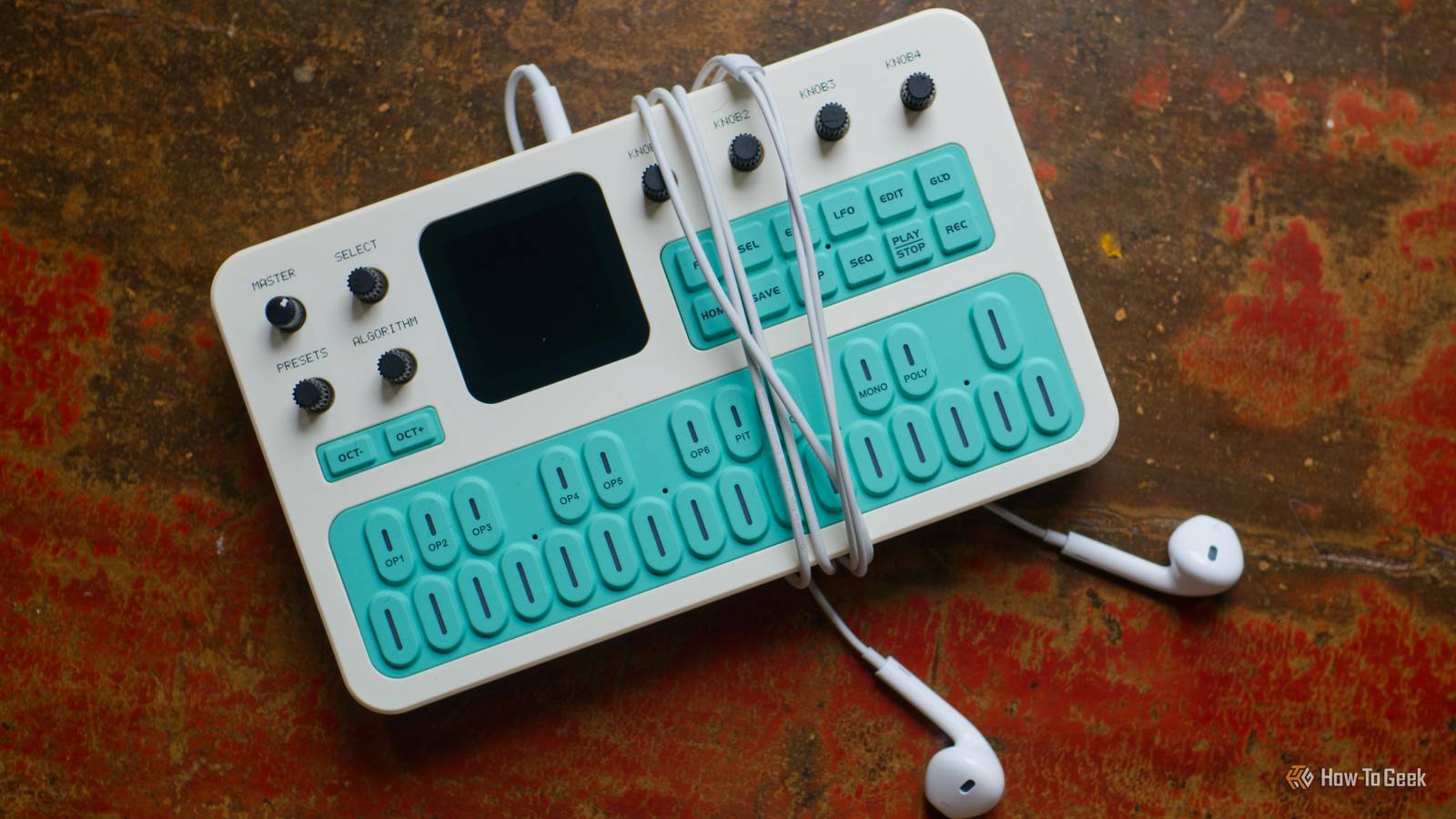
When you think of synthesizers, a $50 USB-C rechargeable slab of plastic isn’t what normally springs to mind.But that’s exactly what has set the internet alight at the tail end of 2026, and it’s having big implications for an established market of music hardware manufacturers.Add How-To Geek on Google Add as Preferred Source Follow on Google Discover Introducing the M-VAVE FM1 A compact, battery-powered synth Close The M-VAVE FM1 is a pocket-friendly FM synthesizer that retails for around $50.
FM stands for “frequency modulation,” and it’s a type of audio synthesis that emerged in the late 60s and went on to define the sound of the 80s.It differs quite dramatically from the technique of subtractive synthesis, which is associated with the warm tones and R2D2-esque beeps and boops of earlier instruments.A key turning point in the adoption of FM synthesis came in the form of the Yamaha DX7, an iconic digital synthesizer that launched for $1,995 in 1983 (almost $6,900 in 2026).
The glassy, metallic, digital sounds of the DX7 became synonymous with music of the time, with “electronic piano” and robotic choral vocals among the most recognizable.The M-VAVE FM1 is essentially a Yamaha DX7 that fits in your pocket.In addition to being loaded with sounds that are familiar to any 80s kid, the synthesizer is also compatible with dexed patches—custom sounds that can be loaded onto real and emulated DX7 hardware.
You can find the FM1 on websites like AliExpress in a variety of colors.It features a small keyboard, several knobs for tweaking values and cycling through the various functions, and buttons for navigating the synthesizer’s various menus.There’s also a small LCD screen, a USB-C port for charging and computer connection, ports for headphones and MIDI, and a small speaker.
In its stock format, the FM1 is a basic synthesizer.It makes sound when you press buttons, allows you to browse through or program your own sounds, and gives you access to sounds that others have created by connecting it to a computer.But it’s what the FM1 does when you start playing around that’s most interesting.
The FM1 has taken on a life of its own Flash, play, repeat While the FM1 is a true FM synthesizer in that it is built on hardware that’s specifically designed to sound like the DX7 and instruments like it, the device has been completely transformed by the community that has latched onto it.This has been achieved by flashing the device with custom firmware to completely change what the FM1 is capable of.The Firmware Hub is a resource that has emerged to keep track of the various FM1 custom firmware, with 180 different firmware types listed as of writing.
With a compatible browser (that’s Chrome or Edge), you can flash your FM1 with one of these custom firmwares right in your browser.Custom firmware focuses on different sound engines (including the ability to synthesize virtual analog instruments like Moog synthesizers), sample playback, wavetable synthesis, and more.This pocketable toy synth has been turned into a complete groovebox with the arrival of firmware like SLOOP, JIANT, and Skiff.
These projects turn the FM1 into a mini studio, allowing you to record various parts and compose whole songs.Other interesting uses include trackers (which were traditionally used to compose chiptune in classic video games), drum machines and samplers that squeeze every drop out of the FM1’s limited pool of memory, and strange contraptions like FM1 Doom (yes, it plays ).My personal favorite so far is GR!MM, which is designed to create “dark ambient, dungeon synth and deathdream.” Other hardware manufacturers are taking notice The cat is out of the bag The FM1 is a lot of fun to mess around with, and I was installing custom firmware on mine within about 20 minutes of unpacking the China Post parcel.
It’s worth the price of admission if you’re remotely curious, though there’s a good argument to be made for installing a custom boot loader like m-bootloader so that you can unbrick your FM1 if something goes wrong during a flash.Beyond this, there are signs that the FM1 experiment is having a serious knock-on effect on other hardware manufacturers.Right now the FM1 isn’t the only instrument receiving a deluge of custom firmware releases, thanks in large part to vibe coding.
Behringer, a longstanding manufacturer of audio equipment, shared code and mockups for a new product called the Kick on its GitHub page.The company later posted an update on Facebook describing the project as “our first open-source hardware sampler” with a target price of $150.For context, this device closely resembles the AKAI MPC One, an instrument that retails for $800 or more.
There are even signs that Behringer is applying a similar model to its guitar pedals, with a range of offerings supposedly coming for “just $10-15 each.” Once again, words like “open-source” and “hack” are used liberally.The idea seems to be that the FM1’s success can be imitated by saving money on software development by having the community do it.Behringer has an established reputation for being a roguish manufacturer of musical devices, taking established hardware and making it affordable.
The Kick with its $150 target takes things to another level.The FM1 is the most exciting thing to happen to the synthesizer space in a long time, and it’s surely a sign of things to come.While vibe coding firmware for a pocket synth is fairly innocuous, using coding agents without understanding the underlying code can be seriously dangerous in other areas.
Read More