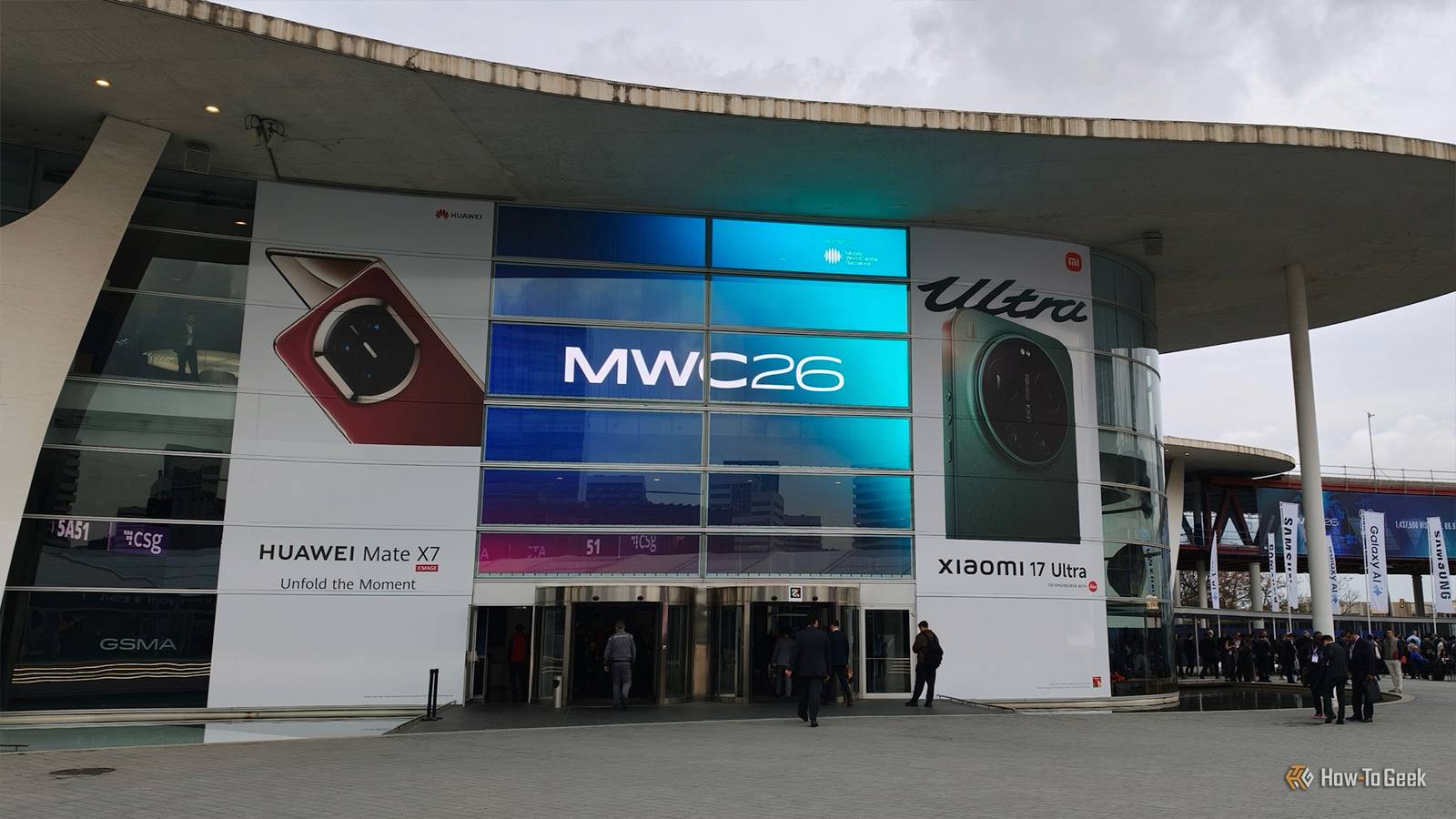
We're in the swing of MWC 2026, the annual smartphone and consumer electronics trade show where leading brands announce their latest products.Unsurprisingly, there's no shortage of cool tech to talk about, but these are our favorites of 2026.Best Concept: TECNO Modular Phone Ultra-thin phone design finally gets put to good use Ultra-thin smartphones like the iPhone Air and Galaxy S25 Edge sacrifice battery life, camera quality, and other key features to achieve their slim figure.
They're thin for thin's sake, which isn't really all that exciting.TECNO takes this idea to the extreme with its modular concept phone.Shown at MWC 2026, the device measures just 4.9mm thick—about 1mm less than Samsung and Apple's offerings, and far too thin to accommodate a USB-C port.
But this thinness gives the concept device a surprisingly practical superpower: it can attach to a range of magnetic modules, including telephoto lenses, action cameras, battery packs, wallets, belt clips, kickstands, and more.Modular smartphones are nothing new, of course.Several brands have offered modular Android phones over the years, most notably Motorola with its Moto Z series.
Google also pursued the idea in 2011 after buying modular-smartphone patent from a short-lived company called Modu, but the modular philosophy never trickled down into Nexus or Pixel phones.But it's been a while since we've seen something like this.TECNO's concept is notable for its super-thin design and content-creator-friendly accessories—it feels like a product of the mid-2020s, as opposed to some early, chunky Android hardware experiment.
As for whether the TECNO modular phone will ever be sold in North America (or any other region): It's not impossible, but we're not holding our breath.TECNO showed off a total of 10 concept devices at MWC 2026, mind you.Best Networking: 6G Here we go again! It took about seven years, but we've finally reached the point where 5G cellular networks are available in most of the United States.
And we've clearly benefitted from 5G's deployment—cellular network quality is much higher than it was a decade ago, and high-speed 5G home internet is a blessing.But we never got the autonomous "connected cities" that carriers promised.mmWave speeds are much rarer than they should be, and despite the doomsday warnings from conspiracists, 5G proved to be an ineffective form of mind control.
There's a lot of progress to be made in cellular network technology (especially that mind control thing), so Qualcomm is using MWC 2026 as the springboard for its 6G initiative.And although the company doesn't seem to have a clear idea about what the extra "G" will do for us, it's offered a few proposals that may sound familiar.The 6G standard will accelerate smart glasses adoption by providing the necessary bandwidth for streaming AR and XR content, and it'll lead us into a "hybrid AI" future where computing is distributed through a dense cellular cloud network.
Out of all the things that Qualcomm has suggested, the only thing is "sensing capability".Essentially, 6G can remotely track vehicles, drones, and other objects.This will aid in the development of fully-autonomous vehicles, though it'll also provide a new backbone for "national security" in the era of spy drones and other threats.
This "national security" promise is vague and obviously crafted to bring in lucrative military contracts, but it raises some genuine questions about privacy and surveillance.And, of course, it creates fertile ground for future conspiracy theories.Qualcomm is giving us a preview of the conversations, arguments, and delusions we will experience well beyond 2030 (the year that 6G deployment is expected to begin), so we feel compelled to give 6G an extremely premature award.
Best Smart Home: eufy Lawn Mower C15 A robot mower that actually appeals to the average homeowner Robotic lawn mowers are an exciting but frustrating niche.They actually work quite well, but the affordable models require a boundary wire, which practically requires professional installation if your yard is reasonably large.Expensive robot mowers utilize a vision and mapping system instead of a frustrating boundary wire, but they sit in the $1,000 to $2,000 price range, which is far more than what the average person pays for regular landscaping each year.
(And even if you're paying someone $1,000 to take care of your yard, it's not like they're mowing the grass).Now, Eufy is taking a massive step in the right direction with its new C15 robot mower.Revealed at MWC 2026, the C15 utilizes Eufy's Vision FSD system, which we smothered with praise when reviewing the company's $2,300 E15 mower last summer.
Here's the cool thing—the new C15 costs just €899 MSRP, approximately $1,050 USD.It's intended for relatively small lawns up to 500m² (about 0.12 of an acre), though this is arguably the market that companies like Eufy should be targeting, as it has the highest potential consumer base.One important thing to note here is that the aforementioned E15—the one that sold for $2,300—has dramatically dipped in price since its launch.
It now sells for about $1,800 and (at the time of writing) is on sale for just $1,000.It's reasonable to assume that the C15's price will also fall below MSRP, making it an incredibly appealing option for homeowners who want to foist their mowing responsibilities onto a robot from a well-known, pretty trustworthy brand.Unfortunately, North American pricing and availability has yet to be announced, but the C15 will arrive in the EU by June 2026.
Best Business Laptop: Lenovo ThinkPad T14 Gen 7 A lighter ThinkPad with repairable ports and modern AI silicon The ThinkPad T-series has been a mainstay in Lenovo's business laptop lineup for years, so the refresh shown at MWC 2026 focused more on modernization than reinvention.The ThinkPad T14 Gen 7 can be configured with Intel Core Ultra processors with vPro or AMD Ryzen AI PRO 400 Series processors, both of which include NPUs designed for on-device AI workloads.What makes the T14 Gen 7 stand out are the practical improvements that matter for enterprise deployments.
Lenovo is leaning into repairability again, with a replaceable battery, a replaceable keyboard, and improved internal serviceability.The USB-C ports are now field-replaceable through a modular design, and the touchpad is easier to swap out, which should simplify repairs for IT teams.Some configurations also adopt LPCAMM2 memory, a newer modular RAM format that delivers the efficiency of LPDDR while remaining upgradeable.
That's a notable shift at a time when many thin laptops are moving toward fully soldered components.The rest of the package stays true to the ThinkPad formula: a 14-inch display with multiple panel options, modern connectivity like Wi-Fi 7, and the keyboard-first design the series is known for.Lenovo even introduced a new Cosmic Blue color option alongside the traditional black.
It's not the most dramatic laptop reveal at MWC, but the T14 Gen 7 shows how a well-established business machine can evolve with new silicon and better repairability without losing what made it successful in the first place.Best Accessory: Xiaomi Tag Cheaper than AirTags, and more versatile, too Xiaomi is entering the Bluetooth tracker fray, but it's not picking sides.The new Xiaomi Tag supports both Apple's Find My and Google's Find Hub tracking networks, meaning that it can be utilized by iPhone or Android owners.
A one-pack only costs £12.99 (around $18), a four-pack is £44.99 (about $60), yet Xiaomi Tag offers the same IP67 dust and water resistance as the costly Apple AirTag.Plus, its CR2032 is user-replaceable, and the tag supports NFC, so people can scan it for your contact details if they come across your lost luggage, your keys, or whatever you choose to attach the tracker to.But there are some caveats here.
For one, you can't use the Find My and Find Hub networks simultaneously—this restriction makes it impossible for Android owners to share the Xiaomi Tag with iPhone owners, and vise versa.More importantly, Xiaomi Tag doesn't support UWB, so it doesn't offer the precision tracking that you get with AirTags or the Moto Tag (though it's got a built-in siren, so it shouldn't be too hard to find if it gets lost between some couch cushions).And at £12.99 apiece, Xiaomi Tag is almost half the price of its UWB competition.
The integrated keychain loop, which AirTags and Moto Tags lack, is also a nice little money-saver.Xiaomi still needs to clarify some of the details here, specifically U.S.availability.
The company's U.S.presence is somewhat limited, so it's unclear whether Xiaomi Tag will be offered stateside.Best Wearable: PetPhone A remote camera, pet tracker, and pet cellphone MWC hasn’t been a huge show for wearables this year—unless you’re a cat or dog.
We’ve all seen devices that have the ability to track your pets with GPS, and many people simply use AirTags for this.But what do those trackers lack? Cellular connectivity, of course! The PetPhone is surprisingly exactly what it sounds like.It clips onto your pet’s collar and tracks their location and daily activity, but it also has a speaker and microphone.
You can call the PetPhone and let your pet hear your voice, and there’s even a camera attachment so you can see their POV.It gets weirder, though.You can train your pet to call you with the PetPhone as well.
All they have to do is jump three times in six seconds.What will they have to say? That’s between you and your pet.PetPhone is available now for $105 with one free month of service.
Best Smartphone: Moto Razr Fold The most premium-looking book-style foldable we've seen yet After teasing the Razr Fold at CES earlier this year, Motorola finally shared more details about its first book-style foldable at MWC.Now that all has been revealed, it’s clear this is a premium device, not the affordable book-style many were hoping for.Subscribe for MWC 2026 tech highlights and insightful coverage Get deeper perspective—subscribe to our newsletter for expert analysis of MWC 2026 innovations, context on tech trends like modular phones, 6G, and smart-home gear, and thoughtful takes that help you understand their impact.
Get Updates By subscribing, you agree to receive newsletter and marketing emails, and accept our Terms of Use and Privacy Policy.You can unsubscribe anytime.The device features a 6.6-inch external display and an 8.1-inch 2K internal display.
It has a 6,000mAh silicon-carbon battery, which is a first for the North American market, and the brand-new Snapdragon 8 Gen 5 chipset.That’s paired with 16GB of RAM and 512GB of storage.No corners are being cut here.
I really enjoy Motorola’s software choices, which is why I’m personally excited about the Razr Fold.The Razr is my preferred flip-style phone over Samsung’s Z Flip simply because you can do more with the external display, and it’s a cleaner Android UI.Book-style foldables have always felt too big for me, but the Razr Fold could get me to try one again.
The starting price is €1,999 (about $2,350), and that gets you the Moto Pen Ultra as well.It’s launching first in Europe and then in North America later this year.We don’t know the exact U.S.
pricing, but it should be similar to the Galaxy Z Fold 7.Best Tablet: Honor MagicPad 4 Incredibly thin and surprisingly powerful Android tablets aren’t generally super popular, but that doesn’t stop manufacturers from trying to push the boundaries.Honor’s new MagicPad 4 is a 4.8mm thin slice of glass and aluminum that makes almost every other tablet look bulky—and that includes the 5.3mm iPad Pro M5.
Despite the thinness, it manages to include eight speakers for spatial audio.However, Honor did have to trim the battery down to 10,100mAh battery.Under the hood, the tablet is just as modern as its exterior design suggests.
Its powered by the Snapdragon 8 Gen 5 chipset and offers up to 16GB of RAM.Honor previously announced the device last month, and it showed it off again at MWC, but the company still hasn’t shared pricing or a launch date.The MagicPad 4 is a sleek, highly premium piece of hardware, so it will almost certainly not be cheap.
Regardless, I have to appreciate Honor for going all out in a product category that’s mainly dominated by one company.
Read More