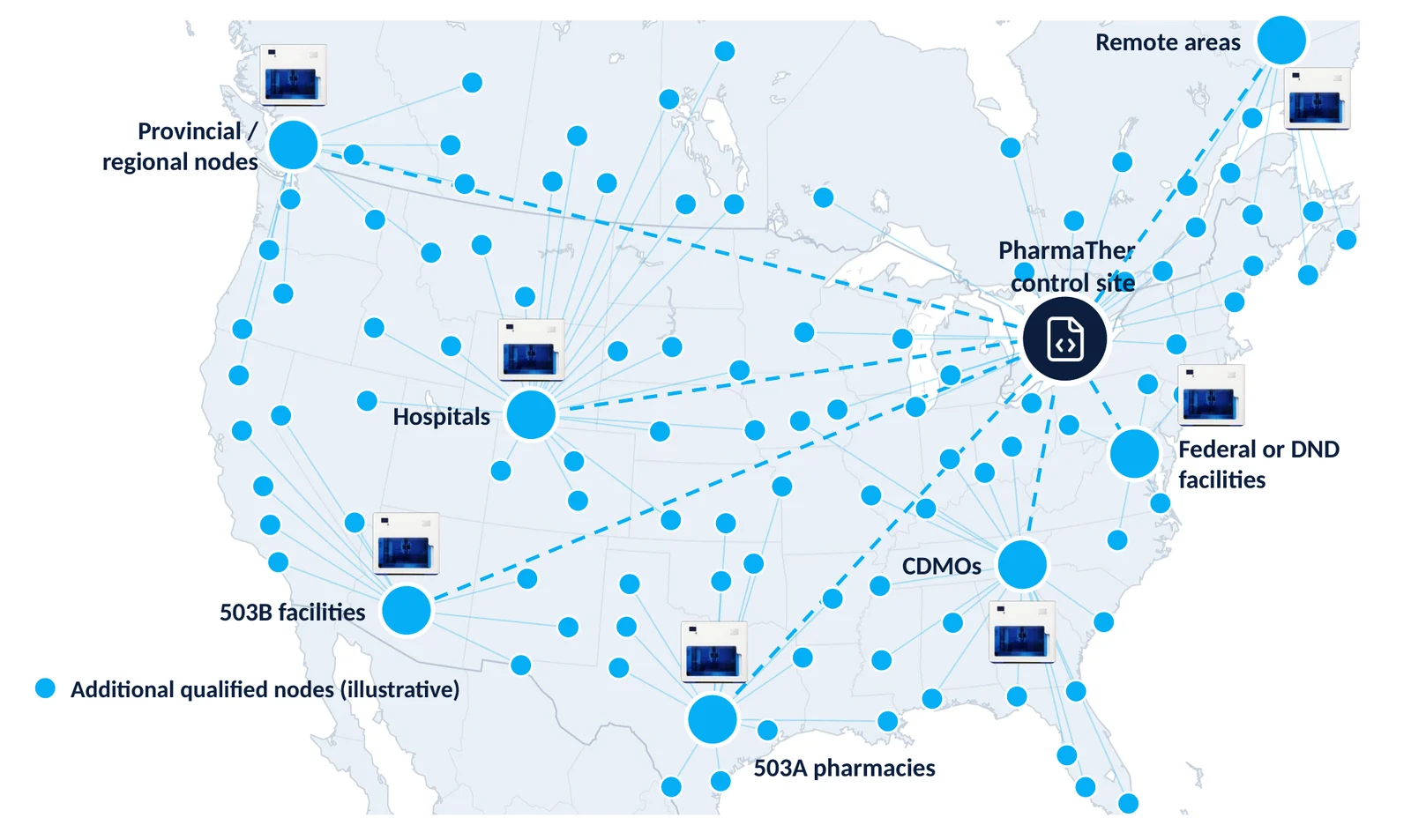
3D printing medicines has often been tied to the idea of personalization, basically making a pill in the right dose, shape, or drug combination for a patient.PharmaTher is now trying to build something much larger around that capability.The Canadian pharmaceutical company has launched its M3DICINES National Network Program, a plan to create a distributed network of sites that can 3D print medicines closer to where they are needed.
The program will begin with U.S.compounding pharmacies and could eventually extend to hospitals, contract manufacturers, research institutions, and government facilities.Instead of producing every medicine at a central plant and shipping finished doses around the country, PharmaTher’s model would distribute validated formulations and digital manufacturing instructions to qualified locations equipped with the same pharmaceutical 3D printing system.
From Individual Printers to a Manufacturing Network Every site in the proposed network will use Craft Health‘s CraftMake pharmaceutical 3D printer.PharmaTher became the exclusive North American distributor of the platform on October 1, giving it rights to distribute CraftMake printers along with CraftControl software, CraftBlends printable materials, consumables and services.Craft Health’s CraftMake printer to make polypill pharmaceuticals.
Image courtesy of Craft Health.The company is targeting up to 50 CraftMake placements over the next 12 months.Its first planned installations include PD Labs, a U.S.
503A compounding pharmacy that will serve as PharmaTher’s U.S.Center of Excellence, and an unnamed GMP contract manufacturer.Under the network model, PharmaTher and its partners would first develop and validate a formulation and its digital recipe.
Participating sites would then install a CraftMake system and complete qualification and training before producing medicines locally.The same network could support PharmaTher’s own products as well as partner programs, research projects and clinical trial supply.That makes the network more than a plan to sell pharmaceutical printers.
PharmaTher describes each machine as a piece of infrastructure in a larger manufacturing system.Why Make Medicines This Way? The model is mainly aimed at medicines that are difficult to produce in large quantities.Traditional pharmaceutical factories work best when they can produce large numbers of the same tablet.
That becomes harder when patients need different doses, only small batches are needed, or there is limited demand for a particular medicine.PharmaTher sees 3D printing as a way to make these smaller batches.This could include personalized doses, medicines for rare diseases and children, discontinued drugs, drugs in short supply, and small batches for research and clinical trials.
According to the companies, CraftMake can print different doses of the same medicine.The system works at room temperature and does not use heat or UV light, which means it can also handle some temperature-sensitive drugs.Each printed dose also comes with a digital batch record.
CraftMake after printing polypills.Image courtesy of Craft Health.The goal is to develop a drug formulation once and then produce it at different qualified locations.
This could make it easier to produce smaller amounts of a medicine without setting up a traditional production line each time.The FDA Is Also Looking at Distributed Drug Manufacturing PharmaTher’s network arrives as U.S.regulators are taking a closer look at distributed pharmaceutical manufacturing.
In July 2026, the U.S.Food and Drug Administration (FDA) proposed new rules for distributed drug manufacturing.The idea is to have one central hub oversee production at several smaller manufacturing sites in different locations.
Today, those sites generally have to register separately with the FDA.Under the proposed rules, some networks could register as a single operation.The FDA says this could make it easier to expand or move manufacturing sites and support more drug production in the U.S.
PharmaTher’s planned network is different, at least for now.It will initially focus on 503A compounding pharmacies, which operate under different rules, and compounded drugs are not FDA-approved.Still, the FDA proposal shows that regulators are looking at ways to make drugs across networks of smaller, distributed sites.
From Drug Shortages to National Emergencies The network could also have a role during emergencies.PharmaTher plans to use the same 3D printing sites to produce medicines locally when supplies are disrupted, or demand suddenly increases.In fact, according to PharmaTher, “qualified CraftMake locations could become nodes” in a planned National Emergency Preparedness Node Network.
During an emergency, PharmaTher says validated digital recipes could be released to those locations so that required doses could be produced locally.The company says the concept is intended to “complement existing national stockpiles rather than replace them.” Over the next year, PharmaTher plans to test the emergency network and seek contracts with U.S.and Canadian government agencies, although none have been announced so far.
For now, much of the national network is still in the planning stage.PharmaTher is targeting up to 50 printer placements, but those installations have not yet been completed, and each site must be qualified before it can join.If the company reaches that goal, dozens of sites could eventually use the same 3D printing platform to produce medicines locally across the U.S.
Subscribe to Our Email Newsletter Stay up-to-date on all the latest news from the 3D printing industry and receive information and offers from third party vendors.Print Services Upload your 3D Models and get them printed quickly and efficiently.Powered by FacFox Powered by 3D Systems Powered by Craftcloud Powered by First Mold Powered by Xometry 3DPrinting Business Directory 3DPrinting Business Directory
Read More