Computer storage has always been a problem.There never seems to be enough of it.Just as we get bigger disks and drives, file sizes swell to accommodate them.
So you can imagine in the '90s what a chore it was to move large media files or make backups when all you have are 1.44MB floppy disks.Even Iomega's 100MB Zip drives aren't enough when you take professional jobs into account.They not only need much more storage space, but also more speed.
The company had an answer for this though: the Jaz drive.The dream: Removable storage that behaved like a hard drive It seemed like the ultimate solution The only storage technology in the '90s that really ticked all the boxes for the use case the Jaz drive needed to fill was the humble hard drive.Hard drives were fast and could store multiple gigabytes of data at that point.
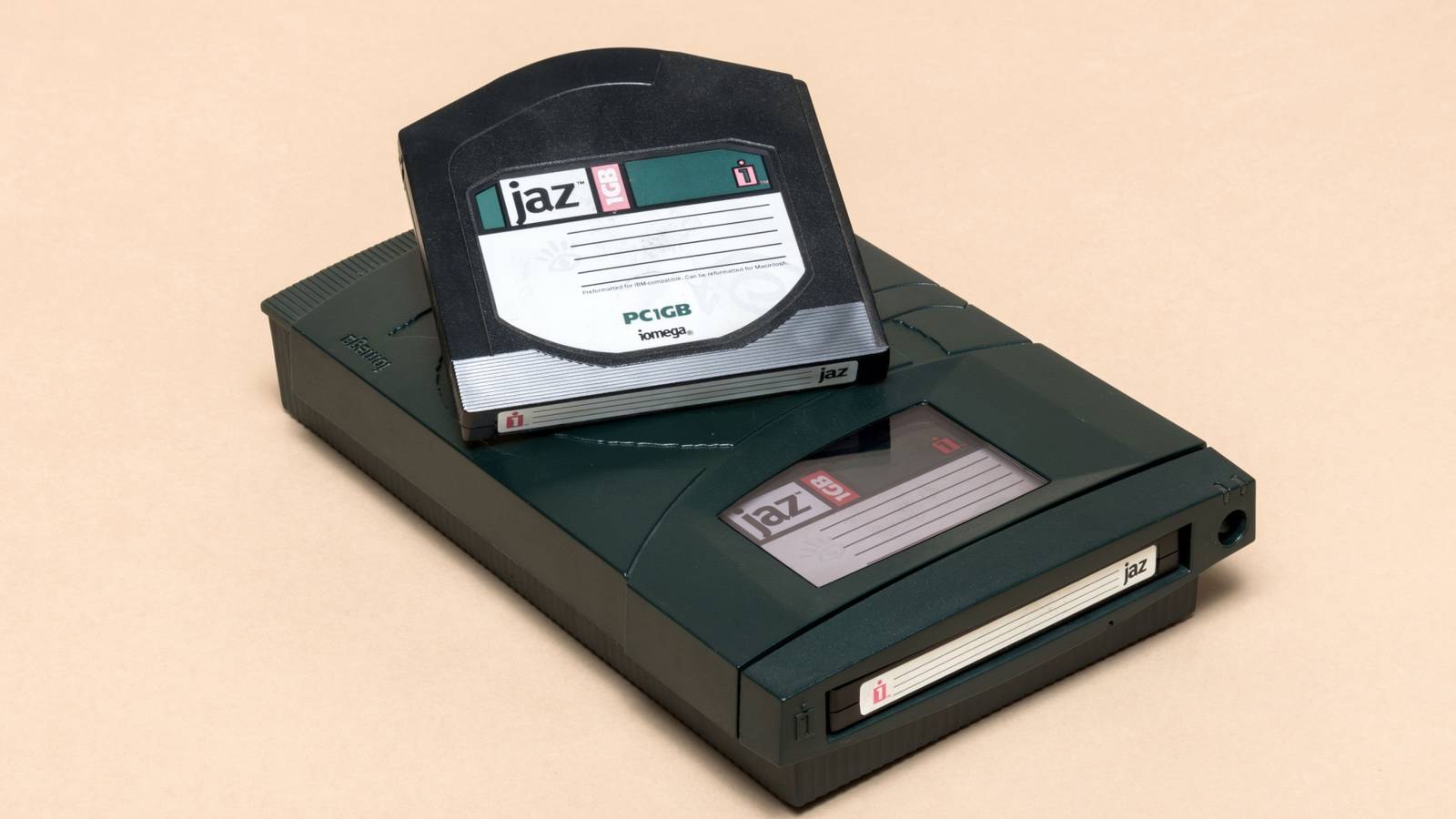
So, why not create a removable hard drive? To be clear, external hard drive technology already existed, but hard drives were expensive.The Jaz drive is effectively a hard drive with no platters, and the Jaz cartridge is a set of hard drive platters with no hard drive.Quiz 8 Questions · Test Your KnowledgeStorage Through the AgesFrom ancient clay tablets to modern SSDs — how much do you really know about the wild history and quirky facts of data storage?HistoryHardwareCapacityOdditiesModern TechBegin 01 / 8HistoryWhat was the storage capacity of the very first commercially sold hard disk drive, IBM's 350 RAMAC introduced in 1956?A1 megabyteB5 megabytesC10 megabytesD50 megabytesCorrect! The IBM 350 RAMAC stored a whopping 5 megabytes — and weighed over a ton.
It was the size of two refrigerators and leased for around $3,200 per month, which is roughly $35,000 in today's money.Not quite.The IBM 350 RAMAC, launched in 1956, stored just 5 megabytes of data.Despite that tiny capacity by modern standards, it was a revolutionary machine that filled an entire room and cost thousands per month to lease.Continue 02 / 8OdditiesWhich of these has genuinely been used as a data storage medium by researchers and engineers?AFrozen ice crystalsBDNA moleculesCSoap bubblesDTree ringsCorrect! DNA storage is a real and rapidly advancing field.
Researchers have successfully encoded entire books, images, and even operating systems into synthetic DNA strands, which can theoretically store 215 petabytes per gram of material.Not quite.The answer is DNA molecules.Scientists have encoded movies, books, and even malware into synthetic DNA strands.
DNA storage is extraordinarily dense — theoretically capable of holding 215 petabytes per gram — making it one of the most promising future storage technologies.Continue 03 / 8HardwareWhat does the 'SSD' in SSD storage stand for?AStatic State DriveBSolid State DriveCSequential Storage DeviceDSolid Silicon DiskCorrect! SSD stands for Solid State Drive.The 'solid state' refers to the fact that it uses solid-state electronics — NAND flash memory chips — with no moving mechanical parts, unlike traditional spinning hard disk drives.Not quite.SSD stands for Solid State Drive.
The term 'solid state' comes from electronics jargon meaning the device uses semiconductor components rather than moving mechanical parts, which is why SSDs are faster, quieter, and more durable than HDDs.Continue 04 / 8CapacityApproximately how many standard 1.44 MB floppy disks would you need to match the storage of a single modern 1 terabyte hard drive?AAround 70,000BAround 350,000CAround 700,000DAround 1,400,000Correct! One terabyte equals roughly 1,048,576 megabytes, and dividing by 1.44 MB per floppy gives you about 728,000 disks.Stacked, that pile would be taller than most skyscrapers — a humbling reminder of how far storage has come.Not quite.You'd need approximately 700,000 floppy disks to match a single 1 TB drive.
That stack of disks would reach over a mile high if laid flat, which is a staggering way to visualize the enormous leap in storage density over just a few decades.Continue 05 / 8HistoryWhat storage medium did NASA use to store data from the original Apollo moon missions in the 1960s and 1970s?AEarly magnetic hard disksBMagnetic tape reelsCPunched paper cardsDOptical laser discsCorrect! NASA relied heavily on magnetic tape reels during the Apollo era.In fact, thousands of original Apollo-era data tapes were eventually lost or accidentally erased and reused, leading to a massive archival effort years later to recover what footage remained.Not quite.NASA used magnetic tape reels to store Apollo mission data.
Tragically, many of these original tapes were later lost or even deliberately erased and reused due to tape shortages, which is why some original high-quality Apollo footage is gone forever.Continue 06 / 8Modern TechWhat is the name of the technique used in modern NAND flash storage that stores multiple bits per cell to increase density?AQLC (Quad-Level Cell)BMRC (Multi-Read Cell)CDBC (Dual-Bit Compression)DTPC (Triple-Pack Cell)Correct! QLC, or Quad-Level Cell, stores 4 bits per cell and is used in high-capacity, budget-friendly SSDs.While it offers great density and lower cost, QLC NAND typically has lower endurance and slower write speeds compared to TLC (3-bit) or MLC (2-bit) designs.Not quite.QLC stands for Quad-Level Cell, and it's a real NAND flash technology that stores four bits per cell.
It allows for very high storage densities at lower cost, but trades off endurance and write performance compared to older, less dense cell types like MLC or SLC.Continue 07 / 8OdditiesThe Svalbard Global Seed Vault in Norway stores seeds for agricultural preservation — but what famous tech company also operates a nearby 'Arctic Code Vault' to preserve software?AGoogleBMicrosoftCGitHubDIBMCorrect! GitHub operates the Arctic Code Vault in Svalbard, Norway, where they stored a snapshot of all active public repositories on film designed to last 1,000 years.The project is part of GitHub's Arctic Vault Program to preserve open-source software for future generations.Not quite.It's GitHub — owned by Microsoft — that runs the Arctic Code Vault.
In February 2020, they photographed every active public repository onto special archival film and stored it deep within a decommissioned coal mine in Svalbard, designed to last a thousand years.Continue 08 / 8HardwareWhat was the primary reason early floppy disks were called 'floppy'?AThey failed frequently and were considered unreliableBTheir magnetic coating was applied in a loose, uneven layerCThe plastic disk inside was thin and physically flexibleDThey could be folded and stored flat in a walletCorrect! Early floppy disks — especially the original 8-inch variety from IBM in 1971 — used a thin, genuinely flexible magnetic disk inside a soft protective sleeve.You could literally flop the thing around.Later 3.5-inch versions came in rigid plastic cases, but kept the 'floppy' name.Not quite.
The name 'floppy' came from the physical flexibility of the magnetic disk inside the sleeve.The original 8-inch IBM floppy disks introduced in 1971 had a noticeably limp, floppy disk that you could bend.Even the rigid-cased 3.5-inch disks that followed kept the iconic nickname.See My Score Challenge CompleteYour Score/ 8Thanks for playing!Try Again When you insert the cartridge into the drive, a motor engages the hub of the platters, and read-write heads enter the cartridge through a hole covered by a retracting metal cover.
Jaz cartridges are remarkably small, with a slightly larger footprint than a 3.5-inch floppy, while being as thick as around three of them.You get speeds more like an internal hard drive, but without the cost of multiple expensive hard drives with motors, mechanical parts, and electronics.UGREEN NASync DXP2800 Brand UGREEN CPU Intel 12th Gen N-Series This cutting-edge network-attached storage device transforms how you store and access data via smartphones, laptops, tablets, and TVs anywhere with network access.
Memory 8GB (Upgradeable to 16GB) Drive Bays 2 x 22TB Ports 2.5GbE, USB-C, USB-A (x3) Caching Expandable up to 8TB OS UGOS Dimensions 7 x 9 x 4 inches Weight 3.5lbs $699 at Ugreen See at Amazon Expand Collapse Why hot-swappable storage sounded like the future People were hot-to-swap The first Jaz disks offered 1GB of storage, and later we would get 2GB disks.That doesn't sound like a lot today, but you have to consider this in context.At the start of the '90s, a typical home PC might have a 40MB hard drive, which is exactly what our family 80286 PC had back then.
Over the course of the '90s, HDD sizes grew rapidly, and by the mid- to late '90s, when the Jaz drive was relevant, a typical household PC might have 500MB to 2GB of storage space.If you were rich or your employer was footing the bill, you might have 10GB of hard drive space, with 20GB being the pinnacle of consumer storage capacity by the end of the '90s.So a 2GB removable disk was a deal.
You could back up the entire typical computer system disk to a single Jaz disk and still have room left.Video editors, programmers, database engineers, there was no end to the list of people for whom a 1-2GB removable disk was a godsend.The fatal flaws hiding under the hood Put together with that classic '90s engineering On paper, it looked like the Jaz was set up for success, and it didn't exactly .
Jaz drives sold well enough that Iomega supported them into the early 2000s.However, there were some issues with the technology.First, there's a reason that hard drives are carefully sealed.
Dust and hair getting into the platters was an issue, and the best Iomega could do was offer a plastic protective dust cover and hope that people would use it.Jaz drives also developed a bit of a reputation for being untrustworthy.Like the Zip drive, the Jaz drive had its own version of the "click of death" though in this case it related to a jammed drive that would not eject.
That undermined using them for critical backups.The cartridges weren't as expensive as entire hard drives, but they were expensive, as were the drives.So they really only made financial sense for very specific users where they'd need lots of disks which would work out cheaper than heaps of external drives.
Subscribe to the newsletter for more retro tech tales Want the next deep dive? Subscribe to our newsletter to unlock more forgotten storage innovations, engineering trade-offs, and technical retrospectives that reveal how past designs influence today's hardware and practices.Get Updates By subscribing, you agree to receive newsletter and marketing emails, and accept our Terms of Use and Privacy Policy.You can unsubscribe anytime.
The final significant issue was the reliance on SCSI interfaces for both internal and external Jaz drives.Most home PC users did not have SCSI cards, this was a professional interface for high-end machines.Mainstream external drive solutions used the serial or parallel ports, and internal drives used an IDE connection.
Relying on a niche connection standard limited how many people could even use a Jaz drive.By the end of the '90s, USB had established itself as the new standard for peripheral connection.I do wonder if a USB 2.0 Jaz drive could have made a difference, but Iomega did sell a USB adapter (along with FireWire and parallel port options) and that didn't seem to make much of a difference.
WD 16TB Elements Desktop External Hard Drive Storage Capacity 16TB Brand Western Digital The WD Elements Desktop External Hard Drive is great for your storage needs.It comes in sizes up to 24TB and supports USB 3.2 Gen 1 speeds for data transfer.$250 at Amazon $450 at B&H Photo Video Expand Collapse The market shifts that killed the Jaz dream It's hard to separate the eventual downfall of the Jaz drive from Iomega's overall woes, but I think the big problem was that the Jaz just didn't keep up with the rest of storage technology.
People quickly gained access to much bigger hard drives, so the need for Jaz drives as hot-swappable storage was reduced, and writable CDs (although much smaller in capacity) were dirt cheap on a per-megabyte basis and perfectly good as a medium-term backup medium.We still use external spinning platters today I think perhaps the rise of complete, sealed, and reliable external hard drives made it unnecessary for something like a Jaz drive to exist.Combined with the widespread adoption of USB, this quirky hard drive-based storage tech is now nothing more than a brief footnote in computer history.
Read More