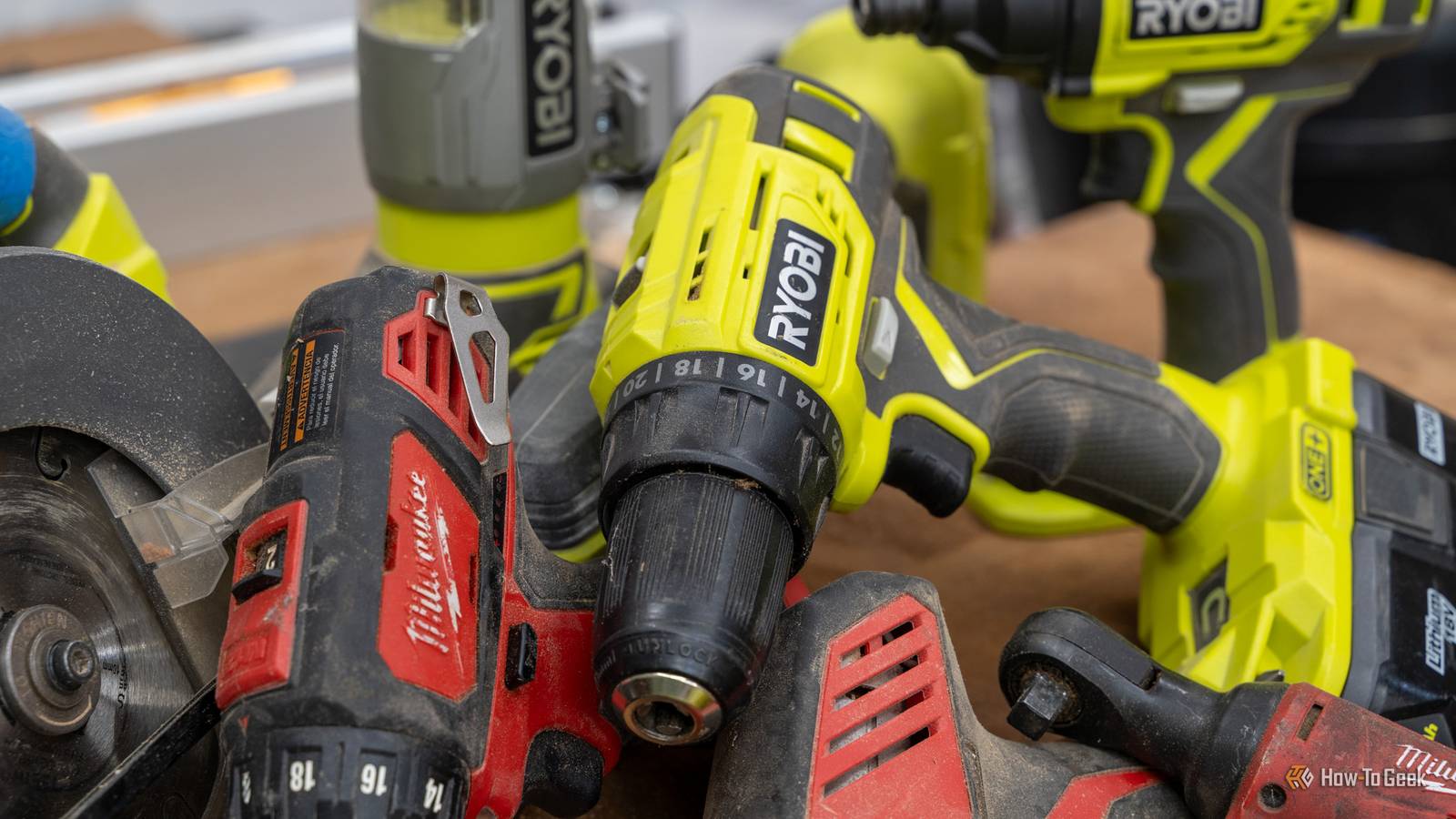
If you're new to the world of cordless power tools, it can be rather confusing.There are brushless tools, older brushed motors, different voltages, battery capacities, different output types, and so many brands to choose from.Ryobi is popular with the DIY crowd, but you'll also hear people everywhere suggesting buying Milwaukee.
And while there's a lot to consider in that decision, don't go by voltage alone.To make matters worse, products and options can be wildly confusing from individual brands.For example, there's the Milwaukee M12 (12-volt) vs.
its bigger M18 (18-volt) line, MX FUEL models, different battery tiers and types, and more.It's a lot to take in and can cause a lot of frustration.I recently heard a neighbor telling a friend that Ryobi is cheap, not very powerful, and closer to the Milwaukee M12 line in terms of performance.
And if they want something better, go with the Milwaukee M18 lineup.The friend said, "Well they're both 18V, so shouldn't the power be the same?" My neighbor replied that any Milwaukee 18V tool will always be better, which certainly isn't accurate.Power tool voltage ratings are misleading Voltage alone doesn't indicate performance Close Buying a higher voltage tool doesn't always guarantee better real-world performance.
Without getting too technical here, a prime example is DeWALT 20V vs.Milwaukee M18 (18V) tools.You'd think DeWALT is better because of the higher voltage.
That entire rating is not only misleading, but it's nothing more than a marketing stunt.See, DeWalt's "20V MAX" is just the maximum initial voltage rating, which is the same as Milwaukee's 18V nominal (and ~20V peak) charge.Both lines operate at the same voltage.
It's a marketing move to sound more powerful, even though there's way more to the story and situation.When it comes to buying Ryobi vs Milwaukee, most people choose between Milwaukee's M18 platform and Ryobi's 18V ONE+ line.They're both 18V, come with a slew of tools for a variety of jobs, and are solid options.
Fun fact, both of these brands are owned and manufactured by Techtronic Industries (TTI) out of China, but that doesn't mean they're the same.Related Ryobi's best advantage over Milwaukee isn't power—it's all these oddball tools Weird tools you'll actually love.Posts 9 By Cory Gunther Since Milwaukee is a premium brand and more expensive, you'd understandably think that a Milwaukee M18 drill will be better than a Ryobi 18V ONE+ drill.
Not quite.You have to pay attention to the motor type, battery size, torque or RPM specs, and so much more.A Milwaukee M18 drill with a small 2.0Ah battery will run for less time and deliver less power than a similar Ryobi with a larger 6Ah battery.
That bigger battery lasts longer and delivers more power—thus more torque.And that's without mentioning the motor type.There's more to it than the voltage or Ah rating.
Brushed vs brushless power tools Friction vs circuit boards A big thing you'll want to pay attention to when buying power tools is whether it has a brushed motor or a newer brushless motor.See, older tools all had brushed motors that used physical carbon brushes inside that pressed against a spinning commutator to flip the electrical field and spin the motor at full throttle.It's loud, hot, and physical, creating constant friction.
Newer brushless power tools employ magnets inside the rotor, copper coils that remain in a fixed position, and microprocessors and circuit boards that act as the tool's brain.This system replaces those old physical brushes and commutators, and ends up with fewer moving parts, more power, lower heat output, better efficiency, etc.Walk into any hardware store or Home Depot, and many items on the shelves from Milwaukee will have a brushless motor, and then there are even better FUEL Brushless variants.
However, they're not all brushless, and that's important.Related Why brushless tools feel so different (and cost more) More power, torque, smarts, and battery life.Posts 4 By Cory Gunther Milwaukee officially launched its line of brushless cordless tools—marketed under the M18 FUEL brand—in spring 2012.
They followed shortly after with the compact M12 FUEL brushless line.Not every M18 tool is brushless, and if you're looking at a Milwaukee M18 tool that has an older brushed motor and a 2.0 Ah battery, just because it's an 18V tool doesn't mean it'll automatically be better than Ryobi.See, Ryobi didn't start releasing brushless tools until 2015, and they were few and far between.
Then, it wasn't until 2018-19 that it introduced the Ryobi 18V ONE+ HP (High-Performance) line, similar to Milwaukee FUEL in that "HP" signifies a high-powered, capable tool with a brushless motor.Ryobi was late to the game, which gave it quite a disadvantage when it's compared to Milwaukee, Makita, DeWALT, or others.But that doesn't mean they're bad, or that they're not as good.
Ryobi makes excellent tools, and if you're choosing between a Ryobi HP Brushless drill and an older Milwaukee M18 with a brushed motor, brushless is the answer.The right tool for the job All of this is to say: make sure you're getting the right tool for the job, and don't choose one brand over another based on voltage or hearsay.There's a lot more to a tool's power and usage than its voltage rating and battery type.
Make no mistake, Milwaukee makes great tools, but so does Ryobi, they just cater to a different consumer.
Read More