In the first article in this series, we look at how a European chair company invested in the world by pioneering mass manufacturing, modularity, bent wood, tubular steel, catalogs, composites, and more to form a seed that helped to make the modern globalized world.Now we look at how the De Havilland Mosquito has influenced aviation.World War II planes are all aluminum skins combined with steel for mounting components.
Bombers were heavily armored flying fortresses in name, philosophy, and design.The De Havilland Mosquito was made of glued spruce, ash, fir, and birch.It was revolutionary.
Wood components were bent or machined into shape and glued and screwed together.Many structural components and leading edges were plywood.Reinforcement was also out of wood.
The plane’s fuselage was molded wood in two halves made of a sandwich of balsa, plywood, and balsa again.They molded that structure over mahogany and dried it in concert with the skin.They wired it before joining to save time.
Then they covered the whole plane with a finely woven cloth called Mandapollam, then coated it with five coats of aircraft dope, a lacquer.Aircraft dope, in various forms, had been applied to the Wright Flyer but was also responsible for the Hindenburg disaster.It was kind of like a flying composite candle.
If anything ever sounded like a bad idea, it was the Mosquito.The Mosquito was light, smooth, aerodynamic, and had a pioneering monocoque design.The wood and monocoque design saved massive amounts of weight and showcased a world where the skin is the structure and doesn’t need internal reinforcement.
This approach reduces parts and weight, can make a plane much more efficient to build, can lead to radically new designs, improves performance, and can create more aerodynamic structures.Think of a parking garage with columns everywhere.Imagine you can now make that garage without the columns.
How different would the inside of it be? How many more parking spaces would you have? You’d be able to have a much smaller garage that could take more cars, be built more cheaply, have fewer floors, or have a tonne more parking spaces in the same space while using significantly less concrete.Because the Mosquito was built in two halves, staff could install wiring and the like more easily without crawling through the aircraft while it was being made.A lot of the credit for this pioneering design should go to Arthur E.
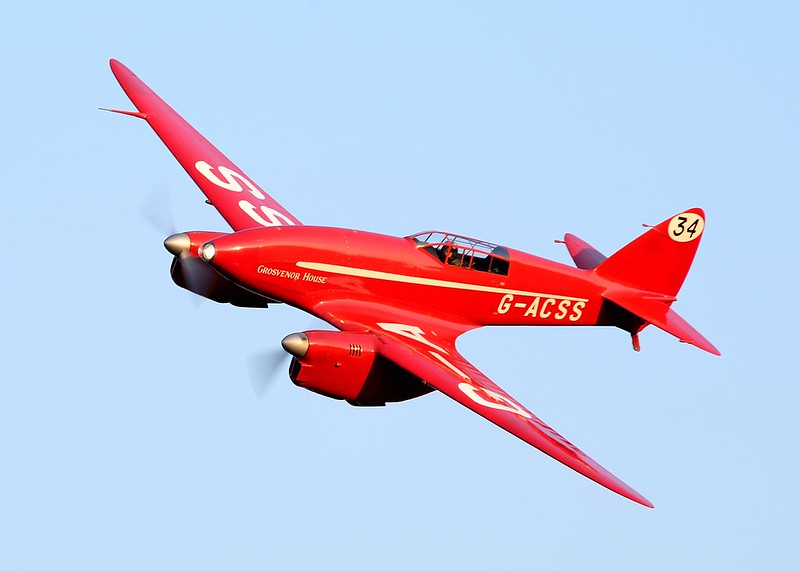
Hagg, the lead draughtsman on the Mosquito who also helped design the pioneering Moth, Albatross and DH88 Comet Racer (which I still think is the most beautiful aircraft of all time). Instead, he’s not credited enough next to Bishop, DeHaviland and his son, the test pilot DeHaviland Junior, Tamblin, Clarkson and Wilkins.Indeed, we tend to look for solitary geniuses as being responsible for inventions.But this was a complex, groundbreaking engineering project that required many stellar people working together.
This kind of invention is not a flash of thunderous inspiration but rather a grind in concert with many sparks flying.The team’s work also grew out of long-term work on composite structures at De Havilland and a great deal of pitching by De Havilland and its management.One central misgiving that held up acceptance was that the plane was mostly made of wood, which felt very WWI-ish.
But the other idea was encapsulated in those layers of wood and Aerolite glue, a synthetic urea-formaldehyde adhesive.Initially, glues were made of casein, milk-based glues used in woodworking.Today, that glue is mostly used to attach beer bottle labels to bottles because it resists precipitation from ice.
Beetle cement, a urea-formaldehyde resin, was also tried, but both fared poorly in the tropics. It was that, through maneuverability and speed, the aircraft would protect itself.Now this was pitched at a time when the main idea was to make flying tanks bristling with guns.The idea that a supreme lightweight monocoque composite plane could outrun trouble was initially met with skepticism.
But the speedy high-altitude craft was very successful.It accounted for about 70 air-to-air losses and 500 victories, with low losses on bombing runs.With bouncing bombs, the aircraft was used to destroy dams, while daring daytime bombing raids in Berlin gave the UK a much-needed propaganda victory.
Another advantage was that it needed only a two-person crew.The Avro Lancaster and B-17 needed 7 to 10 people to fly.With a lack of staff being a major issue and many bomber aircraft being downed, a two-person plane was also tempting due to the significantly less training, cost, and loss of life that it would entail.
With metals scarce, it seems that when approval for this new design direction finally came, it was because of Air Chief Marshal Sir Wilfrid Freeman believing in the plane and the work of DeHavilland and his engineers, but also out of sheer desperation.In retrospect, the Mosquito was a celebrated success, but at the time it was a desperate gamble.The Brits have dressed the Mosquito up as some pioneering boffins, a few toffs with derring-do and good old British ingenuity and gumption.
It was all of those things.But the Mosquito was approved in July of 1940; France had just fallen, Dunkirk had just been evacuated, with the Allies rescuing 330,000 but losing 20,000 men, and the Allies had also withdrawn from Narvik.Britain stood alone, and an awful lot of people thought that she should make a separate peace with Germany or that some kind of surrender should be negotiated.
Looking back, it was all stiff upper lip, but if Britain ever twitched and quivered that lip, it was now.Over the coming months, Britain would be battered by submarine warfare.The US would not enter the war until December 1941.
And the Battle of Britain lay ahead from June to October of 1940.544 fighter pilots would die, and 1,000 planes would be lost.Additionally, 744 bomber crew and 380 Coastal Command crew died as well.
The RAF would lose around 300 planes a month and build 400 aircraft, and they’d lose 240 pilots per month as casualties or captured, and train 200 per month.Some pilots would crash and be given another plane the next day.And pilots were doing four sorties a day. By some estimates, Britain was only 20 days of attrition away from simply not having enough pilots able to fly and the remaining force collapsing from exhaustion.
Training was shortened to the extent that average new pilots lasted about a week.So when Wilfrid Freeman looked at green-lighting the Mosquito, he was facing the Battle of Britain and submarine warfare.In retrospect, green-lighting the Mosquito was also an act of desperation.
It was as much a flying Sten gun, or the only thing they could hope to make if they were cut off from metals.At the same time, the British were looking to make the Spitfire out of wood composites as well.Using Gordon Aerolite (a phenolic-soaked flax fiber distinct from the glue used on the Mosquito) made by Chilean aerospace engineer Dr.
Norman de Bruyne and materials scientist J.E.Gordon they tested it.It was de Bruyne who, at the firm Aero, had pioneered early composites for DeHavilland.
In 1936 they started to work on phenol-formaldehyde resins to make propellers.He also later made the Redux resin used in aviation and beyond, seeing extensive use in later aircraft such as the Fokker Friendship.He also invented the popular Araldite glue.
His partner, J.E.Gordon, was instrumental in making composites work, and his lifelong study of them made him a pioneer in biomechanics and materials science.Without their pioneering work on the glue, the Mosquito would not have been possible.
They also made a flax-soaked phenolic composite, which they used to build and test a full-scale composite Supermarine Spitfire.They did this to see whether the UK could build the aircraft if cut off from aluminum.Rather confusingly, Aerolite Spitfire today is a team that started building Spitfire replicas out of composites inspired by the wartime composite Spitfire prototype.
They now want to make a contemporary flying Spitfire kit for enthusiasts.Once accepted, the Mosquito found work as a bomber, fighter, a pathfinder ahead of bomber forces, night fighter, photo reconnaissance, anti-submarine, and transport for VIP’s (being used to spirit away Niels Bohr and procure invaluable ball bearings).Whether guiding in bombers or intercepting them, the wooden wonder was supremely effective.
The Spitfire and Hurricane get all the props, but the Mosquito was a supremely effective aircraft that accomplished many key missions.It also invented new roles that didn’t exist: something like a precision bomber could be built that would put bombs on target, not just bomb a postal code.It was also a special-mission, special-ops long-range aircraft.
This started what would be one of the most expensive dreams in history: the swing-role, or later multirole fighter, dream.The idea was simple: if you made a plane good enough, it could fulfill many roles.In the Pacific, meanwhile, the Grumman F6F Hellcat had been specifically designed, based on an intact captured Zero fighter, to outperform a Zero over the sea.
Since then, fighter jet history has been a battle between the ideal specialized jet and the one jet to rule them all.Images courtesy of Tim Spouge, Kev Cook, Andrew Bone.Subscribe to Our Email Newsletter Stay up-to-date on all the latest news from the 3D printing industry and receive information and offers from third party vendors.
Print Services Upload your 3D Models and get them printed quickly and efficiently.Powered by FacFox Powered by 3D Systems Powered by Craftcloud Powered by First Mold Powered by Xometry 3DPrinting Business Directory 3DPrinting Business Directory
Read More