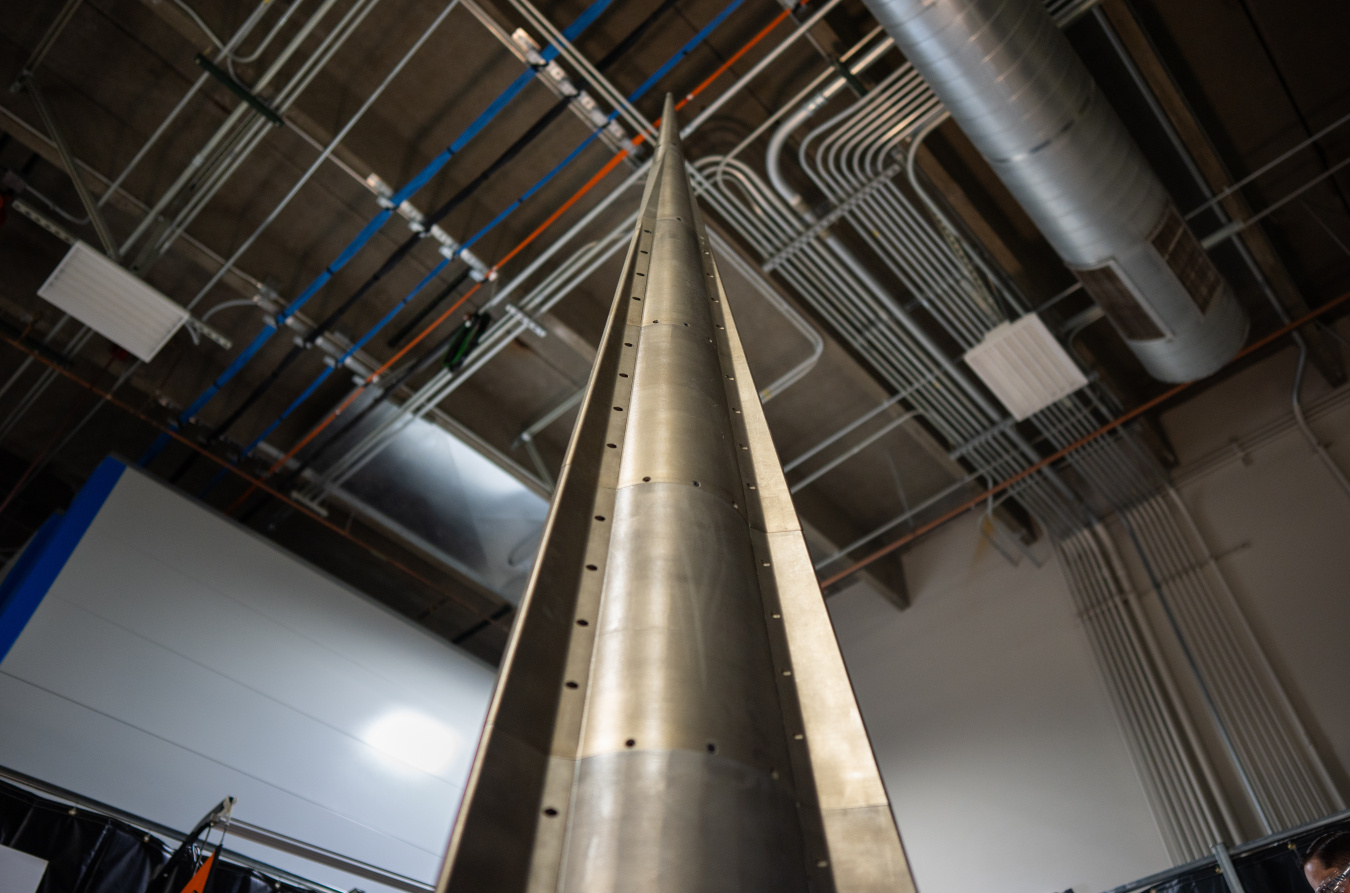
The Department of Energy‘s National Nuclear Security Administration (DOE/NNSA) is part of the US government that manages the US nuclear stockpile, helping to upgrade, improve, and maintain nuclear weapons, and helps to maintain the Navy’s nuclear propulsion program.This is a super-secret, super-sensitive part of the government that we don’t often see or hear from.Now they’ve introduced Aires Tide, a rapid implementation of a hypersonic vehicle that used the DOE’s Genesis Mission AI supercomputing capacity to make the vehicle, “15 times cheaper and seven times faster than traditional manufacturing.” The work was done by Los Alamos, Lawrence Livermore, Sandia, and the Kansas City National Security Campus.
NNSA Administrator Brandon Williams said, “Aires Tide is a remarkable early demonstration of how NNSA is putting the Genesis Mission into action.“President Trump has made it clear that America must lead the world in artificial intelligence and use emerging technologies to strengthen our national security.By combining AI, high-performance computing, and additive manufacturing, we are pioneering a faster, more efficient model to design and produce capabilities for national security while keeping human judgment firmly at the center.” The Venado supercomputer at Los Alamos National Laboratory helped power the AI-driven design of the Aires Tide flight test vehicle.
Image courtesy of NNSA.The Aires Tide vehicle was flight tested in May.The vehicle was tested at the US Army’s Dugway Proving Ground, being dropped from 32,000 feet.
The design was made on the Venado and El Capitan.El Capitan is currently the world’s second most powerful supercomputer.The US$600 million system was built on the HPE Cray EX architecture and reportedly can run at 2.821 exaFLOPS.
The computer uses 11,039,616 CPU and GPU cores, consisting of 43,808 AMD fourth Gen EPYC 24C “Genoa” 24-core 1.8 GHz CPUs (1,051,392 cores) and 43,808 AMD Instinct MI300A GPUs (9,988,224 compute units, 228 per GPU, which have a total of 639,246 stream processors, 14,592 per GPU).The 700-square-meter system is at Lawrence Livermore National Laboratory (LLNL).The system was commissioned and built specifically for nuclear weapons design and testing.
Named for the rock formation in Yosemite, this computer is near the precipice of computing today.The Venado is currently the 26th most powerful supercomputer in the world, down from 11th only a few years ago when it was launched.The machine has 481,440 cores and is made of 2,560 NVIDIA Grace Hopper Superchips and 920 NVIDIA Grace CPU Superchips.
Although less powerful, Venado is in some respects a much more critical system.The Venado was made by HPE specifically for AI.Have you heard of AI? Well, these guys probably have the world’s best cat pictures.
OpenAI and other Frontier models are being run on the machine, on its own network, for National Security use.So far, the system has also been used to find new materials, looking at frontier AI models themselves, and astrophysics.By using them in design, the NNSA is pushing forward at the intersection of engineering, science, and materials.
If we look at Genesis, it’s a supremely ambitious initiative; just one element is: “Manufacturing Accelerating advanced manufacturing Turning design into production at the speed of need.Engineers and AI-driven digital twins share a continuous feedback loop between design, sensors, and fabrication, cutting qualification time and boosting efficiencies.” Now there are a lot of buzzwords there, but it’s really important nonetheless.If we can tie what is happening on the factory floor directly to the physics of materials and manufacturing, we can make it in a completely new way.
A much more fluid and fundamental method of making could be introduced.We could change a material to offset a manufacturing tolerance issue, or change a design to make printing easier or to improve surface texture, not just before making that design in FEA, but by working backward from the physics of manufacturing and real-world performance.We’re talking about a new world beyond CFD and FEA.
Now I’m aware that this sounds rather woolly, but Aires Tide is a very concrete result.We can use this new design system to cost-effectively design new vehicles more cheaply and quickly than we normally would.This is very important now, since the US has depleted its precision interceptors and needs to produce more missiles while lacking superiority in hypersonics.
The new drone world, which we will talk about on the 30th, needs a more agile and faster US defense establishment.Aires Tide combines AI with 3D printing to quickly produce cutting-edge vehicles.That is great news for us, but it could also point to a future in US manufacturing for defense.
We’re not sure what this vehicle is, but our guess is that it’s a hypersonic glide vehicle cruiser, which suggests this is a very important, cutting-edge development indeed.Subscribe to Our Email Newsletter Stay up-to-date on all the latest news from the 3D printing industry and receive information and offers from third party vendors.Print Services Upload your 3D Models and get them printed quickly and efficiently.
Powered by FacFox Powered by 3D Systems Powered by Craftcloud Powered by Xometry 3DPrinting Business Directory 3DPrinting Business Directory
Read More