I've always had a saying.The best Linux laptop is, as a matter of fact, a Windows laptop.Linux laptop projects such as System76 are lovely, but most people are better off just buying a regular Windows laptop and putting Linux on it.
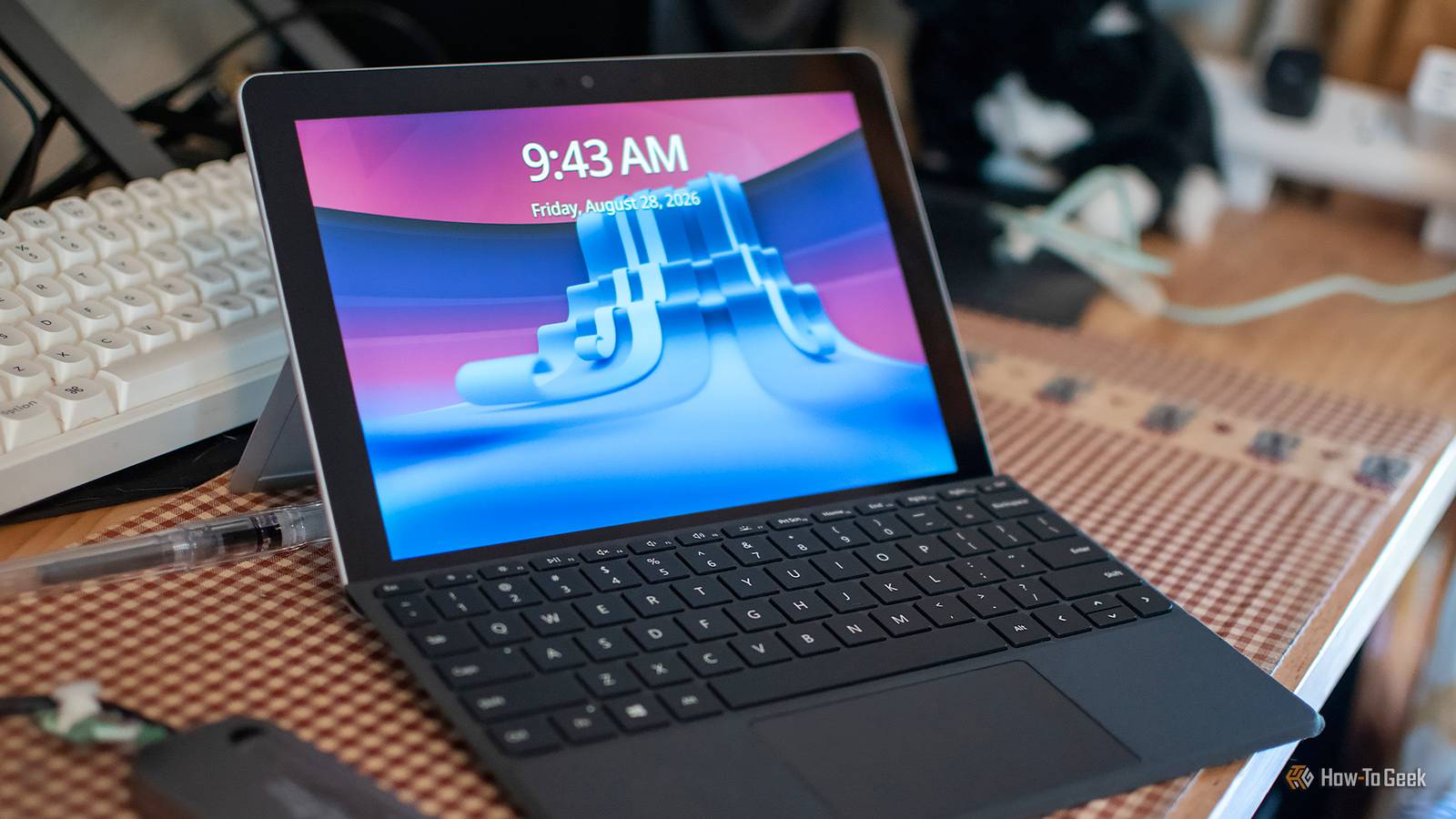
To that effect, a second-hand Surface Go might just be the best cheap, tiny Linux laptop you can get.Here's why.Amazing portability A footprint that fits almost anywhere The Surface Go's defining feature isn't raw power—in fact, some models have pretty weak specs.
Rather, it's how little space it takes up.With a 10-inch display (10.5 inches if you choose a later model) and a frame smaller than most paperback books, it fits into a jacket pocket or the front pouch of a backpack without adding noticeable bulk.That makes it well-suited to commutes, flights, and meetings where pulling out a full-size laptop feels unnecessary.
The built-in kickstand removes the need for a separate stand or case, and the keyboard folds flat against the screen, adding almost no thickness when closed.Weight is where the device really stands out.Weighing rougly over one pound, it's lighter than many tablets marketed purely for portability, despite running a full desktop operating system underneath.
It's practical to use standing on a train, balanced on a knee, or set up on a small cafe table where a 13-inch laptop simply wouldn't fit.None of that would matter much if battery life couldn't keep pace, but even on the aging hardware found in budget units, a full workday of writing and browsing is realistic without needing to stay near an outlet.Premium build doesn't disappoint Materials that outperform the price tag Close What separates the Surface Go from other budget devices is how it feels the moment it's picked up.
Microsoft built these using the same magnesium alloy chassis found across the rest of the Surface lineup, and that choice is obvious immediately.There's no flex in the frame, the kickstand hinge moves with the same smooth, weighted resistance expected from laptops costing several times as much, and the display glass sits flush with minimal wasted bezel.Even in units that have seen years of use, wear tends to show up as scuffed corners rather than loose hinges or creaky panels, which speaks to how solidly these were assembled originally.
This is a computer that launched at a price tag around $400, and it's heavily discounted because of the age.Still, this matters.The keyboard, sold separately but widely available secondhand, offers real key travel for something so thin, and the trackpad, while modest in size, tracks accurately and supports mutli-touch gesture control in KDE and other desktop enviornments.
Port selection is limited to a single USB-C, a headphone jack, and a proprietary charging connector, a reasonable trade-off given the size constraints at the time and one that still holds up.The display itself is a strong point too, a sharp 1800 by 1200 panel (1920 by 1280 on later models) with decent color accuracy that makes text and photos look noticeably better than the price would suggest.This isn't a device that competes with a flagship ultrabook, but for something that often sells for less than a pair of wireless earbuds, the fit and finish punch well above their weight class, and that's before factoring in what it can actually run.
Quiz 8 Questions · Test Your KnowledgeThe origins of LinuxTrivia challengeFrom a Finnish dorm room to the world's servers — how well do you know the story behind Linux?HistoryPioneersOpen SourceUnixMilestonesBegin 01 / 8PioneersWho created the Linux kernel?ARichard StallmanBDennis RitchieCLinus TorvaldsDAndrew TanenbaumCorrect! Linus Torvalds created the Linux kernel in 1991 while studying at the University of Helsinki in Finland.He initially developed it as a personal project and famously announced it on a Usenet newsgroup.Not quite.The Linux kernel was created by Linus Torvalds, a Finnish student, in 1991.
Richard Stallman founded the GNU Project, Dennis Ritchie co-created Unix and C, and Andrew Tanenbaum created the educational OS Minix.Continue 02 / 8HistoryIn what year did Linus Torvalds first announce the Linux kernel to the public?A1989B1991C1993D1995Correct! On August 25, 1991, Torvalds posted his now-famous message to the comp.os.minix Usenet newsgroup, describing Linux as 'just a hobby' and saying it 'won't be big and professional like GNU.' History proved him delightfully wrong.Not quite.Torvalds made his famous announcement in 1991, posting to the comp.os.minix Usenet group.He described the project modestly as a hobby, little knowing it would eventually power billions of devices worldwide.Continue 03 / 8UnixWhich operating system directly inspired Linus Torvalds to create Linux?ABSD UnixBMS-DOSCMinixDSolarisCorrect! Torvalds was using Minix, a small Unix-like OS created by Andrew Tanenbaum for educational purposes, and wanted to build something more capable and freely usable.
His frustration with Minix's limitations drove him to write his own kernel.Not quite.The direct inspiration was Minix, an educational Unix-like system created by Andrew Tanenbaum.Torvalds used Minix on his PC but found it too limited for his needs, which motivated him to develop his own kernel from scratch.Continue 04 / 8Open SourceUnder which license was the Linux kernel released, making it freely available to modify and distribute?AMIT LicenseBApache LicenseCBSD LicenseDGNU General Public License (GPL)Correct! In 1992, Torvalds re-licensed the Linux kernel under the GNU General Public License (GPL), a move that proved transformative.
The GPL ensures that anyone who distributes Linux or a modified version must also make the source code available.Not quite.The Linux kernel is licensed under the GNU General Public License (GPL), which Torvalds adopted in 1992.This license was crucial to Linux's growth, as it guaranteed that the kernel and its derivatives would always remain open and freely modifiable.Continue 05 / 8HistoryWhat was the version number of the very first publicly released Linux kernel?A0.0.1B0.01C1.0D0.10Correct! The first publicly released version of the Linux kernel was 0.01, uploaded by Torvalds in September 1991.
It was a rough early build not really intended for wide use, but it marked the true beginning of the Linux project.Not quite.The first public release was version 0.01, uploaded in September 1991.It was a bare-bones kernel that could barely run any software, but it invited collaboration from developers around the world who helped shape what Linux would become.Continue 06 / 8PioneersWhich organization, founded by Richard Stallman, provided many of the essential tools and utilities that combined with the Linux kernel to form a complete operating system?AThe Open GroupBThe Free Software Foundation and the GNU ProjectCThe Apache Software FoundationDBell LabsCorrect! Richard Stallman's GNU Project had been developing free software tools since 1983, including compilers, editors, and shells.
When the Linux kernel arrived, it filled the missing piece, and the combination became what many call GNU/Linux.Not quite.The GNU Project, launched by Richard Stallman and backed by the Free Software Foundation, had built a nearly complete free OS by the time Linux appeared.The kernel was the missing link, and together they formed a fully functional free operating system.Continue 07 / 8MilestonesWhich was the first major Linux distribution aimed at making Linux accessible to everyday users?AFedoraBDebianCSlackwareDUbuntuCorrect! Slackware, created by Patrick Volkerding, was released in 1993 and is considered one of the earliest and most influential Linux distributions.
It helped bring Linux out of purely academic and developer circles and toward a broader audience.Not quite.Slackware, released in 1993 by Patrick Volkerding, was one of the first Linux distributions designed to make Linux more accessible.Debian also launched that same year, while Ubuntu didn't arrive until 2004, and Fedora followed in 2003.Continue 08 / 8HistoryWhat university was Linus Torvalds attending when he began developing the Linux kernel?AMITBUppsala UniversityCUniversity of HelsinkiDAalto UniversityCorrect! Torvalds was a computer science student at the University of Helsinki in Finland when he began work on the Linux kernel in 1991.
He was running Minix on his new 386 PC and wanted a more powerful, free alternative.Not quite.Torvalds was studying at the University of Helsinki in Finland when he started the Linux project.He had recently bought an Intel 386-based PC and was experimenting with Minix before deciding to write his own operating system kernel.See My Score Challenge CompleteYour Score/ 8Thanks for playing!Try Again Just as good with Linux as every other laptop Swapping Windows for Linux barely changes the experience The strongest case for the Surface Go is that, being a Windows laptop you can swap Windows out of, it makes for a great Linux laptop, naturally.
It's probably for the best, anyway.These machines were never particularly fast by Windows standards, and the operating system's background processes tended to make the experience feel sluggish regardless of use case.Strip that away and install a lightweight distribution, and the same hardware becomes noticeably more responsive.
Touchscreen support, kickstand-friendly display rotation, and even pen input work with mainstream distributions, thanks to years of community driver development focused specifically on Surface devices.Everyday distributions built on recent kernels tend to perform well, since support for the Surface Go's touchscreen and Wi-Fi hardware has matured considerably and no longer requires the manual patching early adopters once dealt with.Core tasks like writing, browsing, video calls, and light coding run smoothly, and battery life holds up just as well as it does under Windows, sometimes better, since Linux is generally lighter on system resources.
Related I’ve tested dozens of Linux distros, and these 3 are the only ones I’d put on a laptop Not all Linux is built for laptops.From Ubuntu’s gesture support to Linux Mint’s efficiency, these are the best "laptop-first" choices Posts 99 By Dibakar Ghosh There are honest trade-offs worth noting: camera support is super iffy, particularly on later models, and some firmware updates are easier to apply while still on Windows before switching over.But for the core experience of using a small, portable computer for everyday work, Linux on the Surface Go doesn't feel like a workaround or a downgrade.
It feels closer to what these machines should have shipped with in the first place, which is a large part of why these budget 2-in-1 continue to find an audience well beyond their original release window.The tiny laptop that could For about $70 (do note that this is an average price for a first-gen Surface Go—later models tend to cost more), the Surface Go range offers portability, build quality, and Linux compatibility that pricier machines often fail to match.It's proof that a capable laptop doesn't need to be new, expensive, or full-size.
Read More