Legacy software modernization across Europe starts from a split estate.Eurostat reports that in 2025, 52.7% of EU enterprises with 10 or more employees used paid cloud computing services, a 7.4 percentage point increase compared with 2023.ContentsKey TakeawaysWhat the 2027 Data Says About Aging SystemsTop Legacy Software Modernization Companies in Europe1.ReenbitAI Modernization ToolingProof Points2.
Software MindAI Modernization ToolingProof Points3.InnowiseAI Modernization ToolingProof Points4.N-iXAI Modernization ToolingProof Points5.
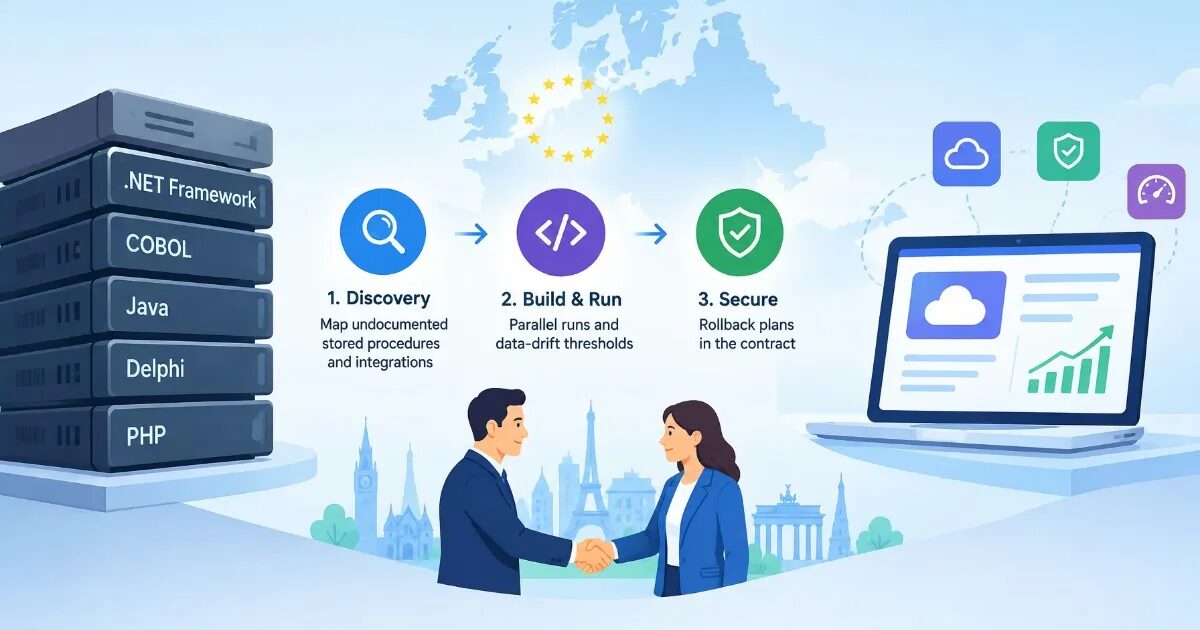
CiklumAI Modernization ToolingProof Points6.ELEKSAI Modernization ToolingProof Points7.NetguruAI Modernization ToolingProof PointsLegacy Software Modernization Paths for a Business That Cannot PauseRehost When a Support Date Sets the DeadlineRefactor the Code You Plan to KeepRe-Architect Around the Parts That Change Most OftenRebuild Only the Modules With No Salvage ValueRisks That Surface Mid-Migration and How to Contain ThemUndocumented Rules Buried in Stored ProceduresData Drift Between the Old and New DatabasesIntegration Points Nobody MappedScope Growth Once the Code Is OpenSelecting a Modernization Partner That Owns the Cutover GapFrequently Asked QuestionsWhy do enterprise legacy modernization projects use phased delivery rather than a full rewrite freeze?What legacy stacks and legacy sources do European modernization partners cover?How long does an initial discovery or assessment phase typically take?To choose a European legacy software modernization partner, match your legacy stack (.NET Framework, COBOL, Java, Delphi, or PHP) against each vendor’s verified practice, start with a short discovery phase to map undocumented stored procedures and integrations, and write parallel runs, data-drift thresholds, and rollback plans into the contract.Eurostat counted 20.0% of EU enterprises with 10 or more employees using AI technologies in 2025.Reenbit lists 100+ tech experts, 89% of staff certified, and 75+ delivered projects across 8+ years.Under Netguru’s published practice, discovery runs as a 2- to 4-week block and produces a dependency map.Buyers hit the problem at the code level.
A.NET Framework monolith tied to an on-premises SQL Server carries business rules nobody wrote down.Freezing that system for a rewrite halts invoicing, dispatch, or patient records for months, so the migration has to run while the old platform stays live.This guide profiles 7 providers identified by our review as top legacy software modernization companies in Europe for 2027, with a comparison table you can use to shortlist vendors for a live system.Key TakeawaysPhased delivery keeps invoicing, dispatch, and patient records running while each module moves to the new platform.A typical assessment of 1 to 2 weeks that maps code, data, and integrations gives you a rehost, refactor, re-architect, or rebuild decision per module before the budget locks.Data residency now shapes vendor choice, and Gartner forecasts reported by Data Center Dynamics estimate that European spending on sovereign cloud infrastructure will triple from 2025 to 2027.Mid-migration risks such as hidden business rules and unmapped integrations carry fixes you can price into the contract at signature.The list of top legacy software modernization companies in Europe profiled in this guide contains Reenbit, Software Mind, Innowise, N-iX, Ciklum, ELEKS, and Netguru.What the 2027 Data Says About Aging SystemsLegacy budgets in 2027 face pressure from two sides.
Support deadlines close old platforms as AI and cloud adoption climb.Here are the 5 figures behind that squeeze:More Read A Proven Template For Financing Data-Driven Startups An Introduction To Hands-On Text Analytics In Python Forget Derivatives – Hedge Risks with Innovation and Integrated Data How Organizations Are Leveraging Big Data for the Greater Good Here Is How To Selectively Backup Your Data Eurostat counted 20.0% of EU enterprises with 10 or more employees using AI technologies in 2025, up from 13.5% in 2024, a rise of 6.5 points in a single year of survey data.The Bitkom Cloud Report 2026 reported 86% of 603 surveyed German companies with 20 or more employees using cloud computing in 2026, while the remaining 14% planned or discussed a move.Gartner forecasts reported by Data Center Dynamics project that European spending on sovereign cloud infrastructure as a service will triple between 2025 and 2027, with Europe expected to overtake North America on that measure during 2027.When Microsoft extended support ends for Windows Server 2016, servers still on that release receive security patches only through paid Extended Security Updates delivered via Azure Arc.Once SQL Server 2016 leaves Microsoft extended support, paid Extended Security Updates cover critical fixes on a 4-core minimum per virtual machine.A pricing change that should take an afternoon takes six weeks.The rule lives in a module nobody has edited since the engineer who wrote it retired, the test suite covers about a third of what the system actually does, and the release window is a Saturday night because the batch job cannot be interrupted.
Maryana Kalynovska, Content Writer, Crunch, in Top Legacy Software Modernization Companies, 2026Top Legacy Software Modernization Companies in EuropeLegacy software modernization firms move aging applications, databases, and integrations onto supported platforms while the business keeps running.Our review of the European market has produced 7 companies for 2027, with the table setting out author-recorded Clutch scores at the time of review, service lines, and the legacy stacks:1.ReenbitReenbit is a top legacy software modernization company in Europe for growing companies that can’t pause operations to rebuild.
Under Reenbit’s published methodology, each engagement moves through 6 stages: assessment, planning, design, development, deployment, and maintenance.According to the company’s service overview, cloud moves run on Azure Migrate, Azure Site Recovery, and Azure Database Migration Service, with data landing in Azure SQL, Cosmos DB, or MongoDB.That work covers app infrastructure, integrations, architecture, and UI for teams in manufacturing, construction, healthcare, retail, energy, and fintech.Agile and DevSecOps transformation completes the service line.
AI Modernization ToolingIn a self-reported case from Reenbit, an autonomous AI agent ran the legacy modernization of an energy platform built on.NET, Angular, SQL Server, and Azure, working in Claude Code.Reenbit reports that reviewers accepted more than 90% of the generated code.The same AI-assisted service line covers legacy code analysis, mapping of the highest-debt areas, and incremental modernization in steps.Proof PointsReenbit reports 30x faster modernization on its energy platform project, cutting key operations time from 30-40 seconds to 3-6 seconds.Reenbit’s published case study reports €400,000 saved in year 1 for Brands of Scandinavia after a back-office sync across 5 production and commerce tools.Self-reported Cloudbooking space management digitalization with 27% lower maintenance effort and a 99.9% sync rate.Company-reported ISO 27001:2022 certification and Microsoft partner status for Azure.Reenbit lists 100+ tech experts, 89% of staff certified, and 75+ delivered projects across 8+ years.Rehost, refactor, rebuild, replace, and retain paths, plus mainframe modernization and application containerization.2.
Software MindAccording to the company’s service descriptions, Software Mind runs application modernization through Software Mind Shift, a set of multi-agent AI tools for code migration, test generation, and cloud-native transformation.Legacy front ends move to React or Angular, while monoliths and SOA estates break into microservices.Founded in 1999, the group operates within Ailleron Group, and the delivery offer also includes AI Pods.AI Modernization ToolingIn Software Mind’s published process, code assessment starts with Software Mind Blueprint, which the company says scans source code and returns a board-ready report within 48 hours.
Shift then handles migration with agents that check each other’s output, convert screens into React or Angular code, and generate automated tests.Software Mind’s published figures put AI at 70% to 80% of the implementation work.Proof PointsSoftware Mind reports test development 86% faster on Shift projects, with coverage raised from 0 to 95%.Vendor-stated legacy sources that include COBOL, RPG, PL/1, NATURAL, JCL, VB6, PowerBuilder, and Oracle Forms.Self-reported Orange Polska custom system moved to Google Cloud, with unit test coverage over 80%.Company-reported ISO 9001, ISO 14001, and ISO 27001 certification, plus SOC 2 compliance.Software Mind states 1,600+ experts, 2,000+ delivered projects, and 350+ clients.Vendor-listed Microsoft Solutions Partner for Digital & App Innovation and AWS Select Tier Services Partner.3.InnowiseInnowise states that it provides legacy software modernization for Java,.NET Framework, PHP, C/C++, and Python systems, along with mobile apps built on Cordova, Ionic, and Xamarin.
Published migration work from the company also covers Windows Forms interfaces sitting on top of COBOL cores.Since 2007, the firm has run modernization alongside AI and custom software development practices.AI Modernization ToolingIn our review of the company’s practice, AI-driven code rebuild handles the repetitive parts of refactoring and migration.That work covers syntax conversion, dependency updates, and structural changes, delivered through the company’s AI-augmented development practice.
Proof PointsInnowise reports a COBOL migration covering about 900 applications built on IBM COBOL and Micro Focus Visual COBOL.Company-listed ISO 9001, ISO/IEC 27001, and ISO 13485 certification.Self-reported 1,600+ completed projects and a 93% share of recurring customers.Vendor-reported Officine 08 server response time under 500 ms, reached in 5 months.Innowise lists AWS Select Tier Services Partner, Microsoft Solutions Partner for Data and AI, and IBM Silver Partner status.Self-reported staff count of 3,500+.4.N-iXAccording to N-iX’s published materials, the company delivers AI-driven application modernization, from monolith-to-microservices work and re-engineering to technical debt remediation and cloud containerization.Version roll-ups and application rationalization sit in the same service line.
The firm states that a staff of 2,400+ specialists supports the work and that it holds the Azure Advanced Specialization in Modernization of Web Applications.AI Modernization ToolingN-iX states that modernization runs through APEX, a proprietary framework for AI engineering adoption with 4 stages: assess, pilot, expand, and excel.According to N-iX, on one transportation account, AI tool adoption rose from 13% to 91% across 140 engineers, with sprint velocity up 27%.Proof PointsN-iX reports 150+ modernizations completed for 90+ enterprises.Self-reported Boohoo Group operational costs cut 10x through AWS migration and tech modernization.Vendor-reported AI-driven QA modernization for a housing management firm, with 60% fewer bugs reaching production.Company-stated ISO 27001 and ISO 9001:2015 certification.N-iX lists AWS Premier Tier Services Partner status since March 2025.Legacy system migration to.NET through a dedicated.NET practice.5.CiklumAccording to the company’s service overview, Ciklum offers AI-Assisted Legacy Refactor, a service that analyzes, transforms, and improves legacy code at scale.
Published guidance from the firm frames that work around COBOL, legacy.NET, and 15-year-old Java monoliths.The company notes that Recognize has held the majority stake since 2020 and operations date back to 2002.AI Modernization ToolingAI agents handle code analysis as the first step of a refactor, with engineers supervising each transformation.Ciklum’s published figures credit its AI-augmented engineering with transformation timelines up to 40% shorter.Proof PointsCiklum reports Salling Group technology costs down 40%.Self-reported Salesforce ticket resolution 23% faster and lead assignment 10% faster.Vendor-reported Betsson platform handling millions of daily transactions.Company-listed 400+ client companies and 3,000+ engineers.Ciklum notes Infogen and GoSolve acquisitions in 2024 and 2025.6.
ELEKSIn its service documentation, ELEKS states that it provides legacy software modernization services covering rehosting, refactoring, re-architecting, rebuilding, re-platforming, and replacement.Projects open with a requirements and scoping phase, then move into delivery on AWS, Google Cloud, or Azure.Alongside that, the company states that its practice holds AWS Advanced Tier Services Partner status with Cloud Operations and DevOps competencies.
AI Modernization ToolingELEKS reports that Delphi-to-C# migration work inside the practice has used Anthropic Claude and GitHub Copilot models for code conversion.Self-reported results from ELEKS show around 80% to 90% correctness on clean business logic.The firm also states that it holds OpenAI Select Partner status.Proof PointsELEKS reports Aramex warehouse operations apps delivered with a 5x cost reduction.Self-reported MedusaBusiness operational savings of 40% and support effort down 20%.Vendor-reported 30-month modernization of a national government HR system onto.NET, delivered with Lifeline Logistics.Company-stated HITRUST, ISO 27001, SOC 2, CREST, and Cyber Essentials Plus credentials.ELEKS lists Microsoft Solutions Partner status for Data & AI, Digital & App Innovation, and Infrastructure.Self-reported 2,000+ specialists and 1,000+ end-to-end projects since 1991.7.
NetguruAccording to Netguru’s published approach, the company modernizes legacy systems in phases, using strangler-fig migration, monolith decomposition, and cloud-native rebuilds that keep the business running.A Platform Operate phase follows cutover, and commerce replatforming targets VTEX, commercetools, SAP Commerce Cloud, and Shopify Plus.The firm notes that its work since 2008 spans healthcare, e-commerce, finance, education, proptech, and agritech.AI Modernization ToolingDelivery pairs AI-assisted refactoring with characterization tests to retire technical debt.
Under Netguru’s published practice, discovery runs as a 2- to 4-week block and produces a dependency map, a risk register, and a starter characterization test suite.Proof PointsNetguru reports that the Anime Digital Network backend moved from Joomla/PHP to Node.js, with a React frontend and zero-downtime releases.Self-reported Nodus Medical AWS Fargate migration with a maximum downtime of 5 minutes.Vendor-stated commerce replatforming from Magento, SAP Hybris, and older custom systems.Company-reported ISO 27001 certification, B Corp status, and TÜV NORD certification.Netguru lists 2,500+ delivered projects and 400+ people.Self-reported OLX and Otodom marketplace work with 21% higher conversion.A live system running your business cannot go dark mid-project.Ask every shortlisted vendor how they protect you during the transition.Strong partners will talk naturally about phased rollouts, running old and new systems in parallel, rollback plans, and automated testing.
If a vendor only wants to discuss the end state and skips past the question of how they get you there safely, treat that as a warning sign.Volodymyr Khomichenko, Author, Zoolatech, in Top 10 Legacy Software Modernization Companies, 2026Legacy Software Modernization Paths for a Business That Cannot PauseA live estate moves module by module, and each module can take its own route based on the change it needs and the risk it carries.Teams managing complex enterprise IT systems assign 4 distinct paths before signing a delivery plan.Rehost When a Support Date Sets the DeadlineRehosting lifts an application onto Azure with minimal code change, so your team keeps the same codebase and business logic.
A Windows Server 2016 machine nearing the end of extended support makes the typical case.Cutover fits a maintenance window of a few hours, and testing centers on infrastructure and performance.The catch sits in the bill, since a rehosted monolith carries its old inefficiencies into a metered environment.Refactor the Code You Plan to KeepRefactoring restructures code inside its current architecture, so users see no change and your release cadence stays intact.
AI-assisted tooling now speeds up the mechanical conversion, while engineers check each change against production behavior.Typical work on a.NET estate covers:Moving.NET Framework 4.8 to.NET 10Replacing deprecated librariesAdding tests around untested logicSplitting oversized classes into modulesWiring builds into a CI/CD pipelineRe-Architect Around the Parts That Change Most OftenRe-architecting splits a monolith into services through the strangler fig pattern, so your old code retires one function at a time.Good first candidates include:Order and payment flows.
Pricing and tax rules change often, so a separate service ships each change alone.Booking engines.Load peaks at set hours, and a standalone service scales on demand.Customer portals.Front-end teams release faster, and an API layer frees them from back-end schedules.Reporting and analytics.
Heavy queries slow the transactional database, and a separate data warehousing or analytics service takes that load.Rebuild Only the Modules With No Salvage ValueRebuilding writes a module from scratch on a new stack, and that choice pays off when the original language has no supported runtime or the component vendor no longer exists.Scope the rewrite to those modules alone and run the new version in parallel with the old one.Your traffic switches only when outputs on live transactions match.Risks That Surface Mid-Migration and How to Contain ThemMid-migration problems tend to surface once the team opens the real codebase and the contract terms already apply, so thePractical fixes go into the plan before signature.
Here are the 4 risks to price in before you sign.Undocumented Rules Buried in Stored ProceduresLegacy.NET and SQL Server estates often hide pricing and approval rules inside stored procedures, and a rewrite that misses one sends wrong invoices to your customers.Here is how a typical discovery process contains that risk:A code-and-database scan during assessment lists every stored procedure, the process behind it, and its owner.Each extracted rule becomes an automated test case that the new system has to pass before cutover.Business owners sign off on the extracted rule list, so finance confirms what the old code actually does.Shadow runs feed identical live inputs to both systems for a set period and flag every differing output.Data Drift Between the Old and New DatabasesDuring a phased migration, both databases take writes.A sync job that fails silently over a weekend leaves records out of step until month-end reconciliation exposes the gap.
Automated row counts, checksums, and alerts built into the sync from day one close that gap early.Agree on a written drift threshold that pauses cutover, and your finance team gets a number to check each morning.Integration Points Nobody MappedOld systems accumulate connections, from nightly file drops to SOAP calls from partner portals, and each one breaks the moment the endpoint moves.The owner of the dependent system may sit in another company, so your fix has to work without their help.
Five practical controls contain the damage:An illustrative window such as 30 days of production traffic logs to spot active callersA compatibility layer per integrationDated cutover notices for each partnerContract tests on every external APIRollback routes kept live for an agreed post-cutover window, such as 2 weeksScope Growth Once the Code Is OpenOnce engineers see the real code, requests multiply, and each addition sounds small until the timeline slips by months.Here is what keeps your budget on the approved figure:Fixed phases.Each phase carries written acceptance criteria and its own ship date.A priced backlog.
New requests wait there with an estimate, ready for the next phase.One steering group.A single forum decides yes, later, or no on every addition.Effort caps.Any request above a pre-agreed effort cap goes back to the steering group before work starts.Selecting a Modernization Partner That Owns the Cutover GapLegacy software keeps a business running and holds rules, data, and integrations that took years to build, yet the platforms under it lose vendor support on fixed dates.
The risk lives in the gap between the old system and the new one: rules that nobody listed, data that drifts between two databases, and partner connections that break at cutover.When nobody owns that gap, your migration can slip by quarters, the support window closes, and the business risks paying twice: once for Extended Security Updates and again for the delayed project.The top legacy software modernization companies in Europe take ownership of that gap from the first week.They map every rule and integration before any code moves, run old and new systems side by side, and write the cutover criteria into the contract.A partner that hands back a migrated system with no reconciliation reports and no rollback plan leaves you holding the risk you paid them to carry.
Ask any candidate to show you the discovery document and the rollback procedure from a past project, and the answer tells you who will own the gap on yours.Frequently Asked QuestionsWhy do enterprise legacy modernization projects use phased delivery rather than a full rewrite freeze?Enterprise legacy modernization projects use phased delivery rather than a full rewrite freeze because freezing a system halts invoicing, dispatch, or patient records for months.Phased delivery keeps these essential operations running while each module moves to the new platform.This migration approach ensures the old platform stays live throughout the process, preventing major business disruption while aging code, unwritten rules, and batch jobs are safely addressed.What legacy stacks and legacy sources do European modernization partners cover?European modernization partners cover legacy stacks and legacy sources spanning several programming languages, frameworks, and enterprise architectures.
The stacks and sources documented include .NET Framework, legacy .NET, ASP.NET, AngularJS, Blazor, mainframe, Java, Delphi, and PHP.Partners also address COBOL, RPG, PL/1, NATURAL, JCL, VB6, PowerBuilder, Oracle Forms, C/C++, Python, Cordova, Ionic, Xamarin, Windows Forms, Magento, SAP Hybris, and Joomla.How long does an initial discovery or assessment phase typically take?An initial discovery or assessment phase typically takes 1 to 2 weeks for a standard mapping of code, data, and integrations to decide between rehosting, refactoring, re-architecting, or rebuilding per module.Depending on vendor practice, discovery can also run as a 2- to 4-week block that produces a dependency map, a risk register, and a starter characterization test suite before full delivery begins.
Read More