
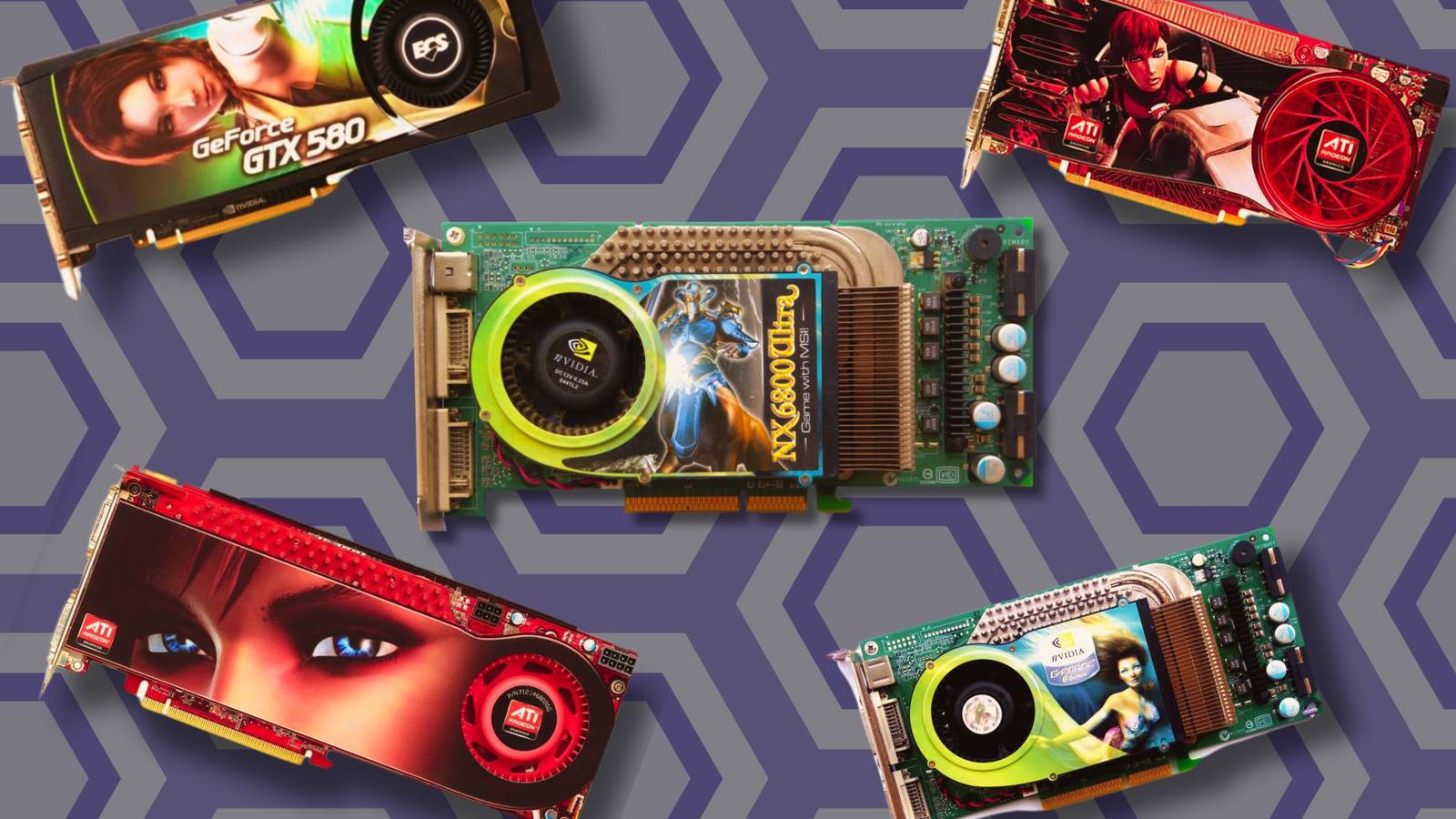
Do you remember how graphics cards used to be fun? And no, I don't just mean that they used to have mind-blowing specs and huge gen-on-gen performance gains.I mean when their designs were actually fun.And mildly horrifying, but that's another thing entirely.
In the late '90s and all throughout the '00s, detailed, colorful, bizarre, and wild GPU shroud designs were much less unusual than they are now.And don't even get me started on the box art.Can we have them back now, please? Modern GPUs all look so bland And sure, no one buys them for their looks, but still I love graphics cards, and every new release is (almost) just as thrilling as the previous one.
But let's face it: modern GPUs just don't look that exciting.In fact, unless you're an expert or an enthusiast, you'll struggle to tell them apart if there's no obvious model/manufacturer sign on the shroud or on the backplate.Quiz 8 Questions · Test Your KnowledgeThe Legacy of 3dfxFrom Glide to the grave — test your knowledge of the company that revolutionized PC gaming graphics forever.HistoryHardwareTechnologyIndustryInnovationBegin 01 / 8HistoryIn what year did 3dfx Interactive file for bankruptcy and sell its assets to NVIDIA?A1998B1999C2000D2002Correct! 3dfx filed for bankruptcy in late 2000, and NVIDIA acquired its key assets — including patents and engineers — for around $70 million.
It was a stunning fall for a company that had dominated the GPU market just years earlier.Not quite.3dfx filed for bankruptcy in 2000, not the year you chose.NVIDIA swooped in to purchase their intellectual property and hire their talent, effectively ending 3dfx as a competitive force and accelerating NVIDIA's own dominance.Continue 02 / 8TechnologyWhat was the name of 3dfx's proprietary graphics API that gave their cards a major competitive advantage in the late 1990s?ADirect3DBOpenGLCGlideDVulkanCorrect! Glide was 3dfx's proprietary low-level graphics API that offered developers direct access to the hardware, resulting in superior performance and visual quality compared to rivals.
Many iconic late-90s games were optimized specifically for Glide.Not quite.The answer is Glide, 3dfx's own proprietary API.Unlike Direct3D or OpenGL, Glide was hardware-specific, which gave 3dfx cards a stunning edge in compatible games — but also tied developers tightly to their ecosystem, a double-edged sword in the long run.Continue 03 / 8HardwareWhat was the groundbreaking product that launched 3dfx to fame in 1996 and is widely credited with beginning the 3D gaming revolution?AVoodoo2BVoodoo Graphics (Voodoo1)CBansheeDRushCorrect! The original Voodoo Graphics card, often called Voodoo1, launched in 1996 and was a revelation.
It brought arcade-quality 3D graphics to home PCs at a relatively affordable price, transforming games like Quake into breathtaking experiences.Not quite.It was the original Voodoo Graphics (Voodoo1) released in 1996 that launched 3dfx's legacy.The Voodoo2 came later and pushed things even further, but it was the original Voodoo that first made consumers and developers take notice of dedicated 3D acceleration.Continue 04 / 8IndustryWhat controversial business decision did 3dfx make in 1998 that many analysts believe contributed to their downfall?AAbandoning the Glide API for Direct3DBAcquiring board manufacturer STB TechnologiesCPartnering exclusively with Microsoft for software dealsDReleasing the Voodoo3 before the Voodoo2 was profitableCorrect! 3dfx acquired STB Technologies to manufacture their own graphics cards, cutting out third-party board makers.
This alienated partners, reduced their retail presence, and stretched their resources thin — a strategic mistake that helped NVIDIA and ATI capture the market.Not quite.The pivotal mistake was acquiring STB Technologies in 1998 to become their own board manufacturer.This cut off crucial relationships with third-party add-in board partners, who quickly turned to NVIDIA instead — dramatically expanding NVIDIA's market reach at 3dfx's expense.Continue 05 / 8Innovation3dfx pioneered which multi-GPU technology that allowed users to link two Voodoo2 cards together for higher performance?ACrossFireBSLI (Scan-Line Interleave)CNVLinkDHybridCrossLinkCorrect! 3dfx introduced SLI — Scan-Line Interleave — with the Voodoo2, allowing two cards to split rendering duties line by line.
This concept was so influential that NVIDIA later revived the SLI branding (as Scalable Link Interface) for their own multi-GPU technology decades later.Not quite.The answer is SLI, which stood for Scan-Line Interleave in 3dfx's implementation.NVIDIA later borrowed the SLI name — rebranding it as Scalable Link Interface — for their own multi-GPU solution, a clear nod to how influential 3dfx's original concept truly was.Continue 06 / 8TechnologyWhich visual quality feature, heavily associated with 3dfx Voodoo cards, became a must-have benchmark for 3D graphics quality in the late 1990s?ARay TracingBBilinear FilteringCFull-Screen Anti-Aliasing (FSAA)DTessellationCorrect! 3dfx's Voodoo5 was a pioneer in Full-Screen Anti-Aliasing (FSAA), which smoothed jagged edges on 3D objects.
While the Voodoo5 launched too late and too expensively to save the company, FSAA became a foundational feature that every modern GPU still implements in various forms.Not quite.Full-Screen Anti-Aliasing (FSAA) was the standout visual feature 3dfx championed, particularly with the Voodoo5.Though the Voodoo5 arrived too late to turn the tide for the company, FSAA itself became one of the most enduring features in GPU development, refined and expanded by every graphics card maker since.Continue 07 / 8IndustryWhich company primarily benefited from 3dfx's collapse by absorbing their talent, patents, and market share to become the dominant GPU manufacturer?AATI TechnologiesBIntelCMatroxDNVIDIACorrect! NVIDIA was the primary beneficiary of 3dfx's collapse.
By purchasing their patents and hiring key engineers, NVIDIA gained crucial intellectual property and expertise that helped cement their position as the world's leading discrete GPU manufacturer — a position they still hold today.Not quite.NVIDIA was the company that truly capitalized on 3dfx's downfall.While ATI did gain some market share as well, it was NVIDIA that bought 3dfx's assets and absorbed their engineers, using that foundation to build an almost unassailable lead in the discrete GPU market.Continue 08 / 8HistoryWhat is considered one of 3dfx's most lasting legacies in the modern GPU industry?AInventing the concept of a dedicated graphics processing unitBPioneering consumer-focused 3D acceleration and multi-GPU configurations that inspired modern GPU designCDeveloping the first programmable shader language used in modern gamesDCreating the PCI Express interface standard for graphics cardsCorrect! 3dfx's greatest legacy is democratizing 3D acceleration for consumers and pioneering multi-GPU technology with SLI.
Their work forced the entire industry to prioritize real-time 3D performance, directly shaping the competitive GPU landscape that produced the powerful graphics cards we rely on today.Not quite.3dfx's most enduring legacy is their role in making consumer 3D acceleration mainstream and inventing the SLI multi-GPU concept.These contributions forced every competitor — especially NVIDIA and ATI — to innovate rapidly, establishing the fiercely competitive GPU industry that still drives graphics technology forward today.See My Score Challenge CompleteYour Score/ 8Thanks for playing!Try Again 99% of all GPUs currently made are some mix of black, with maybe a dash of silver.
Sometimes, you'll find vendor-specific coloring elements, like red for AMD, green for Nvidia, or blue for Intel.But I'm not talking all over the shroud; I'm talking small accents that don't make much of a difference one way or another.And sure, we don't buy graphics cards for their aesthetics.
But since they're so expensive right now, would it really hurt if they looked a bit better? Not everyone cares about the aesthetics of their PC build, so for most people, going down the boring route is the way to go.But for some of us who actually want a fun-looking PC, the state of the GPU market is disappointing, as far as unique designs are concerned.And it wasn't always like this.
Far from.The '90s and the '00s were a wild period for PC graphics, and it wasn't just the specs; the designs were out of this world, too.Asus GeForce RTX 5070 Ti Prime $750 $830 Save $80 Memory Clock Speed 2,482MHz Graphics RAM Size 16GB $750 at Amazon Expand Collapse GPU makers used to sell hardware with attitude Combined with a dash of terror Back in the '90s, '00s, and even into the 2010s, GPU makers didn't seem remotely interested in looking restrained.
Many GPUs had a completely unabashed "gamer aesthetic," and back then, that was a lot more pronounced than the RGB we're being fed these days.Back then, it meant fantasy, horror, or sci-fi-themed designs, and sometimes, it was a mix of all of those genres.You'd get a mix of wizards, chrome cyborgs, goblins, sea gods, tribal graphics, and female characters in armor ...
well, some armor, at least.Even when the card itself was fairly normal, the whole product was loud, specific, and unforgettable.You wouldn't mistake one of those GPUs for a different model, that's for sure.
Sometimes, the hardware joined in, too.You got bright red or blue PCBs, chunky coolers with odd shapes, translucent plastic, metallic accents, weird mascots, and shrouds that looked like a toy.A lot of it was ugly, but with my nostalgia goggles firmly on, I still want these GPUs to come back.
All of the fun mostly disappeared once GPUs got bigger, hotter, and pricier.Modern cards have to move serious heat, survive shipping at absurd sizes, and appeal to a global market.And the market is now largely into black, RGB, or all-white builds, so what does a goblin zombie wizard cyborg-type thing have to do with any of that? The boxes were their own genre of unique And 'unique' doesn't necessarily mean 'pretty' Manufacturers have more space on GPU boxes, but you'd still be hard-pressed to find some wild art on a regular GPU box.
Meanwhile, those boxes used to be their own little subculture.The card inside might have had a fairly ordinary shroud, but the front of the box was doing everything it could to scream at you loudly from a store shelf."Sleek" and "elegant" were much less of a thing; the point was to capture the attention of gamers, and back then, games didn't look like they do today.
These days, we have Nvidia's DLSS 5 to turn in-game characters into uncanny valley, nearly-real-but-not-quite faces; back then, games didn't look realistic, and so GPU boxes were a lot more "out there." Some box art was downright cursed, but most was genuinely fun.You had stuff like the Asus GeForce 256 box with that strange child on the front, Leadtek's endless obsession with wizards, the deeply cursed face on the Hercules 3D Prophet 9500 Pro, and Sapphire boxes that looked like they were selling a fantasy RPG instead of a graphics card.PNY got in on it too with tribal graphics, angel wings, and enough visual chaos to make the whole thing feel more like a mixtape cover than a PC component.
The art may not have had a lot to do with the hardware itself, but it was so fitting for the era.The tech of the 2000s was filled with excess, and the marketing was a lot louder, which is what gave us some of these unexpected gems.But now? You're going to get a black box with elements of green, red, or blue, and you're going to like it.
We don't need every GPU to be tasteful I just want my PC to look awesome These days, if you want a cool-looking GPU, you're probably out of luck.There are options, like the Asus Astral GeForce RTX 5090 Dhahab Edition (priced at over $10,000), or the Gigabyte Aorus RTX 5090 Infinity, which does give me that throwback kind of feeling, but it's not the same thing.If you're desperate for fun designs, manufacturers like Yeston or Colorful do release them from time to time.
You'll find a lot of pastel and anime-themed GPUs.However, those are mostly available in Asia, and importing one from overseas can be a real hassle - if it's even possible at all.For the rest of us, it's plain old designs, take it or leave it.
I need a T-rex on an RTX 6090, stat Look, I'm a simple human being.I just want my hardware to look fun.I already get made fun of for still loving RGB in the year 2026, but I deal with that.
But why is it so hard to get a GPU with a shroud that looks all kinds of colorful, wild, and isn't necessarily an anime character? (Although some of those are admittedly very cute.) PC aesthetics still matter, but unfortunately, with the amount of cooling these hefty GPUs need these days, we'll have to stick to boring designs or some art on the backplate, which, unfortunately, isn't all too visible.Overclocked: An Archive of Graphics Card Box Art $25 at Amazon Expand Collapse
Read More


