
This article is Part III of a five-part series by AMPOWER, Gold Sponsor of Additive Manufacturing Strategies 2027.Application understanding begins where the datasheet ends.Western AM suppliers claim to know their applications.
Most know the part.The customer, however, decides on its business, its people, and its risks.Five layers of application understanding, illustrated with orthopaedic implants, dental and defence.
Part II of this series argued that Western AM suppliers must choose a focus and accept the risk that comes with it.A focus decision, however, is only as good as the understanding of the applications it rests on.Almost every supplier would claim to have that understanding.
In practice, it is often reduced to the part: its geometry, its material, its tolerances.That is the layer the industry has always talked about, because it is the layer the machine and technology addresses.Customers do not decide on the part.
They decide on their business.A hip implant manufacturer, a dental lab owner and a procurement officer in a defence organisation evaluate the same technology by entirely different logics.A supplier who understands only the part sells into a decision it cannot see.
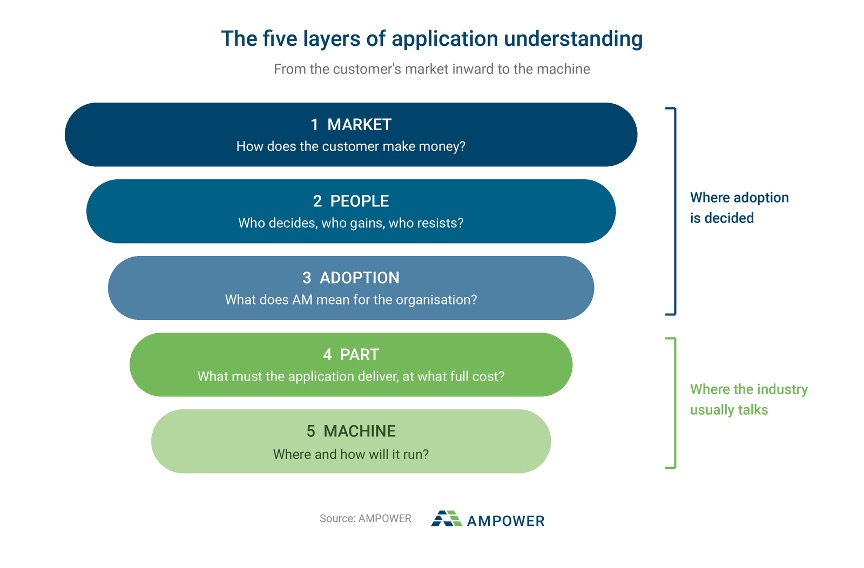
This article structures application understanding into five layers, moving from the customer’s market inward to the machine on the shop floor.Three large application groups serve as running examples: orthopaedic implants, dental and defence.They show how differently the same technology must be explained, qualified, and sold.
Figure 1 shows the five layers of application understanding.Image courtesy of AMPower.Layer 1, Market: How does the customer make money? Application understanding starts with the customer’s business model.
Where does the margin sit? What does product development cost? Who pays in the end? These questions may seem far removed from a build plate, yet they determine whether a technically convincing application is ever adopted.Consider an orthopaedic manufacturer with high margins on an established implant line and high development and approval costs.It has little reason to touch a validated process, even where AM offers clear benefits such as porous structures for bone ingrowth.
The engineering rule “never change a running system” wins.In practice, suppliers almost never convert existing products.AM enters with new product programmes, if at all.
The calculation changes when competitors already use AM and win tenders with it.Then AM is no longer an option but a necessity.A supplier has to know which of the two situations its customer is in, because the sales argument is the opposite in each.
In medical markets, the user rarely pays.Hospitals, insurers and national health systems decide what is reimbursed.Where an implant is paid as part of a fixed case rate, a better AM implant does not earn a higher price.
In dental, reimbursement rules define which restorations insurers fund and to what extent.A supplier that ignores these rules overestimates its customers’ willingness to pay.In defence, money flows through programmes and budget years.
As Part I showed, capability development funds are front-loaded by design, while drone production is a more durable demand stream.Knowing which budget a customer spends determines how long an opportunity will last.AM also moves value between players.
In dental, production shifts between laboratories, chairside systems in the practice and centralised production centres.Whoever gains margin becomes a buyer.Whoever loses it becomes a resistor, which leads directly to Layer 2.
Layer 2, People: Who decides, who gains, who resists? Every AM adoption creates winners and losers inside the customer’s organisation and along its supply chain.A supplier needs to know both.The decisive user.
In orthopaedics, the surgeon is often the final judge.Whether a lattice structure on an implant is accepted often comes down to the individual surgeon’s feel in the hand, not test data.In dental, the technician evaluates fit and aesthetics with a craftsman’s eye.
Neither appears on an org chart as the buyer, yet both can stop an adoption.The losers.AM replaces competence.
A casting department, a team of machining specialists or the supplier of forged blanks lose relevance when AM succeeds.They rarely oppose openly.They raise doubts at the right moment, in the qualification meeting or in the cost review.
Established suppliers may actively work against the change.A supplier who has not mapped these interests will be surprised by resistance it could have anticipated.The language.
Every industry has its own vocabulary for products, properties, customers and applications.A supplier who talks about “parts” where the dentist talks about “restorations”, or about “build jobs” where the defence logistician talks about “availability in the field”, reveals itself as an outsider in the first meeting.Enablement.
Training means something different in each vertical.In a medical production site, it means validated procedures and complete documentation.In defence, a printer close to the front line is useless if it cannot be operated under combat conditions by rotating personnel with limited training.
Enablement there focuses on robust routines and minimal intervention, not on process optimisation.Layer 3, Adoption: What does AM mean for the customer’s organisation? Introducing AM is a project inside the customer’s organisation, with its own timeline, gatekeepers and risks.A supplier who understands this project can plan its own sales cycle.
A supplier who does not will forecast orders that arrive years later or never.Development cycles.Implant manufacturers launch new product generations at long intervals, and regulatory approval adds years.
The window to introduce a new manufacturing technology opens rarely, and a supplier who misses it waits for the next generation.Dental moves faster, with new materials and workflows reaching laboratories in much shorter cycles.Defence follows long standard processes, except under acute operational demand, when qualification can be compressed drastically.
Qualification and standards.Medical requires MDR or FDA approval and certified quality management.Defence brings military standards and customer specific approval.
In both cases, many functions have a say along the process chain: quality, regulatory affairs, procurement, production and, in defence, the operating unit itself.Liability.Who carries responsibility if a part fails? This question often blocks adoption longer than any technical hurdle, and it is rarely asked in the first sales meeting.
Procurement logic.Defence buys through programmes, framework contracts and budget years.Hospitals buy through purchasing groups and tenders.
Sales cycles follow these rhythms, not the supplier’s quarterly targets.Layer 4, Part: What must the application deliver, and what does it really cost? Only at the fourth layer does the part itself come into view.Even here, the relevant requirements are often not the ones on the datasheet.
Requirements of the key applications.Dental restorations carry high optical demands: surface, shade and fit are judged by the patient and the dentist, not by a measuring machine alone.Implants require porous structures that support bone ingrowth, together with cleanliness and fatigue performance.
In defence, ease of use and availability matter more than surface quality, and many applications replace obsolete parts for legacy systems whose original supplier no longer exists.Indirect costs beyond TCO.The cost per part is rarely where the business case is won.
It sits in indirect costs: storage and maintenance of tools for cast or moulded parts, stocks of blanks in dental milling, spare part inventories, logistics to deployed units and the cost of obsolescence.A supplier who compares its cost per part with a conventional quote loses arguments it should win.Demand profile.
Batch sizes, number of variants, patient specificity, and demand predictability determine whether AM fits structurally.A patient-specific implant, a daily stream of dental crowns, and an urgent spare part for a vehicle fleet are three very different production problems, even if the same machine type could make all of them.Layer 5, Machine: Where and how will it run? The last layer returns to the supplier’s own product, but seen from the customer’s environment rather than from the specification sheet.
Operating environment.An implant manufacturer runs its machines in a controlled, central production site.A dental laboratory has limited space and staff without an engineering background.
A deployable system near the front line has to withstand temperature swings, dust, shock and unstable power.In that setting, robustness and simplicity become the most important specifications, ahead of productivity.Workflow integration.
In dental, the printer is one step in a digital chain of intraoral scanner, design software and finishing.Integration into that chain matters more than the printer itself.In medical production, integration into a validated quality system and full traceability are preconditions for any purchase.
Data and sovereignty.In defence, data security, digital inventories and the origin of machine and software decide whether a system is even considered.This is where the shielded markets described in Part I become concrete: where origin is a selection criterion, price competition loses much of its force, and application understanding becomes the main differentiator.
Understanding cannot be shipped from a distance Set side by side, the three examples show how little of this understanding transfers from one vertical to the next.This figure shows the five layers across three applications.Image courtesy of AMPower.
This is precisely why application understanding is the most defensible advantage Western suppliers hold against price competition.A machine can be copied and undercut.Knowledge of how a surgeon judges a lattice, how a reimbursement rule shapes a dental lab’s investment, or how a field unit trains its operators cannot be acquired from a distance.
It is built in conversations, over years, close to the user.Proximity alone, however, is not understanding.Many suppliers have sales teams close to their customers and still know little beyond the part because sales conversations focus on the next order.
The people who matter most for layers one to three are often not in those conversations at all: the payer, the competitor’s customer, the department that would lose its role.Building understanding requires structured inquiry beyond the sales pipeline, with the same separation Part II demanded for scouting.This is where AMPOWER work with suppliers typically begins.
Since 2017, we have conducted more than a thousand interviews with AM users across industries and regions.In the AMPOWER Strategy Challenge, this external customer perspective comes first: how a supplier is perceived against its competitors, what the customer journey really looks like, how loyal customers are and how willing to change, and which needs remain unmet.Only then does it make sense to decide on portfolio, processes, and focus.
The part comes last The industry has spent two decades explaining what AM can do for a part.The suppliers that win the next decade will be those who can explain what AM does for a customer’s business, its people and its risks, in the customer’s own language.Part IV of this series looks at how to obtain and maintain that understanding.
Subscribe to Our Email Newsletter Stay up-to-date on all the latest news from the 3D printing industry and receive information and offers from third party vendors.Print Services Upload your 3D Models and get them printed quickly and efficiently.Powered by FacFox Powered by 3D Systems Powered by Craftcloud Powered by First Mold Powered by Xometry 3DPrinting Business Directory 3DPrinting Business Directory
Read More