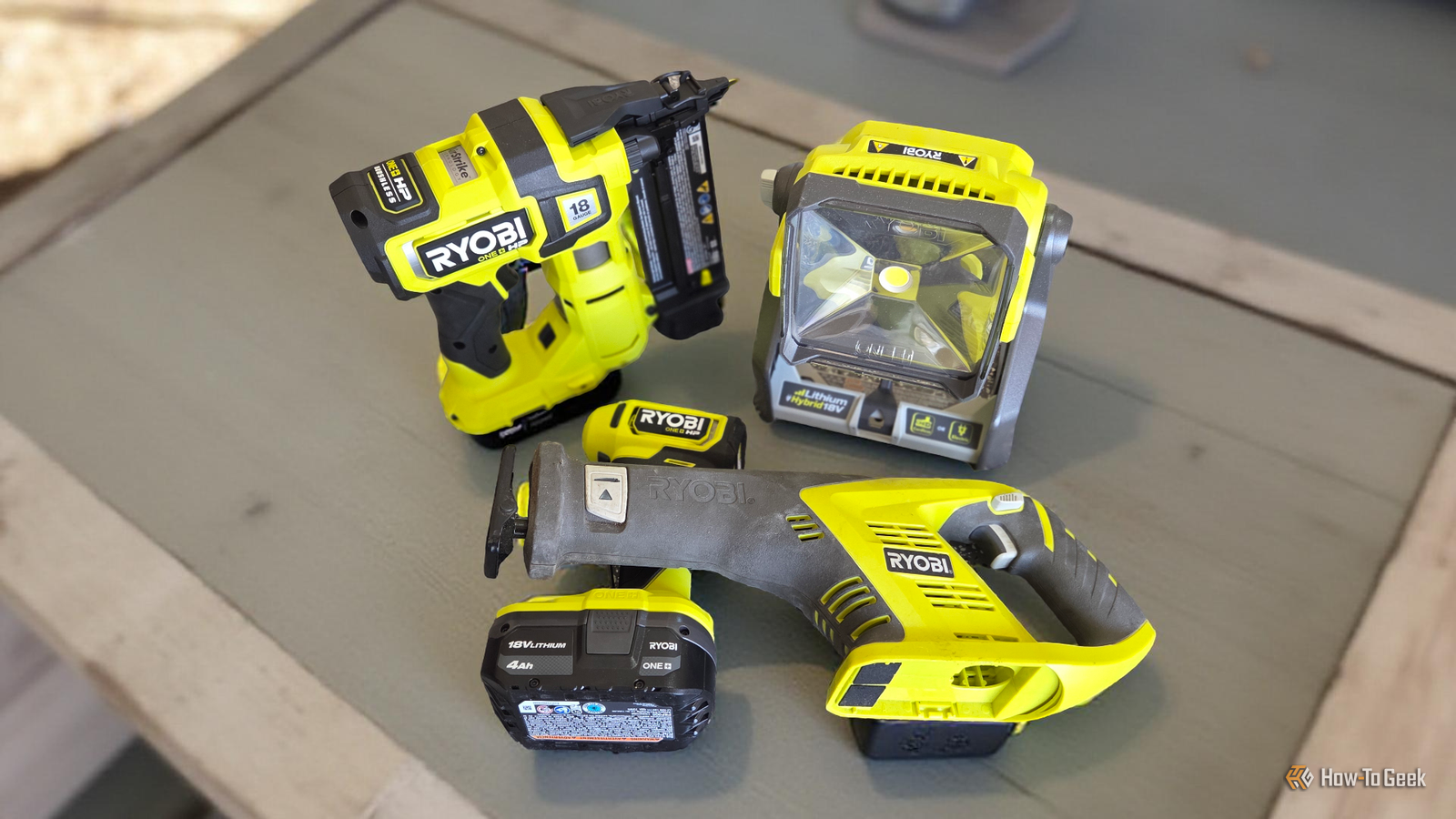
Back in 1996, Ryobi promised they would never change their 18V battery mount.Thirty years later, the batteries still fit, the power tools never die, and my garage looks like an explosion at a tennis ball factory.That awful neon lime green color is everywhere, but I love it.
To this day, that brilliant engineering pledge is still one of the most consumer-friendly moves in power tools, and it's why I've been buying Ryobi tools for over 20 years.All the while, it's been ruining the aesthetics of workshops everywhere.All jokes aside, you either love the bright green color or you hate it, but in the end, the color doesn't even matter.
Ryobi's battery pledge The same battery fits every 18V tool you own Close Ryobi made its first power tool in 1968 and continued making all sorts of things for a few decades, but everything changed with the introduction of the 18V platform and its first cordless drill in 1996.The now-famous 18V ONE+ tool platform came in a dark blue colorway back then, and I still have (and use) several of those old blue tools.At the time, the company promised consumers that the battery design would never change and that any tool you bought now would be compatible with battery packs years down the road.
On the flip side, any Ryobi 18V product released between now and 1996 will work with the tools and battery packs you can buy at Home Depot today.You can literally grab a 25-year-old Ryobi tool, head to Home Depot, buy a battery, and it'll work.That's hugely important, a massive reason for its success, and it's the main reason I'm still buying its tools today.
Three decades later, it still holds true.Related Why my old blue Ryobi drill outlasted all my Milwaukee tools I'm still using this 20-year-old tool.Posts 14 By Cory Gunther Just over 25 years ago, my first few power tool purchases were Milwaukee.
I've talked about it before, and how the V28 platform, along with the V18 line, was eventually phased out, disregarded, and replaced by its current M18 platform.During the transition, I bought my first Ryobi drill (pictured above) and quickly realized it was more affordable, worked great, and every model that came after it used the same 18V battery design.It all worked together, while my Milwaukee tools didn't.
Eventually, I sold those V28 and V18 Milwaukee tools, started collecting Ryobi tools, and never looked back.That's the power of consistency.One battery design works with every Ryobi 18V tool, and it's never changed.
Combine that with affordable pricing, easy availability, and an endless stream of new products, and I don't see myself ever switching to anything else.Ryobi's transition to bright green The introduction of lithium-ion tools Close Not that the color matters all that much, so long as the tool is affordable and gets the job done, but people everywhere talk about Ryobi's iconic color.Back in the 90s, I drank Mountain Dew a ton, just like everyone else.
I never thought that its color would eventually take over my entire garage.Four years after launching its 18V platform, the Chinese conglomerate Techtronic Industries (TTI) acquired Ryobi and its licensing rights.They began mass-producing tools at scale, with the ONE+ branding becoming more prominent in 2004.
Those vintage blue power tools were mostly sold with 18V NiCd (Nickel-Cadmium) batteries.Ryobi's signature neon yellow-green color first emerged in 2007, and for a good reason.Whenever you bought a green tool, you knew you were getting an all-new Ryobi 18V ONE+ tool or battery with a modern lithium-ion battery.
Green signaled the phase out of old battery technology, bringing in lithium-ion, which promised better performance, longer runtime, more power, and faster charging, to name a few.Related Can a Ryobi impact wrench actually remove lug nuts? I tested two to find out The perfect tool for home mechanics.Posts 7 By Cory Gunther It actually took until 2014 for Ryobi to completely abandon the old blue color, and many tools were sold side by side in both color variants, with the newer lithium-ion green tools costing a little more.
In fact, many times the same tool came in both blue and green, with green variants ending in "G" in the model number.Basically, bright green tools meant modern cutting-edge technology like lithium-ion, and at the time, it was a pretty big deal.Love it or hate it, these green tools are great To this day, everything you buy from Ryobi is the beautiful, bright green color we all know and love (or hate), aside from a few exceptions or limited-edition tools.
What makes Ryobi's battery promise even more impressive is that they've continued to innovate or follow market trends and leaders by switching to powerful brushless motors, more advanced HP (High-Performance) battery packs, and, in recent years, premium tabless "EDGE" batteries that deliver substantial improvements to power, runtime, and charging speeds.All while keeping the exact same battery design from 1996.These days, with so many companies using planned obsolescence to make a profit, Ryobi is sticking to its drills.
At this point, I own so many Ryobi tools and over a dozen battery packs, I'll never switch, and I'm certainly not the only one.
Read More