You can't build anything without a good foundation, yet I suspect that, like me, plenty of people don't spare much thought for the humble build plate.Add How-To Geek on Google Add as Preferred Source Follow on Google Discover What I've learned over the years is that unless you give this little flat plate the right care and attention, you're just setting yourself up for failure.The build plate is where the rubber hits the road You can't print on thin air Close I think of build plates the same way that I think of tires in the automotive world.
It doesn't matter how good the rest of the car is, it's the tires that have the all-important job of transferring power from the engine to the road, and ensuring the car can go around corners without sliding off.Likewise, if your build surface has issues, it doesn't matter how well-calibrated and tuned everything else in the printer is.It doesn't matter whether you're using fancy filament, or an upgraded hot-end.
A bad bed will make for a bad print.Warped model bases or a printer full of spaghetti can often trace the cause back to a bed that isn't set up right, or has a surface unsuitable for keeping your model in one place.So many 3D print failures are just adhesion problems A sticky situation The first 3D printer I ever worked with was back in 2015, and had a rather curious solution to build-plate adhesion.
This was not a printer with a heated bed, but instead the plate was perforated.The printer's software would print a raft with plastic pins that went right through the perforation holes and resulted in a rock-solid build surface.It was just an absolute pain to clean the plate, and, of course, the resulting bottom surface of the model was less than ideal.
I never even considered adhesion as an issue back then, but as soon as I started using printers with heated beds and smooth or textured plates, it became obvious that adhesion would be a challenge.When I got my Creality K1 Max, it came with a stick of glue in the box with instructions to apply it with every print.Ultimately, I started using hairspray, which has yielded excellent, reliable results—up to a point.
Any adhesive you use will eventually degrade.It ends up hurting your adhesion rather than helping.I currently run a first- and second-generation Elegoo Centauri Carbon printer side-by-side.
The factory build-plates for these are impressive, and I rarely if ever need to apply an adhesive like hairspray to them for my first layer to bond properly.However, they can suddenly become completely unwilling to adhere to my print.Without any clear visual indication that something's amiss.
The solution is to wash the plates with plain old soap and warm water, rinse them, and let them dry thoroughly.I sometimes even finish the job by wiping them with 99% IPA.That usually gives me several problem-free prints until I see first-layer adhesion issues again.
I've damaged my build plates through sheer carelessness Whoops, there it is Until I learned to do it the right way, I'd destroyed a few build plates and had to literally pay for my lesson in the form of the replacement cost.A common issue is the use of a bed scraper.Sometimes, parts of a print, especially a failed print, will be stuck to the print bed so tightly that you need a scrap to get them off.
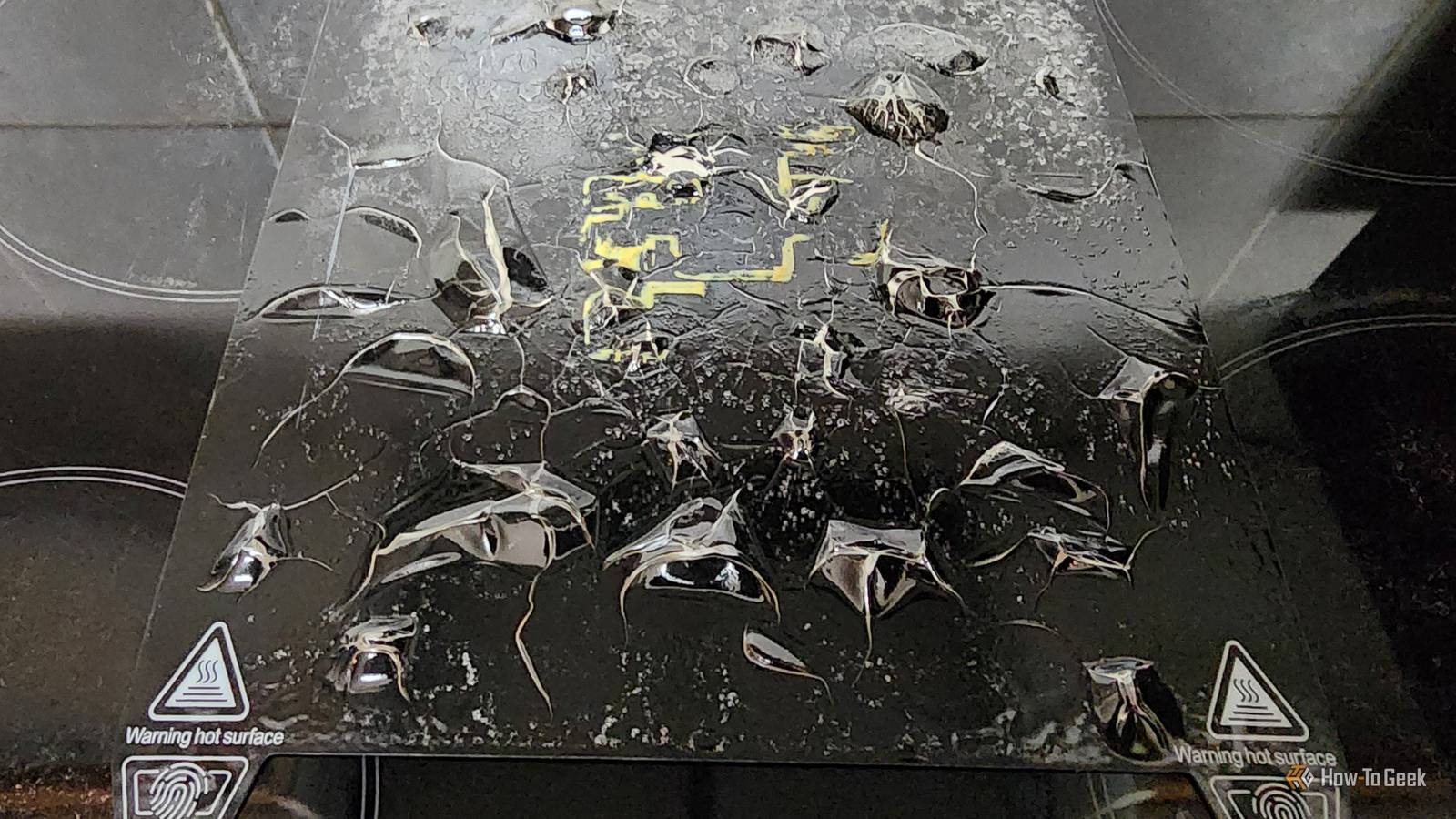
In the bad old days, I had to do this job with safety gloves on, so that a slip didn't mean a trip to the emergency room.But that same sort of slip could gouge the surface of the bed.That horribly melted build plate you see at the very top of this article is the result of me (ironically) trying to use my oven to soften stuck filament on the bed exactly so that I would not damage it with my scraper.
Instead, even though the oven temps were supposedly in the safe zone, all it did was melt and bubble the coating on the plate! Today, this is hardly an issue, because I use scrapers designed to prevent damage to the plate.For example, with an Elegoo printer, or Bambu, as the above example shows, you get a scraper blade in the box, but you print the handle yourself.This handle holds the blade at just the right angle where it will get under stuck prints to release them, but not damage the plate surface.
I've never gouged any build plate since.Now, I treat my plates like gold Developing a good deal of respect for build plates and taking proper care of them has made my 3D printing journey that much smoother.I don't think of them as a boring part of the process, or as disposable.
Instead, I recognize their key role in FDM printing, and if I take care of them, they'll take care of me.
Read More