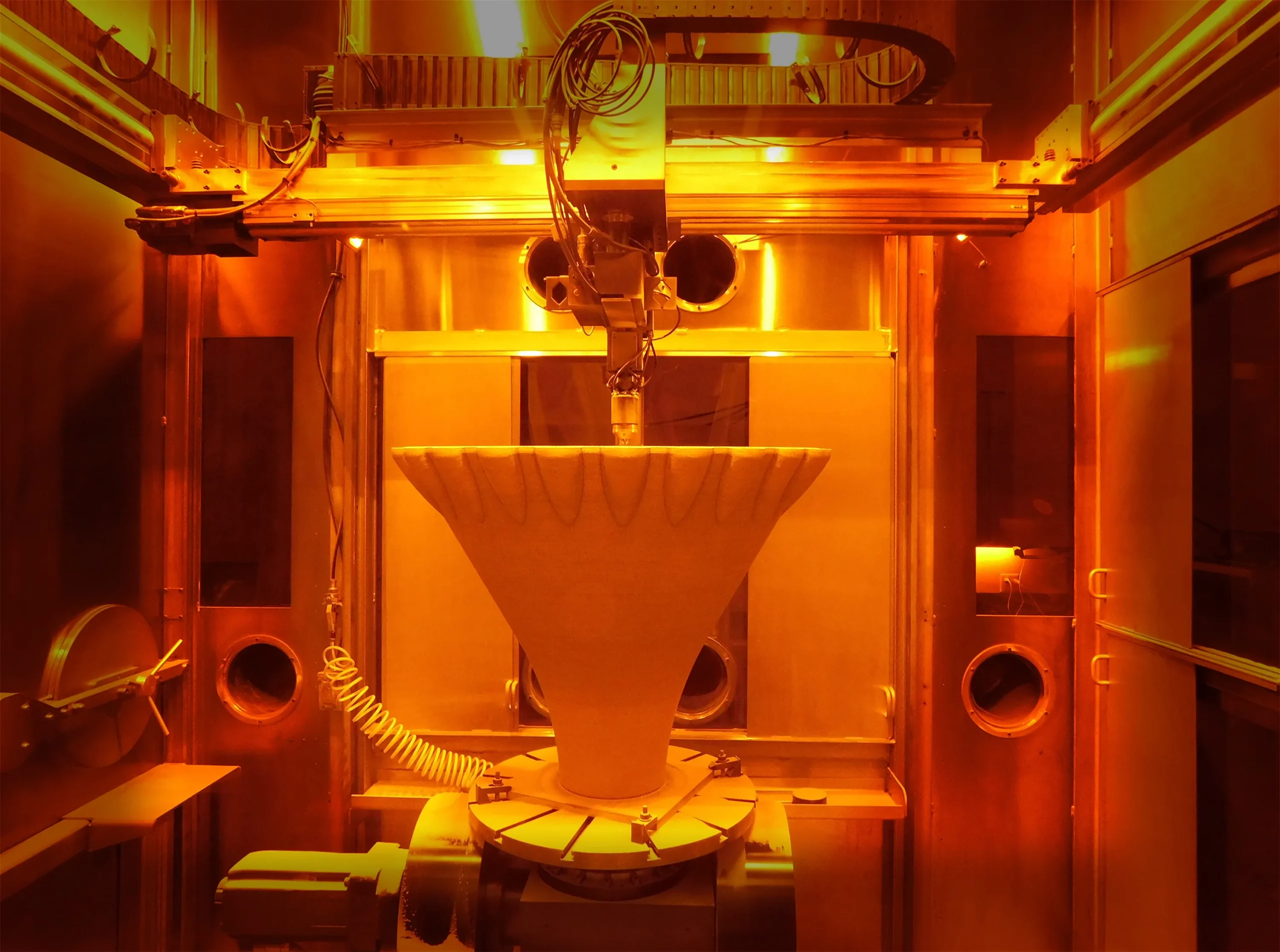
The first decades of PBF development were heavily shaped by machine capability: more power, more lasers, larger build volumes, better recoating, and improved process monitoring.These developments will continue, but the industrial question is changing.Once a platform can build the geometry, further value depends on whether it can repeatedly and economically deliver an accepted part.
This will favor more specialized systems.A platform for high-volume titanium consumer products has different requirements from one producing nickel superalloy combustor components, copper thermal-management devices, orthopedic implants or refractory-metal parts.Build size and laser count remain relevant, but so do atmosphere, preheat, thermal stability, powder handling, inspection, automation, material behavior and the cost of qualification.
Laser PBF is likely to continue separating into high-productivity platforms, precision systems, large-format machines and application-led production cells.Electron beam PBF has a different opportunity.Vacuum, high process temperature and rapid beam deflection can be valuable for reactive materials, high-temperature alloys and applications where residual stress or support strategy limits laser-based routes.
Neither process will win a general technology contest.They will be selected where their particular process physics supports the application.The growth of multi-laser systems also creates a less visible requirement: control must advance with productivity.
Calibration across many energy sources, overlap zones, gas flow, and a larger volume of process data all become more demanding as the architecture scales.The useful measure is therefore not lasers installed or cubic centimeters per hour in isolation.It is qualified output over time, including scrap, downtime, post-processing, and inspection.
DED is integrating with conventional manufacturing DED is following a different path.PBF generally begins with the part inside a build volume.DED more often begins with an existing component, a substrate, a forging, a plate, a robot, or a machine tool.
Its industrial value lies in adding material where it is needed: repairing a worn surface, rebuilding a high-value component, adding features, applying a corrosion-resistant layer, or producing a near-net preform that will later be machined.This makes DED less likely to converge around one dominant machine architecture.Powder-fed laser DED, wire-laser systems, WAAM, plasma processes and electron-beam deposition address different combinations of deposition rate, resolution, material, atmosphere, component size and cost.
A ship repair, a titanium aerospace preform and a graded-material tooling insert belong to different production systems even if all three sit under the DED label.GKN Aerospace’s fan-case mount ring in Trollhättan shows what industrial DED can look like when the process is treated as part of a complete route.In 2025, GKN reported its 200th additively fabricated hot-size ring and a ramp towards full serial production.
The company also reported around 40% less material waste than the conventional route, with an ambition to reduce end-to-end lead time from nine months to four weeks.Deposition, machining, certification, and production planning all contribute to that result.GKN Aerospace delivers an additively fabricated hot-size ring at its Trollhättan facility in Sweden.
Image courtesy of GKN Aerospace.The next development in DED will therefore come through deeper integration with established manufacturing.Robot path planning, adaptive control, scanning, machining, heat treatment, metrology, and qualification data need to work as one route.
In many applications, the deposited shape is an intermediate state.The accepted component emerges only after finishing and verification.This is also why DED may benefit disproportionately from defense and regional manufacturing programs.
Repair, feature addition, and near-net production can use existing industrial assets and established finishing capability.They can address large components that do not fit a powder-bed machine and part volumes that do not justify new tooling.The opportunity is substantial, but it will divide into focused niches rather than one uniform DED market.
Materials development responds to performance and supply risk Metal AM initially relied largely on alloys inherited from casting, forging, and welding.Commercial availability then concentrated around materials that could be processed reliably, particularly in laser PBF.Many industrially important alloys remain difficult to print.
Materials development is now moving in several directions.Researchers are adapting process parameters and post-processing routes to existing alloys.New alloys are being designed to exploit rapid solidification and AM-specific performance opportunities.
Older alloys may also need reformulation when cobalt, nickel, niobium, or other alloying elements become expensive, restricted, or difficult to source.Material performance, printability, and supply security are becoming part of the same engineering decision.NASA’s GRX-810 is a good example of a material developed for AM.
NASA developed the oxide-dispersion-strengthened nickel alloy for additive manufacturing, using computational alloy design and a specific powder-processing route to achieve high-temperature performance beyond conventional printable alloys.GRX-810 is a new metal alloy NASA developed for 3D printing parts that can withstand the extreme temperatures of rocket engines, enabling affordable printing of high-heat parts.Image courtesy of NASA.
Uddeholm’s AM Corrax represents a different, more commercial route: a corrosion-resistant, cobalt-free tooling steel supplied for AM applications such as molds with conformal cooling.One example begins with an extreme performance requirement; the other adapts material and product form to a defined industrial application.The prediction is that materials will cease to be a catalog attached to a machine platform.
More programs will begin with an application, then develop the material, process window, heat treatment, and qualification evidence together.Regional access to powder, wire, and alloying elements will influence which solutions reach production.In some cases, the strongest material will lose to the material that can be sourced, processed, and qualified reliably within the required industrial ecosystem.
Compute expands design, control and qualification Twenty years ago, we could imagine more than computers could handle.We are approaching the reverse: compute can handle more than we know how to imagine.Compute is becoming industrial infrastructure.
Access depends on energy, hardware, data, capital, and algorithms.Additive manufacturing has always depended on computation.Geometry repair, support generation, nesting, slicing, thermal simulation, and toolpath calculation grew with available processing power.
This shift is bigger because compute, sensors, machine data, and AI are advancing together.More design alternatives can be evaluated; larger toolpaths can be calculated; process signatures can be compared across builds; and inspection data can be connected more directly to manufacturing history.Early applications of AI in metal AM will be parameter development, anomaly detection, adaptive toolpaths, simulation, inspection correlation, and documentation.
These data-heavy tasks consume expert time.AI does not remove the metallurgical or regulatory problem, but it can reduce the time required to understand it and provide better evidence for a decision.Expanding compute capacity will also strengthen the connection between AM and conventional manufacturing.
A production-planning system can compare PBF, DED, machining, casting or a hybrid route against geometry, material, volume, capacity, lead time and qualification requirements.Within the selected route, software can coordinate build, finishing and inspection.Decisions will gradually move from disconnected specialist tools into a more coherent production system.
What we expect by 2035 Several predictions follow from these forces.First, metal AM usage will become more regional.Global suppliers will remain important, but defense policy, export controls, data security, material access, and public investment will pull parts of the market toward regional equipment, regional qualification capacity, and trusted production networks.
Second, PBF will increasingly divide into application-specific platforms.The broad category will remain, while the machines, materials, automation, and business models serving medical implants, consumer titanium, propulsion, defense, tooling, and extreme materials become less interchangeable.Third, DED will integrate further into conventional manufacturing.
Its progress will be measured through certified repairs, near-net preforms, added features and hybrid production cells rather than by the number of standalone deposition machines sold.Fourth, qualification will become an economic asset.Time to qualification is part of production economics.
A stable material-process combination, an accepted inspection route, and a reusable body of production data can shorten the path to the next part family.Companies that build and retain that evidence will be in a stronger position than companies offering nominal machine capability alone.Fifth, material development will accelerate and become more application-specific.
AM-adapted versions of existing alloys, alloys designed for additive processing, and reformulated materials shaped by supply risk will develop in parallel.Sixth, compute will speed up experimentation and reduce some manual work in process development and control.It will also increase the gap between companies that can use manufacturing data across the complete route and those that collect large quantities of data without turning it into decisions or qualification evidence.
Seventh, the printer will become less visible in the commercial proposition.Customers will increasingly buy an approved component, a repair route, production capacity or guaranteed output.The competitive system includes design, material, build, heat treatment, machining, inspection, traceability and approval.
The machine remains essential, but machine capability alone will carry less weight.Finally, the period from 2026 to 2035 may prove unusually entrepreneurial.Regionalization creates duplication, new industrial requirements create unsolved problems, and technological competition attracts capital to areas that governments and large companies consider strategic.
A recurring European constraint remains: research, pilots and validation are generally easier to finance than industrial scale-up.This does not revive the indiscriminate investment logic of the previous hype cycle.It creates room for focused companies in materials, process control, qualification, repair, workflow software and application-specific production systems.
These predictions depend on the forces continuing.Defense budgets may slow.Trade policy may change.
Chinese suppliers may face export or qualification barriers.AI may improve dashboards faster than manufacturing outcomes.Conventional casting, forging, and machining will also keep advancing.
Metal AM still has to earn every application.What has changed is the set of applications that may now be worth earning.In a world that values readiness, material efficiency, secure supply, shorter lead times, and regional capacity, metal AM has more industrial problems to address than it did during earlier periods of global cost optimization and AM hype.
It also faces stronger competition, higher expectations, and less patient capital.PBF and DED will continue to improve, while industrial constraints determine where that progress is applied.By 2035, the meaningful measure will be repeated delivery of qualified parts at the required cost and lead time.
Machine capability matters only when it contributes to that result.Ulf Lindhe.Image courtesy of The Org.
About the Author: Ulf Lindhe is a veteran executive in the additive manufacturing industry with decades of experience spanning technology development, industrial strategy, and global market expansion.He has held senior leadership roles within the metal additive manufacturing sector, contributing to the commercialization and international growth of advanced AM systems.Throughout his career, Lindhe has worked closely with aerospace, medical, and high-performance engineering companies, helping bridge the gap between technological capability and practical industrial deployment.
Subscribe to Our Email Newsletter Stay up-to-date on all the latest news from the 3D printing industry and receive information and offers from third party vendors.Print Services Upload your 3D Models and get them printed quickly and efficiently.Powered by FacFox Powered by 3D Systems Powered by Craftcloud Powered by First Mold Powered by Xometry 3DPrinting Business Directory 3DPrinting Business Directory
Read More