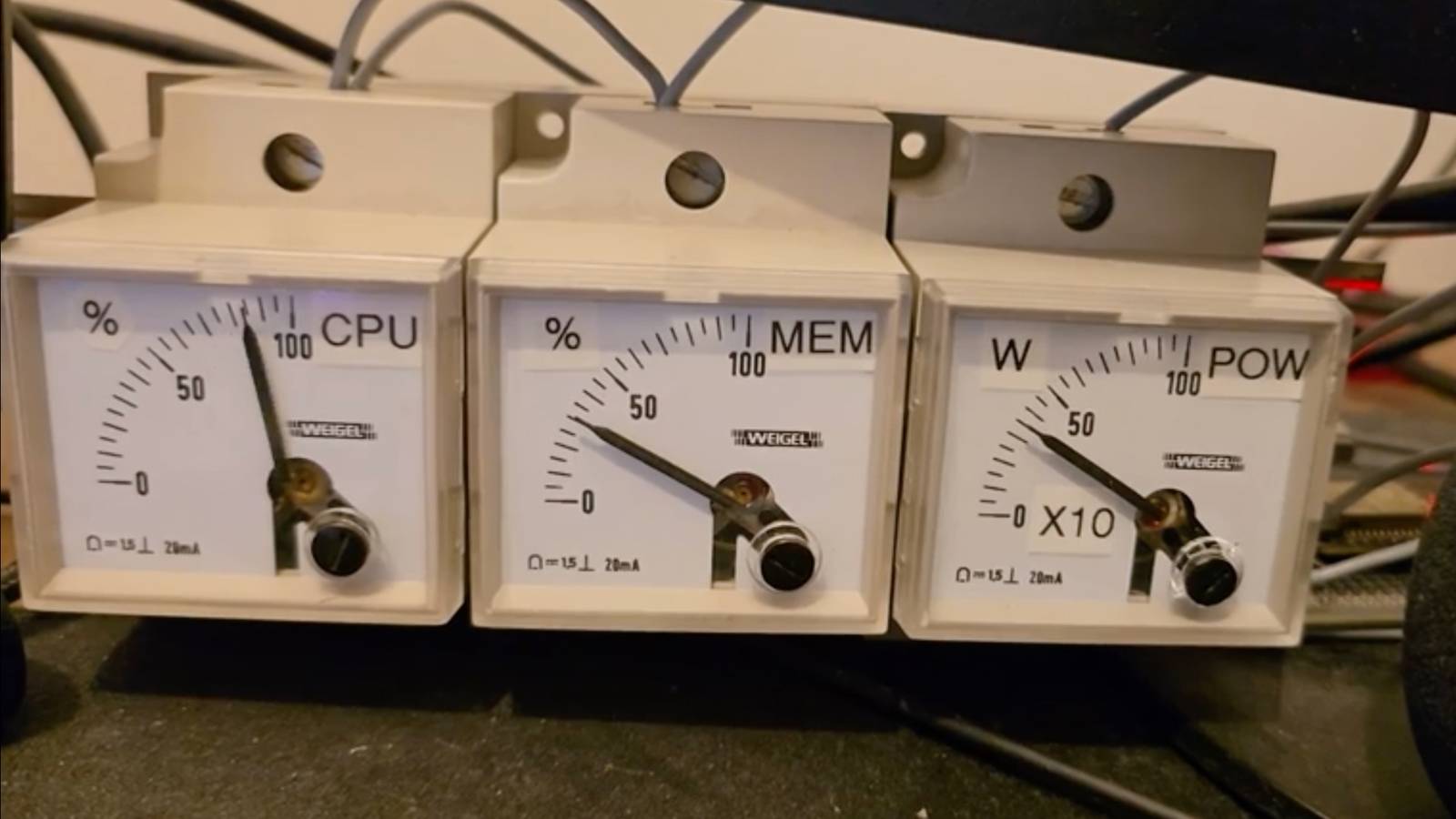
PC monitoring usually means staring at performance graphs, percentages, and numbers.A Reddit user gave their computer an old-school way to show what’s happening under the hood.They saved a pair of analog gauges from heading to the e-waste bin and turned them into a real-time PC monitoring system.
The secret to this is an ESP32 development board doing the heavy lifting between a modern PC and decades-old analog hardware.How an ESP32 bridges modern PCs and analog gauges Three needles tracking PC in real time The gauges are old industrial hardware with a 0-20mA current signal showing pressure readings from 0 to 100 bar.They weren’t designed to accept native connection or digital data produced by modern PC.
So, getting the gauges to display the performance data was the hard part.The Redditor used a PWM output running through a resistor, capacitor, and transistor to control the current flowing through each gauge.The needle response was non-linear at lower levels, and it took a lot of trial and error to accurately match the PC’s performance readings.
At the center of everything is the ESP32 development board that acts as the middleman between the computer’s digital data and the gauge’s physical movement.It receives the incoming percentage-based numbers from the PC’s serial connection and the smart plug and then converts them into signals that actually move the needle on each gauge.The board’s job is simple—receive the information, process the readings, and tell the gauges how far to move.
Louder ESP32 audio development board Brand Louder $24 at Seeed Studio Expand Collapse The whole setup uses three gauges in total, with two of them tracking CPU and GPU usage.These pull live data straight from the connected PC.The third shows how much power the whole system is drawing.
It reads power consumption wirelessly, from a Tasmota-enabled smart plug using MQTT, an open messaging system built for the Internet of Things.The power gauge updates every 10 seconds whereas the CPU and GPU readings refresh roughly every 500 milliseconds.Electronic waste is a big problem with old hardware piling up fast.
The gauges were a perfect example—functional but with no clear modern purpose.The ESP32 development board plays a big part in this project and is why something like this is even possible.It costs just a few dollars and all it takes is enough patience to work through the circuit tuning to give outdated hardware a second life.
Source: Reddit
Read More