Learning Python from lectures and textbooks works for some, but I know firsthand how difficult it is to learn that way.When you can actually put your knowledge to use in a game, it's much easier to learn.Most CS courses get you comfortable with syntax and give you problems that have one clean answer and a grade attached.
However, it's more fun to go to Python games that put you in situations where the code either works or it visibly doesn't, and the feedback arrives fast enough that you actually learn something from it.CodinGame shows you how your code works in real time Facing real players makes concepts stick much faster is a browser-based platform where computer science students can practice real Python code to control animated characters, navigate mazes, or build AI bots that go head-to-head against other players' scripts.Instead of running isolated code exercises, the platform connects your program to a game engine through standard input/output streams.
The game feeds your script the current state of play, your code figures out the next move within a tight time limit, and the result shows up instantly as a visual update on screen.That quick feedback loop is what makes the abstract stuff finally click.You have to actually use computer science concepts to stay competitive.
Navigating maps and outmaneuvering opponents means you need real pathfinding algorithms instead of a surface-level understanding of them.Tree traversal stops being a textbook topic when you're using it to connect scattered resources across a game map or planning several moves under a strict time limit.Sorting algorithms follow the same pattern, since you need to rank targets by distance or resource value in the middle of a match, and you stop thinking of them as something you memorized for an exam.
Obviously, it's a great idea to go against real opponents instead of getting a grade on paper.Getting an A doesn't actually mean you know how to write code, just that you can regurgitate information.With CodinGame, you know how you're doing against others.
CheckiO uses floating islands and puzzles to teach you You learn a lot by looking at how other people solved the problems is a map-based coding site and program.It is a digital ocean dotted with floating islands, each one holding a set of coding missions.To unlock new islands, you have to work through increasingly difficult puzzles.
I've seen this at my son's school before; it is how many learning programs work now.It handles basic syntax problems all the way up to harder stuff with matrix manipulation, parsing, and algorithms.These are real Python functions that run in a browser-based sandbox, and the platform tests them against a suite of test cases to make sure your solution works before letting you move on.
The more interesting part kicks in right after you solve something.When you are determined to be correct, CheckiO shows you how everyone else has solved the same challenge.You get to browse real solutions from other developers, including an "editor's choice" section that highlights particularly clean or clever approaches.
You can filter by different categories, follow developers whose style you like, and bookmark solutions you want to revisit.A solitary grind through coding exercises ends up feeling more like a community code review.That post-solve review is where CheckiO does something most CS courses don't, because if your code works on a regular course, you're not usually getting any review on it.
Elevator Saga makes you handle real-time scheduling Watching live stats helps you fix your logic on the fly is a browser-based puzzle game that's surprisingly well-suited for computer science students trying to get a feel for systems engineering and real-time scheduling.You write code that controls a set of elevators in a building, and your job is to move passengers around as efficiently as possible.You need to keep waiting times low, make sure nobody gets stranded, and keep the whole system moving.
Instead of getting a score, the game shows you live stats while the simulation runs.You can see things like how often elevators are sitting idle, how many passengers are getting through, and how long people are waiting.So you can actually watch your logic play out in real time.
The game runs natively in JavaScript inside the browser, but the core problems it throws at you are pretty language-agnostic.You can also use open-source frameworks like elevator-py to write your control logic in Python instead.That setup runs a local Python backend that talks to the simulation through loopback ports, so you're solving the same problems, just with Python syntax.
The simulation runs on a single-threaded async loop, and your code only does anything when events fire.This includes events like an elevator going idle, a passenger pressing a floor button inside the car, or the elevator approaching a floor it might want to stop at.You also have to handle floor-level events, like a passenger pressing the up or down button to call an elevator.
If you try to do something like run an infinite while loop, you'll lock up the browser thread and crash the whole simulation.CodeCombat turns standard typing into a dungeon crawler You learn object-oriented concepts while gearing up your hero is built for students who are making the jump from drag-and-drop coding tools, like Scratch, to actually typing real code.Instead of moving blocks around, you write Python directly into a browser-based editor, and that code controls your hero inside a fantasy dungeon.
If you want your character to move right, dodge spikes, or attack an enemy, you have to write the command.If your code works, your hero does exactly what you told it to.If something's wrong, the game stops, your character freezes, and you get an error message that helps you figure out what went wrong.
That feels more like solving a puzzle than studying.The game starts simple and kind of looks childish, but don't let that fool you.Early on, you're writing basic instructions like hero.moveRight() and setting straightforward variables.
But as you clear the first dungeon and push into later worlds, the training wheels come off.The curriculum shifts toward object-oriented programming.Your hero becomes an object with its own stats and properties, and the weapons, armor, and pets you buy with in-game currency each add new methods you can call on them.
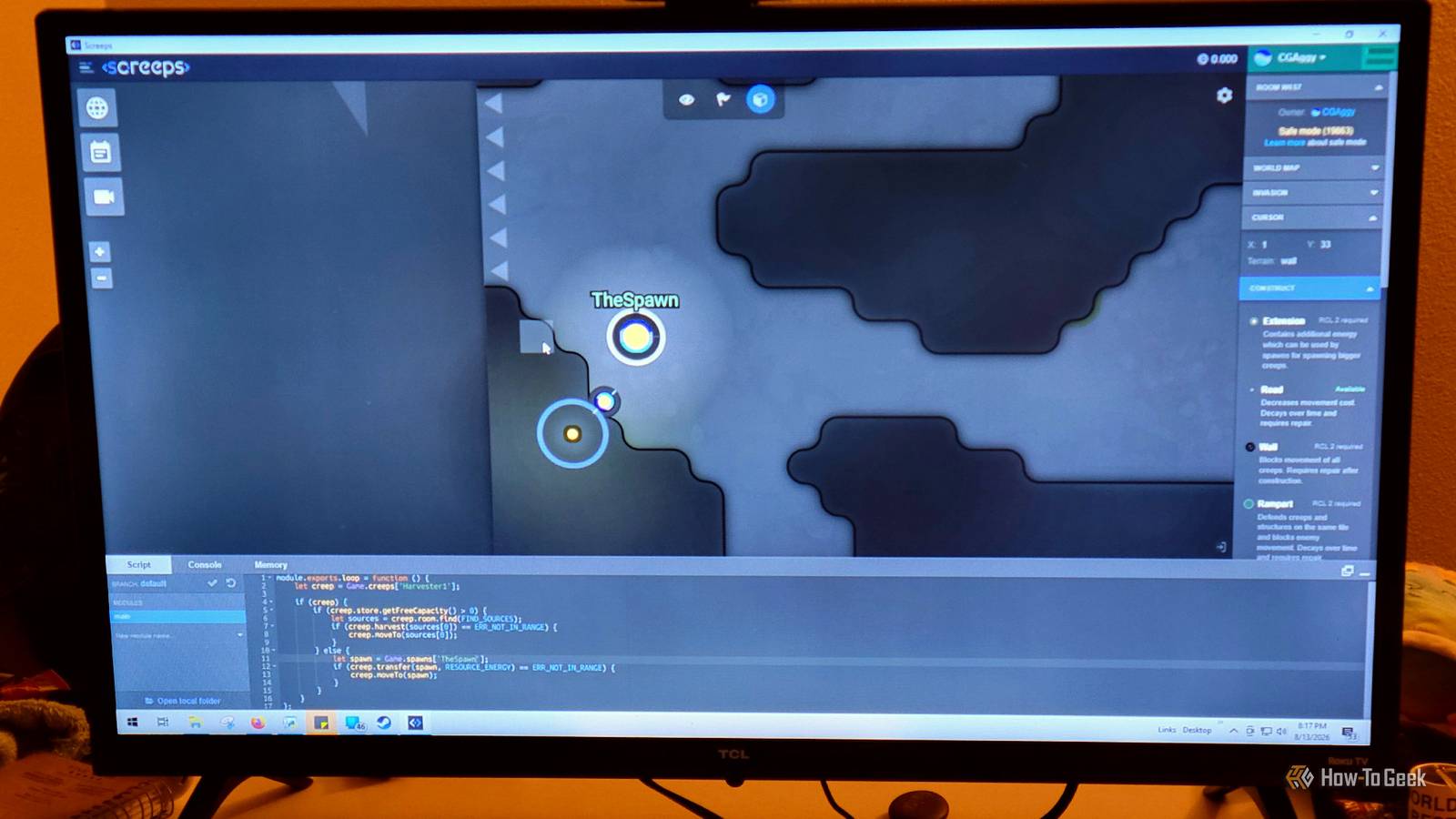
To get through the harder levels, you have to start writing code that checks your surroundings, like enemy = hero.findNearestEnemy(), and passes specific arguments to methods.It's a lot of concepts packed into what looks like a video game, and that's why it works so well.Screeps keeps running your code around the clock Small bugs can break your whole base fast Close is a game where your entire colony runs on code you write yourself.
This one is the only one that costs money to start, but it is worth it.You are supposed to write scripts that run continuously, around the clock, in a persistent online world shared with thousands of other players doing the same thing.Your colony has to harvest resources, build structures, manage logistics, trade on a global market, and defend itself, all without you giving command after command.
While Screeps natively uses JavaScript (as shown in the code snippet below), you can also compile Python to JavaScript using tools like Transcrypt if you want to use this to spawn your first harvester: Game.spawns['Spawn1'].spawnCreep([WORK, CARRY, MOVE], 'Harvester1'); Use this to get your worker to do the work.Make sure to change "Spawn1" and "Harvester1" to whatever you named your Spawn and Harvester.I just used the default names in these examples: module.exports.loop = function () { let creep = Game.creeps['Harvester1']; if (creep) { if (creep.store.getFreeCapacity() > 0) { let sources = creep.room.find(FIND_SOURCES); if (creep.harvest(sources[0]) == ERR_NOT_IN_RANGE) { creep.moveTo(sources[0]); } } else { let spawn = Game.spawns['Spawn1']; if (creep.transfer(spawn, RESOURCE_ENERGY) == ERR_NOT_IN_RANGE) { creep.moveTo(spawn); } } } }; The game keeps moving whether you're at your desk, asleep, or out for a walk.
Since your code never stops running, you can't rely on quick fixes or shortcuts that only hold up when someone's watching.A missed edge case in your pathfinding logic or a memory leak you didn't catch will freeze your units mid-game and leave your entire base open to resource collapse or an attack from a neighbor who wrote better code than you did.The game gives each player a CPU budget per game tick, measured in milliseconds.
Go over it, and your script gets cut off immediately.So anything that hasn't run yet, including your defenses or spawn commands, doesn't happen that cycle.On top of that, nothing carries over between ticks on its own, so you have to learn how to serialize and store your empire's state manually.
The game gives you a memory object cap, which pushes you toward writing tight JSON handling or rolling your own binary serialization if you want to keep from burning the CPU just by saving data.Try out these games None of these replace a solid CS curriculum, and that's not what they're trying to do.A few of them have rough edges, and Screeps in particular will be frustrating before it teaches you anything.
Still, these are worth playing with, because they let you test your skills in logic and coding before anything really happens.
Read More